HOW A FAMILY HEALTH ISSUE INSPIRED AND INFORMED ONE OF MY STORY LINES
I started writing The Summer of Love and Death in January 2022 and submitted it to my publisher in November 2022. In this early draft of my novel, the story did not include Vera Ford, a pivotal character in the earlier books, and the mother of my protagonist, Detective Susan Ford. I couldn’t quite fit her into the plot and so I sent her off on a cruise. In the first two books of my series, Vera and Susan were constantly at odds with each other, trying to navigate a mother-daughter relationship fraught with friction and tension. In her absence, I developed a subplot focused on a contentious relationship between Detective Susan Ford and her new partner, Detective Jack Tomelli.
The response from my editor: “revise and resubmit” (the dreaded R&R). After all, this was the Ford Family Mystery Series, and Vera was part of the family. I was also reminded that Vera was a compelling character who would be sorely missed. On top of that, the feuding between Susan and Jack wasn’t exactly working. It felt contrived and unoriginal.
As I thought about how to incorporate Vera back into the story, specifically in a way that had bearing on Susan’s character arc, I was dealing with my own family crisis: my husband had been diagnosed with dementia in July 2022. Hints of something “off” caught my attention in the fall of 2021, which we both dismissed as “senior moments.” Some behaviors were funny (constantly buying jars of apricot jam), others quite frightening (like when he threw the car into neutral while driving because he used to drive a stick shift). But by the spring of 2022, the memory snafus were piling up, and the alarm bells were ringing loud and clear. I started keeping a journal in order to document the unusual behaviors and memory lapses—or as I referred to them: “glitches in the matrix”—for discussion with the doctor.
I think many people are familiar with what the latter stages of dementia look like, as it’s what we typically see depicted in movies and books (including my novel, The Disappearance of Trudy Solomon). But I get the sense that most people are not attuned to what the early symptoms of the disease look like, which are easy to write off as “senior moments.” If I had to venture a guess as to why, I would blame denial, fear, and stigma. A natural inclination to dismiss, or downplay, or hide what’s going on because the behaviors can sometimes be embarrassing. Even the word “dementia” sucks, sounding like “demented” (defined as crazy, insane) or demeaning (defined as causing someone to lose their dignity and the respect of others). The term has its origin in Latin, and is formed from the prefix “de,” which means a deprivation or loss; root “ment,” which means mind; and suffix “ia,” which indicates a state. In short, dementia refers to “a state out of mind.” Dementia is a thief. And it will eventually rob you of everything—your livelihood, your essence, and, of course, your memories.
The confluence of these two things—the directive to write Vera back into the book and coming to terms with my husband’s diagnosis—steered me in the direction of the new subplot. That journal I kept reminded me of how baffling the early symptoms were, and I thought about how the already-strained relationship between Susan and her mother, Vera (a recovering alcoholic), might play out if Vera began to exhibit signs of cognitive impairment and Susan was thrust into the role of caregiver. At first I was hesitant to go there, but in the end I found it cathartic.
I’d hardly be the first mystery/thriller writer to incorporate a character with dementia into a plot. In fact, it seems to be cropping up a lot these days (or maybe I’m just more attuned to it because of my situation). In the past year alone, I’ve read a number of books that feature a character with dementia (and all of these are done with grace and authenticity): The Ghostwriter by Julie Clark, The Last Devil to Die by Richard Osman, Such Quiet Girls by Noelle Ihli, and Cold Island by Peter Colt. The condition lends itself to mystery/thriller tropes: the unreliable narrator, a blurted out secret, an obstacle to getting to the truth . . . and it offers a compelling way to tease out the protagonist’s character traits vis-a-vis their relationship with an ailing loved one. Dementia will test anyone’s resolve, patience, and fortitude.
I know I’ve been put through the ringer. Luckily I have the support of my stepdaughters, my daughters, my sisters and sister-in-law, my mother, my friends, my caregiver group, and my husband’s friends. There are many caregivers who do not have a support system in place. So if it comes to your attention that someone you know is caring for someone with dementia, think about how you might be able to help. A grocery shop. An errand. A casserole. A shoulder. An ear.
—
THE SUMMER OF LOVE AND DEATH
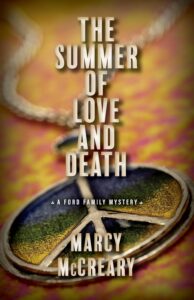 “An addictive and entertaining ride!” ―Christina McDonald, USA Today bestselling author
“Fans of Agatha Christie will die for this smart, twisty tale . . .” ―Susan Walter, bestselling author of Good as Dead and Lie by the Pool
The summer of ’69: memorable for some, murder for others.
Detective Susan Ford and her new partner, Detective Jack Tomelli, are called to a crime scene at the local summer stock theater where they find the director of Murder on the Orient Express gruesomely murdered―naked, face caked in makeup, pillow at his feet, wrists and ankles bound by rope. When Susan describes the murder to her dad, retired detective Will Ford, he recognizes the MO of a 1969 serial killer . . . a case he worked fifty years ago.
Will remembers a lot of things about that summer―the Woodstock Festival, the Apollo 11 moon landing, the Miracle Mets―yet he is fuzzy on the details of the decades-old case. But when Susan and Jack discover the old case files, his memories start trickling back. And with each old and new clue, Susan, Jack, and Will must narrow down the pool of suspects before the killer strikes again.
For readers who enjoy mysteries by Richard Osman, Stacy Willingham, Charlie Donlea, Benjamin Stevenson, and Shari Lapena.
BUY HERE
Category: How To and Tips
Subscribe
If you enjoyed this article, subscribe to receive more just like it.