A Conversation with Jaynie Royal: Building a Literary Press Rooted in Community, Collaboration, and Global Connection
By Jocelyn Cullity
In an industry often defined by opacity and commercial pressure, independent publishers continue to offer alternative models shaped by mission rather than scale. At the center of one such effort is Jaynie Royal, founder of Regal House Publishing, whose work reflects both a personal reckoning with traditional publishing and a sustained commitment to building an author-centered literary community.
Royal’s path to publishing was not linear. Before she became a publisher, she was an author navigating the often opaque and, at times, discouraging process of seeking representation. That experience became the catalyst for founding Regal House Press in 2014—not as a departure from publishing norms alone, but as an attempt to reimagine them from the ground up.
“For an industry that depended so particularly on the creative output of authors, the experience for them seemed opaque and largely unfriendly,” she reflected. “And I thought, well, why should it be so…?”
Building from the Author’s Perspective
When asked whether she looked to other women-led presses as models when starting out, Royal offered a nuanced answer. While she studied traditional publishing structures for their operational frameworks and sought advice from experienced publishers such as Joe Biel of Microcosm Press, she ultimately described Regal House as something closer to an original construct—one built explicitly from the vantage point of an author.
“I did feel as if I were inventing an enterprise from scratch, simply because I built the press from the perspective of an author,” she explained.
That perspective shaped the foundational principles of the press: prioritizing meaningful partnerships, fostering community among authors, and ensuring transparency, clarity, and responsiveness in all aspects of the publishing process. These values were not added later as branding elements—they were embedded in the press’s operations from the beginning.
A Collaborative and Transparent Model
Royal emphasized that independent publishing, at its best, is not merely transactional but relational. Regal House Publishing was designed to function as a collaborative partner to its authors, particularly in areas where writers often find themselves navigating alone, such as marketing and audience building.
Over time, this philosophy has become increasingly important. As marketing responsibilities have grown more complex across the industry, the press has leaned further into community-building as both a practical support system and a defining feature of its identity.
This emphasis on partnership extends beyond internal operations. Royal described the press’s broader ethos as one that depends on trust, mutual respect, and open communication—qualities that she views as essential to sustaining both individual projects and the press as a whole.
A Global Perspective on Independent Publishing
Royal’s sense of the literary ecosystem is shaped in part by her international background—having been born in New Zealand, raised in Southeast Asia, and spent time living in Europe before settling in the United States. That global perspective informs both her outlook and the press’s strategic direction.
Rather than viewing publishing solely through a domestic lens, she sees it as part of a wider international conversation. She referenced connections with industry peers across multiple countries, including figures such as Mary Gannon of CLMP, Victoria Sutherland of Foreword Reviews, Hazel Miller of Book*hug Press, Karen Sullivan of Orenda Books, Anna Mioni of Ac2 Literary Agency, and Louise Russell of Bateman Books—relationships that reflect a network of women contributing to independent publishing across borders.
This international orientation is not incidental. Regal House Publishing has increasingly focused on subsidiary rights, both in selling translation rights abroad and in acquiring works from international markets that are less familiar to U.S. readers.
“With the rising predominance of nationalist agendas, the world feels increasingly fractured; there is hope in bridging those divides by the sharing of stories that illuminate our common humanity.”
For Royal, this global exchange underscores one of publishing’s most enduring functions: connecting readers and writers across cultural and political boundaries through shared narrative experience.
Leadership in Times of Disruption
Like many independent presses, Regal House Publishing has navigated a series of industry-wide disruptions in recent years, including the COVID-19 pandemic, supply chain instability, and the collapse of key distribution infrastructure such as Small Press Distribution (SPD). Each crisis brought different challenges—and different emotional and operational demands.
Royal noted that during the pandemic, the publishing community experienced a shared sense of disruption, which, paradoxically, reduced feelings of isolation among leaders. The industry collectively adapted by finding new ways to connect authors with readers, including launching initiatives like the press’s podcast, The Conspiracy of Lemurs, designed to foster conversation and engagement in a remote environment.
Other challenges, such as tariffs and supply chain constraints, proved in some ways more difficult to navigate. These issues have affected the sourcing and cost of materials like paper and ink, as well as international shipping and sales, often with cascading effects across operations.
“My daily effort is to ensure that Regal House authors are best served, that their publishing experience with us is unfailingly a positive one,” Royal said. “Given the turbulence of the industry these past five years… the challenge of ensuring smooth sailing for our authors at all times does indeed often feel like a heavy lift.”
Rather than framing these pressures solely as burdens, she described them as part of the ongoing reality of independent publishing—complex, demanding, but ultimately rewarding when books successfully reach readers.
Community as Infrastructure
One of Regal House Press’s defining features is its emphasis on community—not as an abstract ideal, but as a practical and intentional part of its publishing model. Royal described the development of a literary community among her authors as one of the press’s greatest accomplishments.
This community extends into collaborative efforts around marketing, mutual support, and shared visibility. It also manifests in initiatives such as author retreats, which provide space for writers to connect in person, exchange ideas, and strengthen relationships across the press’s roster.
Royal sees this relational infrastructure as central to what distinguishes independent presses from larger corporate entities. It is not simply a matter of scale, but of priorities—where long-term relationships and collective growth often take precedence over short-term metrics.
She also noted a growing trend: authors who have previously worked with large corporate publishers increasingly seek out independent presses for a more personalized and transparent experience.
Women in Independent Publishing
When asked about her place within a broader lineage of women-led publishing, Royal emphasized both a sense of connection and a global rather than narrowly defined framework of influence.
Rather than identifying a single lineage, she described herself as part of an international ecosystem of independent publishers—many of whom are women and many of whom contribute to publishing-adjacent organizations that support the industry’s infrastructure.
She also pointed to organizations like CLMP and initiatives such as Publishers Without Borders as examples of communities that foster collaboration, shared learning, and cross-cultural exchange.
In her view, these networks reflect a broader ethos that transcends gender alone: one grounded in cooperation, mutual support, and the strengthening of connections across the publishing landscape.
When asked whether more women-led presses might change the industry, Royal suggested that a greater emphasis on relationship-building and literary citizenship could lead to a more supportive and interconnected ecosystem for both authors and publishers.
Alternative Models and Shared Principles
Royal does not position Regal House Publishing as an exception so much as an example of an alternative approach—one that prioritizes relationships, transparency, and long-term investment in authors and their work.
Rather than viewing this model as oppositional to mainstream publishing, she frames it as complementary, contributing to a more diverse and resilient literary landscape. Independent presses, in this sense, serve as essential spaces for voices and works that might otherwise be overlooked, while also fostering environments where authors can feel genuinely supported.
At the core of this approach is a belief in building bridges—between authors and publishers, between writers within a press, and between publishing communities across borders.
“Perhaps that alternative model is about building bridges,” Royal reflected, “and not just building the bridges, but working tirelessly to strengthen them… for turbulence within the industry, of one kind or another, is really just another Tuesday.”
Given Regal House Press’s emphasis on literary craft and human-centered storytelling, how are you approaching the use of AI in evaluating, editing, or marketing manuscripts—if at all—and where do you draw the line?
“We do not use AI to evaluate, edit, or pitch manuscripts. We believe that authors deserve human readers, whether that is in the submission evaluation stage of acquisitions or in the editing phase after a work is under contract. There is a real concern in the international community regarding the use of AI in translation work. AI-generated narratives are not only full of errors when compared to human-translated manuscripts but invariably lack the subtlety and nuance that is so critical when translating literary works from one language to another.
AI is, however, here to stay, and while independent publishers must be so guarded against AI generated narratives (our contract specifically stipulates entirely human-generated works), it can be a useful tool in a limited capacity, provided that one that is ever-careful of the rights and protections of content creators. Indie publishers often struggle with significant workloads and the limited utilization of AI can be a useful back-office tool to drive efficiencies. For example, AI might be useful at generating additional keywords to attach to a title’s metadata or it might provide useful advice for authors in how to expand their reading audience for a certain type of book.”
Looking Forward
Despite the challenges facing independent publishing, Royal remains focused on what she describes as the enduring value of the work itself: bringing meaningful literary works into the world and supporting the authors behind them.
“It’s exciting to be working in independent publishing now and really give a home to these great literary works written by incredible writers,” she said, “and hopefully also offering that warm, supportive, collaborative experience that I think most writers really appreciate and search out.”
In an industry marked by constant change, Regal House Publishing stands as a model of continuity rooted in principle—a press shaped by the experience of a writer, sustained by a community of authors, and connected to a broader global conversation about what literature can be, and whom it can serve.
—
Jocelyn Cullity is the Director of Creative Writing and the Stokes Center for Creative Writing at the University of South Alabama. Her first novel, Amah & the Silk-Winged Pigeons, won the 2018 Best Book Awards in Historical Fiction, and has been translated into French and Tamil. Her second novel, The Envy of Paradise, was a finalist in Multicultural Fiction for the 2020 International Book Awards. The Nurse at Baker Hospital (October 6, 2026) is a historical mystery set in Eureka Springs, Arkansas during the Depression. Cullity’s short stories, essays, and interviews have been published in Blackbird, The Missouri Review, Hayden’s Ferry Review, and The Writer’s Chronicle, among others.
THE NURSE AT BAKER HOSPITAL
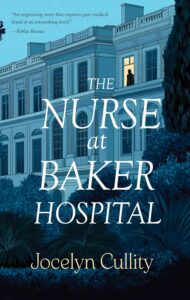 After her father’ s death, nurse Della King is on the brink of homelessness— until she lands a job at the prestigious Baker Hospital in Eureka Springs, Arkansas. What promises safety and purpose— for both Della and the terminally ill patients who come from across the country— hides a far darker reality.
When her beloved patients begin to die, Della must confront her deepest fears and navigate a web of secrets that tests her loyalty, courage, and sense of self. Torn between survival and doing what is right, she risks everything to uncover the truth. The Nurse at Baker Hospital is a gripping tale of mystery, hidden histories, and self-discovery, exploring what it takes to find one’ s place in a dangerous, unpredictable world.
BUY HERE
Category: Interviews, On Writing
Subscribe
If you enjoyed this article, subscribe to receive more just like it.