Why I Wrote a Dual-Narrative Novel
By Laura Bonazzoli
In the summer of 2016, I drove from Maine to Massachusetts to visit my aunt. Although more than two years had passed since my mother’s death, I was struck by the freshness of my aunt’s grief. As I sat in her kitchen, she told me the familiar story of how their mother, my maternal grandmother, had been admitted to a tuberculosis sanatorium in 1932, when my mother was three years old and my aunt was five. “When she went away,” my aunt told me, “I knew I had to take care of your mother. It was up to me. And I felt that way all my life.” My aunt had never married, and in the last decades of her life, had left Boston and returned to her hometown, the same town where my mother still lived. And until my mother’s death, they’d visited or phoned each other every day. Now, without her sister to care for, my aunt was bereft. As she spoke that day, her gaze wandered from the teacups to the windows to the kitchen door, as if she was still hoping to find her little sister somewhere.
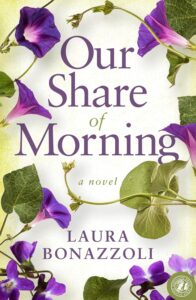
The day I got home from that visit, I opened my laptop and began to write the first chapter of Our Share of Morning, a story of two sisters whose mother, in 1933, is admitted to a tuberculosis sanatorium. As I worked, I “heard” the voice of the younger sister, Glory, frightened and confused by her mother’s sudden absence. The next day, I began writing a second chapter, this one in the voice of the older sister, Violet, who stifles her own fears by taking care of her little sister. Without thinking consciously about it, I’d begun writing a dual-narrative novel.
But why? Why does an author choose to use any particular number of narratives to tell their particular story?
I believe that, ideally, the choice reflects the author’s reason for telling the story.
If the author sees the story as fundamentally that of an individual’s life (or a particular incident or period in an individual’s life), then there’s no need for more than one narrator. Take J.D. Salinger’s Catcher in the Rye, in which Holden Caulfield details his alienation from what he sees as a bankrupt society. It’s essentially a fictional memoir of the narrator’s breakdown.
But there are many other reasons for writing a novel, and many other choices for how many narratives that novel can contain. For instance, in her mystery novel Gone Girl, Gillian Flynn alternates husband Nick’s narration with pages from his wife Amy’s journal that depict her as angelic and him as dangerous. The journal pages serve as a red herring that help Flynn fulfill her goal of keeping the reader guessing about whether or not Nick murdered his wife.
Less commonly, a novel might have three or four perspectives, as in Faulkner’s The Sound and the Fury, in which four individuals’ stories are told. Together, these four stories achieve Faulkner’s goal of portraying the disintegration of a Southern family more fully than might have been possible with one narration.
An author could even use eleven narrators, as I do in Consecration Pond, my novel-in-stories in which each “chapter” is a distinct short story narrated by someone who lives along the pond. Why eleven? Because my goal in writing Consecration Pond wasn’t to explore one or two characters’ lives. It was to explore the life of a community over time and the issues—strife, loss, forgiveness, redemption, and the yearning for consecration—that affect human beings everywhere.
So why was a dual narrative the right choice for Our Share of Morning? First, although the sisters experience broadly the same events in childhood and young adulthood, their responses to and interpretations of these events differ dramatically. Violet is practical and resourceful, sociable, a caregiver, and works actively to maintain the integrity of her family—especially her relationship with her sister. In contrast, Glory is romantic, a poet, intellectually gifted but easily overwhelmed by the challenges in the sisters’ lives. By weaving a dual narrative in which each sister voices her unique responses to shared events, I was able to show simultaneously both their individuality and their relationship.
In addition, choosing a dual narrative enabled me to give two perspectives on the novel’s themes—our potential for forgiveness, the blessing of our grief, and most importantly, our search for meaning. As with all of us, Violet and Glory’s lives are influenced by a host of factors beyond their control—in their case, poverty, misogyny, the prevalence of tuberculosis and lack of effective treatments, and a betrayal that occurs years before the story even begins. These factors influence the sisters’ fate throughout the entire novel. So a question the novel asks is, can the sisters grow to a place in which they can acquiesce to these things they’re powerless to change, and nevertheless find meaning in their lives? Given the sisters’ very different fates, it was essential to me to allow each to share her own unique response to this question.
Just as a duet offers more richness of sound than a solo, a dual-narrative novel can offer a broader and potentially more complex and satisfying experience for readers.
—
Laura Bonazzoli’s short stories, essays, and poetry have appeared in dozens of literary magazines and anthologies. Her short-story cycle, Consecration Pond, published in 2022 by Toad Hall Editions, was praised by Publishers Weekly as “poetic” and “haunting.” Her novel Our Share of Morning will be published in September 2025 by Sibylline Press. She is a freelance editor and writer, teaches at Maine Media Workshops and College, and lives in a renovated schoolhouse in Maine.
 Her eyes were fixed on my face. “Men,” she said simply. “And women. Make mistakes. Blissful, dreadful mistakes. But more often than not, women pay the price.”
1933. A three-story tenement in a mill town west of Boston. In the third-floor apartment hangs a portrait of unforgettable beauty: Ada, a neighbor’s daughter, who disappeared years before. In the apartment below, two sisters—thoughtful, sensible Violet and gifted but fragile Glory—come of age unaware of how the missing Ada haunts their lives. As disease and poverty threaten their family, they are each other’s refuge. But as they reach adulthood, the fallout from a broken love affair—while unraveling the mystery of Ada—threatens their bond.
Narrated in turns by each of the sisters, Our Share of Morning reveals how contagion, misogyny, and a series of betrayals force Violet and Glory to face immutable loss. Poignant and poetic, the novel is a meditation on meaning, fate, forgiveness, and the fierce endurance of sisterly love.
—
Laura Bonazzoli’s short-story cycle, Consecration Pond, was praised by Publishers Weekly as poetic and haunting. Her short fiction, poetry, and essays have been published in dozens of literary magazines and several anthologies. She works as a freelance editor and ghostwriter, and teaches creative writing with Maine Media Workshops. She holds a BA from Regis College in Weston, Massachusetts, and an MFA from the University of Minnesota, Minneapolis. She lives in Midcoast Maine. Our Share of Morning is her first novel.
BUY HERE
Category: On Writing
Subscribe
If you enjoyed this article, subscribe to receive more just like it.