Choose Adventure over Convention. Then Write about It
By Alex Poppe
Hanging onto the Land Cruiser’s roof rack with my left hand, I let go with my right, twisting to take photos of the stampede of children chasing us. Riding the back bumper evoked the exhilarated invincibility of youth. This is why I came here, I thought. This is wh—the humanitarian aid truck hit a deep rut in the dirt road, and I went flying.
It was 2012. The year prior, I had moved to Kurdistan, Iraq, motivated by desperation and curiosity in equal measure. I was forty-five years old.
*
When is “the right time” to choose adventure over convention? When I accepted a teaching job in northern Iraq, I couldn’t find Kurdistan on a map. I bought Arabic for Dummies, not realizing Kurds speak Kurdish, not Arabic. Besides updating my vaccines and deciding which vintage and indie designer dresses to pack, I was flying blind. But moving to Kurdistan proved to be one of the best decisions I have ever made. I stayed until 2021.
Unknowingly working alongside of one Sweden’s most notorious sex offenders, mapping the Domiz refugee camp in the early days of the Syrian civil war, and dining with a pistol-packing rumored hitman were colored-glass pieces of information that fell together in turn, educating me in Kurdish culture and politics beyond what my students taught me in the classroom and what I experienced as a Western woman living in the Middle East. But I was unprepared for how much my heart would broaden from knowing my students. Their capacity for joy and wonder in the aftermath of conflict, their generosity towards me, a citizen of a country which broke theirs, and their resilience awed me. I longed to convey their experiences because I wanted to spotlight people whose lives are forever altered by wars they never choose, especially women and young people. I wanted to celebrate the grit and vitality of those who make sense of their lives amidst the chaos and catastrophe of violent conflict. That perspective is missing from American main stream media and from our cultural output, such as movies and series.
I didn’t set out to write a memoir-in essay. I had tried and failed miserably to write about my experiences in Kurdistan in grad school. In 2021, I was invited to attend the Atlantic Center for the Arts writer-in-residency program. The piece of fiction I brought into our first workshop was rightly eviscerated by my colleagues. A few nights later at our family dinner, I was recounting how I had taught The Handmaid’s Tale and The World’s Wife, feminine dystopian literature, to a class of college freshmen and sophomores in Kurdistan. At one point, in order to get over our collective embarrassment so the students could fully mine the text on a figurative, thematic, and philosophical level, I held my hands up like a conductor and, on the count of one, two, three, invited the students to shout “penis!” with me. When my workshop colleagues’ laughter subsided, the master artist instructed me to bring in a story from northern Iraq to our next workshop. This was the genesis of my memoir-in-essay Breakfast Wine: A Memoir of Chasing an Unconventional Life and Finding a Way Home.
I learned essay structure as I wrote. With some stories, I understood what I had lived only when I sat down to write about it. In that way, memory brought perspective and clarity to what I had experienced. I wrote the essays as I was moved to do so, deciding to organize them sequentially after I had completed six or seven of them. In order to turn the personal into the universal so that someone who hadn’t lived the experience or given birth to me would find the essays engaging, I mined literary nonfiction techniques and hoped the stories resonated. If my writing partner had a dollar for every time I asked her if an essay “was even interesting?”, she’d be a very rich woman today.
I went to Kurdistan chasing adventure, purpose, and belonging. As I sat in my favorite restaurant right before I returned to the United States, a carousel of student faces spun in my mind. I recalled theologian Fred Buechner’s theory that we find our true vocation were our deep gladness meets the world’s great need. I had found great joy in Kurdistan’s classrooms. I realized I had been living a real life in northern Iraq, and now I was leaving it. I felt like a secondhand book; tattered and itinerant.
Ending the memoir with my return to the United States made intuitive sense. Because of my birth gifts, being born white, middle-class, and in the US, I have not had to make sense of a war-interrupted life. My students have. Some people leave their homeland because staying is too hard. Others dig in because leaving is defeat. I wonder if home is simply a construct of choice; either the place we hang onto at all costs or the place that catches us after we let go. Writing about my students allowed me to hang on to them for a little while longer.
—
BREAKFAST WINE
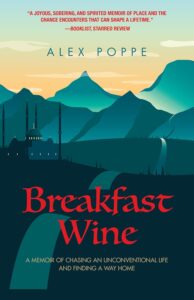 “With machete sharpness and magical imagery, Poppe extols the allure and apprehension of Kurdistan’s people as she embraces their culture and attempts to prepare them and herself for an uncertain future. A joyous, sobering, and spirited memoir of place and the chance encounters that can shape a lifetime.”
—Booklist Starred Review
Dress-obsessed and directionless, 44-year-old Alex Poppe can’t get her life together. A business analyst, turned actor, turned teacher, she works a dead-end marketing job under a mammary gland-fixated man and still waits tables to make ends meet. A chance encounter with an acclaimed journalist encourages her to accept a teaching position in northern Iraq, which charms with a heart and a fist.
Dining with a pistol-packing hitman, being thrown off the back of a truck during a humanitarian aid drop, and unknowingly working alongside one of Sweden’s most notorious sex offenders are colored-glass pieces of information that fall together in a turn, educating Alex in Kurdish culture and politics beyond what her students teach her in the classroom and what she experiences as a Western woman living in the Middle East. There are earthquakes and building fires and a small war juxtaposed against the senseless, drug-fueled death of a good friend and the bone chilling aftermath of the security police’s investigation. Alex navigates teaching online during the COVID lockdown with the help of WhatsApp before her father’s unexpected passing pushes her to return to the US.
Blending memoir, personal essay, local topography, and culture, Breakfast Wine is a frank, human story of pursuing an unconventional life and finding a way home.
BUY HERE
Having worked in conflict/post-conflict zones such as Iraq, the West Bank, and Ukraine, Alex Poppe is fascinated by the human capacity for joy, wonder, and resilience; all of it shaping how we become who we are. She writes about fierce and funny women overcoming adversity in the wake of violence.
Three-time Nobel Peace Prize nominee Kathy Kelly has praised Alex’s writing:
“Care about these characters and you might help build a warmer world, a less predatory world. The stories seem to unfold effortlessly, but at a deeper level, Alex takes truths that everybody knows and makes them into truths no one can ignore.”
Booklist has called Alex’s writing “brisk, raw, and unflinching.”
Alex Poppe is the author of four works of literary fiction: Duende, a 2024 American Legacy Book Awards winner, a 2023 International Book Awards winner, and a 2023 Readers’ Choice Book Awards finalist; Jinwar and Other Stories, a 2024 Pen Craft Book Award runner up, a 2023 Readers’ Choice Book Awards winner and a 2022 International Book Awards finalist; Moxie, and Girl, World, a 35 Over 35 Debut Book Award winner, First Horizon Award finalist, Montaigne Medal finalist, Eric Hoffer Grand Prize finalist, and was awarded an Honorable Mention in General Fiction from the Eric Hoffer Awards. Her short fiction and non-fiction have been nominated for the Pushcart Prize, Best of the Net, and commended for the Baker Prize among others.
In June 2025, Apprentice House Press published her memoir, Breakfast Wine: A Memoir of Chasing an Unconventional Life and Finding a Way Home. In 2021, Alex was an artist-in-residence at the Atlantic Center for the Arts, where Breakfast Wine began. Currently, she works in international development, awed by place, people, and their stories
Find out more about Alex on her website https://alexpoppe.com/writing
Category: Contemporary Women Writers, On Writing
Subscribe
If you enjoyed this article, subscribe to receive more just like it.