The Hardest Part about Writing
By Rebecca Lee Smith
For me, the hardest part about writing is plotting.
Some writers possess that effortless gift for weaving story lines, themes, and character studies together in just the right way, until a plot emerges fully developed. Like magic. Some writers can do this without breaking a sweat. I am not that writer.
In my experience, plotting a novel is like pulling teeth, only not nearly as pleasant. If I need a tooth extracted (and I have), a good dentist (unless he’s Dr. Scrivello from Little Shop of Horrors) will give me a shot of lidocaine to ease the pain. Not so when I’m trying to plow my way through a manuscript. No one shows up with a feel-good hypodermic when I’m stuck in the weeds with great characters, a wonderful setting, and no plot.
If you’re writing a mystery, plotting can be a tricky business. The suspects have to have valid reasons to suspect them, the clues must be legitimate, red herrings need to be planted to keep the reader guessing. And it all has to make sense in the end. Throw a believable romance into the mix, where the hero and heroine have internal and external conflicts they must resolve while falling in love, staying alive, and solving a crime, and you have a bloody nightmare. Or at least, a fairly intense six months of pounding your head against the keyboard.
Developing a plot is especially hard for hybrid writers like me—that weird combination of plotter and pantser—who will never be fully satisfied with either approach. Part of me longs to make neat color-coded charts and graphs instead of shuffling through a pile of notes scribbled on scraps of paper. The other part wishes I could lean back and let my imagination soar by the seat of its pants from beginning to end. But that would take forever. And I don’t have forever. So I end up doing a combination of both.
I like making things up as I go along. I think it keeps my manuscript fresh. But the genre I’ve chosen doesn’t allow me that freedom. Most mysteries are plotted backwards, so before I start writing, I have to figure out the nuts and bolts of how the crime was committed, who is guilty and why. Once the characters’ personal conflicts are created, I play the “what if?” game. Some of the “what ifs” I asked myself while writing A Murder and Maggie MacGill were what if an elementary art teacher named Maggie finds the richest, most despised woman in town dead, then unexpectedly inherits her estate? What if, when the woman’s death begins to look like murder, a series of unexplained pranks directed at Maggie’s family turn nasty, and in order to untangle a web of secrets and find out who has it in for her before it’s too late, she must accept help from the victim’s grandson, a man she’s loathed since high school but whose devastating grin and quick wit can still make her heart race?
Whenever I get bogged down trying to develop an interesting plot, or run into dead ends and can’t figure out how in the world it is all going to fit together, I take comfort in a quote by E. L. Doctorow that I keep in a little frame beside my desk: “Writing a novel is like driving a car at night. You can see only as far as your headlights, but you can make the whole trip that way.”
A Murder and Maggie MacGill
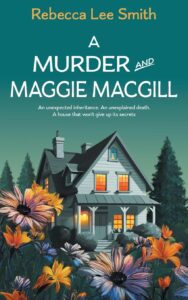 When elementary art teacher Maggie MacGill finds the richest, most despised woman in town dead, then inherits her estate, life in the sweet mountain town of Wrenhaven, Tennessee, takes a greased ride downhill. No one knows why Mrs. Grayson left her fortune to Maggie, but once her death begins to look like murder, and a series of unexplained pranks directed at the MacGill family turn nasty, Maggie must untangle a web of secrets and discover who has it in for her before it’s too late. Even if it means accepting help from the victim’s grandson, a man she’s loathed since high school but whose devastating grin and quick wit can still make her heart race.
Amazon: https://bit.ly/4kjLdw8
—
Rebecca lives with her husband and a dog named Wilbur in the beautiful, misty mountains of East Tennessee, where the people are charming, soulful, and just a little bit crazy. She’s been everything from a tax collector to a stay-at-home-mom to a professional actor and director. She loves to travel the world but her Southern roots and the affectionate appreciation she has for the rural towns she lives near inspire the settings and characters she writes about.
Website: www.rebeccaleesmith.com
Category: Contemporary Women Writers
Subscribe
If you enjoyed this article, subscribe to receive more just like it.