On Writing The Ripple Eclipse: Turning the Tide of Inherited Trauma
By
 Living a turbulent life and writing about it are two very different things. It means revealing family secrets and piercing the veil of a seemingly idyllic life. Yet, that’s what I decided to do, I ignored the warnings from seasoned writers about the psychological fallout of diving into the trauma, and risked hurting people that I love, both living and dead.
My mother, Rachel, was one of the youngest children to survive the Auschwitz concentration camp. She and my grandmother, Regina, eventually found their way to Montreal, where they rebuilt their lives. My grandmother’s entire family perished, including her husband, leaving her a twenty-four-year-old widow. People like my mother and grandmother are labelled “survivors”, a term my mother disliked immensely. She felt it implied that she somehow played a role in her survival, when in reality, it was the disintegrating Nazi infrastructure as the Russian army advanced. To her, that label automatically declared she was damaged. But she was. How could she not be?
From the time I was a young child, my mother’s fears dominated my life-an ever-evolving dynamic that shifted from fear for my physical safety, to anxiety about me growing up and leaving home. In her late sixties, my mother’s mental health began to seriously deteriorate. She stopped grocery shopping, cooking, socializing with her friends and frequently cancelled visits to Toronto, where my family and I now lived. I was on a campaign to “fix” the situation – bring in support around the house and try to convince my mother to go on medication, which she adamantly refused to do.
On Tuesday, September 30th, my family and I were in Montreal for the Jewish High Holiday. I met with my parents privately to discuss the situation. I expected my mother to fight with me, that was how we often interacted. But she was strangely silent. My father, who was doing most of the talking, said, “Your mother doesn’t want to be here anymore.” My mother was prone to grand, dramatic pronouncements, so I did not take it seriously. I took her silence for compliance. I thought I had finally gotten through to her.
The next morning, my children Lindsay and Alex, my husband and I stopped by my parents’ house to say goodbye before driving back to Toronto. After we left, my mother chose to end her life in the garage of our family home. My father also passed away in the garage that day, but the circumstances of his death remain a mystery.
Sixteen years later, I finally sat down to write the book that had been bubbling up inside of me. Despite the trauma our family experienced, the book is a love letter to my grandmother and my parents It’s also a brutal exploration of my role in my mother’s death.
While I have been a communications executive for over thirty years, this was all new territory for me. I was living in a blissful state of ignorance – and perhaps hubris. I thought I would write the book, and it would instantly be snapped up by a major publishing house. Wow, was I wrong.
I knew nothing about the process but was lucky to have connections to people who did. Things started off very smoothly. A former publishing executive felt there was merit to the book. Okay, here we go. She offered to connect me with potential agents and publishers but also discussed bringing someone in to collaborate with me. I was warned that this writer is very selective about the projects she accepts. We had a preliminary call, and she agreed immediately. We worked together on the proposal. A contact sent it to a major publishing house, and they were interested! Two weeks later, we had a call with a senior executive and an editor. It went extraordinarily well. He explained that he was not the final arbitrator but would get back to me. I waited. And then the email arrived – they were passing. Since I was an unknown commodity, they felt that they would need to see the whole book before revisiting it. I was crushed. And worse than that, immobilized.
I couldn’t get myself to sit down and write the book. Then the universe intervened, and I connected with an author who had written a book on the same topic. Maybe he was the answer! He is based in the UK, and after a very positive Zoom meeting, he agreed to collaborate. Back in business. I shared my story with him; he drafted the first chapter. I hated it. He was focusing on the horrifying aspects of Auschwitz. I wanted to focus on intergenerational trauma. He was insulted by my edits and declined to move forward. He did, however, become an amazing mentor, doling out frequent doses of tough love and much needed critiques.
When I was nearing the end of writing the book, which had changed significantly after five major rewrites, I reached out to big publishing houses and prestigious agents provided by a network of friends and associates. I was met with a barrage of feedback – all negative: memoirs aren’t selling, you have no profile, we don’t see a market for your book. So, I reached out to dozens of publishers in Canada and the U.S. who accepted manuscripts from unrepresented authors. Two were kind enough to get back to me to decline. One had an automatic bounce-back message that said if I do not hear from them in six months, they were not interested. Still waiting to hear.
I came to accept that if I wanted to get this book out into the world, I was going to have to self-publish. I had one last glimmer of hope, Rebecca Eckler at RE:Books, a hybrid publisher specializing in unrepresented women authors. Our paths had crossed over the years when she burst onto the scene as an “it” girl journalist, but I didn’t really know her. I reached out, and she got back to me immediately. Yes, she was interested. And then everything started moving very fast. The Ripple Eclipse: Turning the Tide of Inherited Trauma, launches in a matter of weeks. So now, I wait with bated breath to finally learn what the world thinks.
The Ripple Eclipse: Turning the Tide of Inherited Trauma is available at Amazon, Indigo, Barnes & Noble and select bookstores mid-November.
About Audrey Hyams Romoff
Audrey Hyams Romoff was born and raised in Montreal. Her father Brahm was a radiologist, her mother Rachel, a nurse. Rachel was one of the youngest children to survive Auschwitz concentration camp and her lingering trauma had a profound effect on her family. Audrey moved to Toronto to pursue a degree in English literature.
After a series of jobs in marketing and communications, Audrey founded OverCat, a boutique agency specializing in fashion and beauty clients. The agency’s roster features blue chip clients including Estée Lauder, Shoppers Drug Mart and Longines. OverCat launched Victoria’s Secret and Crate & Barrel in the Canadian market and hosted high-profile celebrity events with Sarah Jessica Parker, Katy Perry, and Shania Twain.
While Audrey balanced marriage, two children and a high-profile career, her mother continued to struggle. In 2008, Rachel chose to end her life in the garage of the family home. Her father, also passed away in the garage that day but the circumstances of his death remain a mystery.
Audrey’s memoir, The Ripple Eclipse: Turning the Tide of Inherited Trauma, explores four generations of women in her family and how secrecy can have devastating consequences.
https://www.audreyhyamsromoff.com/
Instagram @audreyhyamsromoff
TikTok @audreyhyamsromoff
Facebook @AudreyHyamsRomoff
LinkedIn Audrey Hyams Romoff
The Ripple Eclipse: Turning the Tide of Inherited Trauma
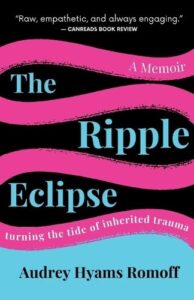 In this true story, four generations of women grapple with the invisible wounds of inherited trauma-from a grandmother and mother who survived unimaginable horror, to the author’s parents’ tragic death, which catapulted her and her daughter into a freefall.
For more than 30 years, Hyams Romoff has lived in the fast-paced, glittering world of Public Relations. As the founder of OverCat Communications, she stages high-profile events for A-list celebrities. But beneath the glamour lies a far more enduring legacy, one that even the most fabulous wardrobe can’t disguise. Her family’s trauma flows like ripples across water, spreading until it eclipses the light and casts shadows over the women in her family. This is the “Ripple Eclipse”-the quiet, powerful force of trauma that shapes and sometimes threatens to darken the lives of those who carry it.
BUY HERE
Category: On Writing
Subscribe
If you enjoyed this article, subscribe to receive more just like it.