Career or Calling?
By Anese Miller
I know I’m not alone in wondering from time to time, Why do we bother writing in the era of visual entertainment? Video, film and photography proliferate in many formats, capturing eyeballs on social media, in games and shows available on-demand. Why slave over a blank page, struggle to publish, and offend one’s introverted nature by sinking precious time into self-promotion? Not to mention the usually vain hope that our words will strike a chord in someone’s heart, maybe making our efforts worthwhile, even though we’ll never hear about it…
Of course, many writers feel an irresistible need for self-expression and find the perfect outlet in written words. Some can even find satisfaction by turning their backs on publication and its dubious rewards. In principle, one can be content with personal writing—journaling or keeping up corresponding with friends and family (a critically endangered species these days, Christmas letters notwithstanding). Some share their work exclusively on Facebook, blogs, substacks, and the various forms of self-publishing, cleverly circumventing gatekeepers of the consolidated industry that has stifled so many dreams over the decades.
True, a long-awaited milestone—such unboxing copies of a novel—can bring enough joy to vindicate that old motto, “Keep writing! It’s never too late!” But in fact, I have given up many times when frustrated hopes became overwhelming: I gave up submitting to magazines and quarterlies, swore off querying agents, and threw in the towel on searching for small presses…only to later give all of those ventures “one last try.”
Yet again, I’ve asked myself, Why crank out hundreds of pages in the age of depleted attention spans? Is the “game worth the candle,” to borrow a phrase from a time when reading had less competition as a form of entertainment and enlightenment?
My favorite uncle, a commercial artist, affirmed the adage that, “Truth is beauty and beauty, truth.” With a smirk, he would add, “That’s all you need to know!” My truth in writing novels of social conflict set in the notorious former swing state of Ohio involves such controversial matters as abortion, gun rights and sexual orientation. The effort to treat these issues with my brand of fictional truth earns me no love from several quarters, including a few branches of my own family.
Was it worth it? Does publishing a book justify losing friends and alienating people? I don’t expect fame or life-altering royalty checks. So, the question leads me to ponder the notion of a “writing career.” It’s a prospect that’s been on my mind for at least 50 years—shining in the distance: the highest achievement I could possibly attain! Social media reveals that this goal is shared by tens of thousands of people in the English-speaking world.
But it’s not self-evident how most of us define the term “career.”
One obvious question is whether a career must produce income. Things we do, no matter how much we love them, tend to be considered hobbies if they fail to bring an income. No doubt, hobbies get an undeserved negative rep due to the connotation of light amusement. Distraction for dilettantes: knitting today, gardening tomorrow.
This is nothing like the attitude of most writers toward our craft. The inner voice that guides the pen (or fingers on keyboard) is an intimate part of our selfhood. Writing expresses a quality of mind that seems to embody our highest personality. A soul. Until we frame experience in words, we hardly know what happened, or what we think. At the same time, writing is a way of reaching out to people we could never meet in our physical lives, a point of contact with humanity. Or, at least, a hope for contact if we succeed in finding readers.
Eventually, we couldn’t switch to another “career,” or even another “creative outlet,” if we wanted to. As writers are known to declare in moments of despond, “I’m entirely unfit to do anything else!” (Although some have done quite well, after all. Bless their hearts.)
Throughout history, writers have failed to earn enough money to shake a quill at. Yet many of these wound up contributing to the canon of world literature. They’ve belatedly entered the hearts of more readers than they ever dreamed possible. Among the members of this special club are Thoreau, Dickinson, Poe, Kafka, at least two of the Brontës, and John Kennedy Toole (the posthumous Pulitzer Prizewinner for A Confederacy of Dunces). The now beloved Zora Neale Hurston achieved some success as a writer, only to wind up cleaning houses in later life. She ended her days in Florida’s St. Lucie County Welfare Home.
These scribes may not have enjoyed grand careers, but they pursued their calling as writers with the devotion we might expect of a sacred vocation.
And it should never be forgotten that others have paid the ultimate price for stubbornly practicing their craft under repressive regimes. Not merely denied publication and a living wage, these writers were hounded, imprisoned, and killed for the truth of their words: Osip Mandelstam, Nikolai Gumilyov, and Víctor Jara. Still more were marginalized and persecuted: Anna Akhmatova, Theodor Kramer, Alexander Solzhenitsyn.
The PEN International Writers in Prison Committee reminds us that persecution continues around the world today. Journalists have come under attack in recent years like never before, and such an august figure as Salman Rushdi was assaulted in public in 2022, suffering grave injury.
American writers may have little more to fear than being ignored and unsupported, but we share the dedication to a practice that often resembles a calling more than a career. We feel an inner drive to seek perfect self-expression despite the lack of material reward. Or reward of any kind. Even praise, recognition, a place in society, and self-respect can become rarities. When our work is such a profound reflection of our minds, affirmation is a persistent craving.
Still, writers persevere.
Few, if any, aspiring writers are hoping for a lifetime of poverty followed by posthumous fame. Most would like to realize a modest profit on book sales, covering their outlays on materials and services. Our wildest dreams may involve the sale of film rights, which might at least begin to pay down an English major’s student loans.
Samuel Johnson would say that the world has grown crowded with blockheads, he of the famous quote, “No man but a blockhead ever wrote except for money.” True, Mr. Johnson lived in an illiterate age, when the slightest skill with letters could pay a premium. It’s far easier today to go broke amid a crowd of scriveners than it was in the 18th century. Nonetheless, this deters few from trying to distinguish themselves. Ourselves. So again, I ask, why do we do it? How do we go on?
It’s hard to turn away from a true calling. What’s often termed “the writing life” requires an almost spiritual discipline. When it may take years to complete a draft, and longer to perfect it, deferred gratification is the order of the day. But for a writer striving to publish, it’s even more essential to “sit with” your ego in the Buddhist sense: to tolerate its flights of arrogance without succumbing to them. To use the ego’s energy while resisting its delusions of grandeur.
You must believe in your skills enough to keep applying words to page, but not so much as to allow specific hopes—This agent will take me! That magazine will feature me!—to outgrow the proverbial tiny mustard seed. Disappointment is always around the corner…though fresh efforts are available as well.
And so, many of us take a monkish satisfaction amid careful management of our expectations. A healthy dose of self-denial, keeping faith with one’s art, always striving in uncertainty to bring forth greater truth. This is a form of loyalty to one’s humanity. To all of humanity.
Then comes the occasional response from a reader: Your story touched a chord, raised a memory, sparked new ideas! Or a reviewer demonstrates a deep engagement with the work, and we exclaim, “Someone saw me at last!” For a moment, drudgery vanishes, and the calling becomes a blessing we cannot fail to answer. The struggle was worth every word: all the words on the page and the thousands more crossed out like submerged stones that let you walk on water.
—
Anesa Miller is a widely published poet, essayist and novelist. Her novels, Our Orbit and I Never Do This, are available from Sibylline Press wherever books are sold. Anesa is a recipient of an Artist’s Fellowship in creative writing from the Ohio Arts Council. She holds a PhD in Russian literature from the University of Kansas and an MFA from the University of Idaho. She can be reached on Facebook, LinkedIn and Instagram or through her website: www.anesamiller.com
I NEVER DO THIS
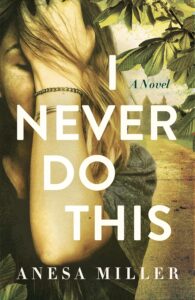 MEET THE UNFORGETTABLE YOUNG WOMAN, LaDene Faye Howell, who finds herself in police custody recounting her story after her paroled cousin Bobbie Frank appears and engages her in a crime spree.
LaDene Faye Howell has spent her life in the small town of Devola, on an oxbow of the Muskingum River, in southeast Ohio. Her family is conservative and deeply religious, although another branch of the Howell clan are notorious criminals. When one of her outlaw relatives returns from prison, LaDene hopes the two of them may share an evening of fun, or even a spark of romance. Instead, Bobby Frank embroils her in kidnapping their old high school principal.
Taken into custody, LaDene recounts her misadventures in the form of a dramatic monologue. Pledging to “tell all in full truth so help me God,” she hopes to keep herself out of jail and perhaps even soften Bobby’s likely sentence. She also aims to capture her listeners’ sympathy by recounting a secret from her past that she has never shared before.
Told with country noir flair, the heart of the story is LaDene’s struggle to live as her own person while remaining true to her heritage and family loyalties.
BUY HERE
Category: On Writing
Subscribe
If you enjoyed this article, subscribe to receive more just like it.