Against Ageism in Fiction
By Valerie Saul
I have a confession. I usually hate older female characters in novels, and I am an older female!
Older women in literature are too predictable.
If women characters are in their fifties, they are frequently the victim of an evil ex-husband. When they find a new love, that’s their big accomplishment, end of story. If they are a minor character, they are barely sketched out as gossipy social climbers or malicious mothers-in-law. Yawn.
Women over sixty are not the main character as often as they should be. Full stop. Instead, they are usually grandmothers or babysitters for the main character. They bake cookies and make soup or are two-dimensional caregivers – all kindness and sacrifice. Even worse, women over sixty are portrayed as frail, forgetful and fearful; what I call the three “F’s.” I know some women age faster than others but not every one! Grandmothers, caregivers and cookie bakers are wonderful, but let’s have some diversity!
Why does it matter?
Literature has always reflected society’s norms and expectations. Too many books showed people of color as household help. That made it harder for people of color to dream of something different.
Similarly, society underestimates older women and those expectations are reflected in the books that get published. And those unimaginative books make it harder for us to dream of anything else for ourselves. I’m not sure I could have written a debut novel in my sixties if I didn’t know someone else who had done it. We need help picturing ourselves taking different paths and literature can do that.
How did this happen?
There are a number of reasons for this sad situation. Longer life expectancies and longer health spans have made it possible for more men and women to have a “third act.” But for some reason, few writers portray this demographic reality in their stories. Whether they make that choice out of ignorance or laziness, the result is the same. Older women in books are portrayed as nearer to the end of life than is typical today. (thus, the three “F’s”)
Women of all ages have a wider array of roles in life to choose from then they once did. I personally know older women who have started non-profits, competed in fencing tournaments, volunteered for the Red Cross and climbed mountains. But no one seems to notice older women doing those things.
Let’s face it. Western society is very “youth-centric” and stories about young people are big sellers. We like coming-of-age stories, stories about finding your soul mate and stories about virile warriors. It’s fun to live through those characters, so books about younger people are stiff competition.
The publishing industry is in a state of flux. From what I hear, traditional publishers are looking for a “sure thing” right now. Given that reality, how likely are they to take a chance on stories about older women? And if that publisher is led by men, they may be even less likely to take a chance. So, stories and characters about older women are overlooked because of industry pressures. And that is despite the fact that we are a huge part of their readership!
Taking Some Responsibility
If you are like me, you were raised to be a quiet unobtrusive achiever. That’s hard for younger women to imagine. They post on social media “Look what I accomplished!” In contrast, we were taught: “No one likes a show-off.” “Bragging is unbecoming” “Just be kind and work hard and you will succeed.”
The subtext was, stay in the background, don’t promote yourself, it’s okay if someone else gets the credit because it’s the outcome that matters. Yikes. So, older women like me are part of the problem. We’ve contributed to society’s narrow expectations by not standing proud. Guilty.
Why is change important?
Statistically, an American woman on her fiftieth birthday can expect to live another thirty to thirty-three years. Many will not have grandchildren and will outlive their spouses. That reality should be reflected in literature. Women my age need stories that showcase strength, agency, and adventure, proof that our next act can be our most powerful yet.
What can we do?
It’s simple: Start writing about older women in all their diversity. How?
Use that excellent imagination of yours to write older women characters that look different and have non-traditional jobs. Make them snarky or weird. Make even minor characters deviate from the obvious.
Be more curious. When you see your silver-haired neighbor or aunt, don’t assume you know what their life is like. It’s shocking how rarely anyone asks me what I do.
Have you got writers’ block? Interview older people for some amazing ideas!
I just realized something. I always have dogs in my stories. Not just because I love dogs but because they are a great plot device. My dog characters relieve tension and provide comic relief whenever I need it. In my stories, they are all goofy, naughty and loyal. Always. I know there are other dogs. Fierce ones, lazy ones, dignified ones. But I always write them the same way. It’s lazy to write the same dog character every time. I can do better.
Don’t write older women as if they are merely a plot device.
—
The Badass Widows: A Mystery
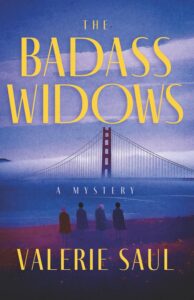 Secret Crime-Fighting Widows take on the San Francisco Bay Area
How do widows get through their grief? They become bad asses and form a secret band of crime fighters of course.
Former FBI agent Beth Winstead has recently lost her husband after a long isolating decline. Determined to build a new life, she joins a rowing club on San Francisco Bay. When Beth rescues widowed rape victim Elena from a derelict sailboat, her sense of purpose is rekindled. They are soon joined by widows Anneke and Zoe and, almost as a joke, they form a secret group of do-gooder crime fighters. They begin small but before long, they’re committing bold acts of secret justice and are hooked on the “rush” it provides. Meanwhile, someone is stalking Beth and Elena. And not every mission is successful. A betrayal from within puts all of their lives in danger. In the end, the widows must decide whether they have found their new calling or made a foolish and dangerous mistake.
BUY HERE
—
Valerie Saul earned a doctorate in audiology, a master’s degree in speech pathology and a bachelor’s degree in psychology followed by an unconventional career in hearing healthcare in the US, New Zealand, South Korea and Singapore. She attended the Stanford Continuing Studies Creative Writing program and participates in multiple critique groups. She is a voracious, omnivorous reader. When she’s not writing stories about badass older women, she can be found hiking the Marin headlands with her husband or rowing a shell on San Francisco Bay.
Category: On Writing
Subscribe
If you enjoyed this article, subscribe to receive more just like it.