Authors Interviewing Characters: Ellen Barker
NOTHING NORTH OF DELMAR
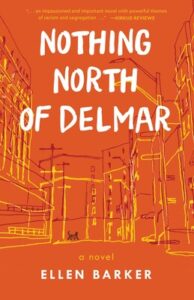 For fans of Catherine Ryan Hyde and Laurie Frankel, a novel of one young woman’s post-college foray into the adult realities of landlords, economics, and urban politics, set against the Bicentennial summer of 1976.
It’s 1976, the Bicentennial year and a watershed moment in America. The draft, the Vietnam war, Woodstock, and the Summer of Love are long gone. Tie-dye is out, and everyone has cut their hair. The Civil Rights Act has passed, the Equal Rights Amendment is just a few states from ratification, Roe v. Wade is firmly enshrined, and closet doors are creaking open. The sixties have changed the world.
Only they haven’t, as Novelle is about to find out.
At this moment, she arrives in St. Louis to start graduate school in economics, a clear-cut field of mathematic problem sets with answers. Except, it’s not. Almost immediately, she discovers that Delmar Boulevard is a Great Wall of China separating St. Louis into Black North and white South, and that economics is the mortar between the bricks. She gets caught up in unraveling a plan to “take back” a Black neighborhood that has leaked over the divide. By the time she finishes her degree, she is getting hate mail and death threats. But she’s also come into her own as a force for change. A satirical, witty look at a slice of history that still resonates today.
Betty (Novelle’s boss) Character Interview by Ellen Barker
Novelle arrives in Saint Louis in June 1976 for graduate school and immediately starts looking for a summer job. One of the first people she encounters is Betty, who hires her as an office assistant.
EB: Tell us how you first met Novelle.
Betty: Oh, it was the second of June in 1976. I remember that because it was chaos that day at the office. The director had just had a massive heart attack and I was trying to hold things together. Novelle walked in—I think she was looking for job listings, I don’t know really. But I was in a state and there she was, all prim and proper and exuding calm and confidence.
EB: Prim and proper? Really? On a college campus in 1976?
Betty: Well, okay, not exactly prim. But when you spend your days surrounded by undergraduates, someone like Novelle comes across as a full-fledged adult. Competent, you know?
EB: How did that work out?
Betty: Oh, it was like she had always been there. The director—Ray—died the next day, and she . . . well, she didn’t know anything yet, but she just did whatever needed doing. Answered hundreds of phone calls about Ray—remember, she never even met him—and jumped right into cobbling together a sort of reception separate from the big public one, something where the students who loved Ray could grieve in a more . . . adolescent way, shall we say.
EB: okay, let’s get back to what Novelle was doing there on campus.
Betty: She was here at WashU to start grad school in the fall, in Economics. I could never remember what it was because she didn’t seem like an economist.
EB: So she spends the summer working for you . . .
Betty, Yes, just office stuff like typing and filing and phones. Oh, and bride-sitting.
EB: Brides? As in weddings?
Betty: Yes, you see our office space is right next to Graham Chapel, which is popular for weddings. It’s very photogenic and not associated with any particular religion. But what it doesn’t have is any space for the bride and bridesmaids to finish dressing and so on, We don’t have much going on over the weekends, so they pay us a nominal fee and use our space. Someone has to be here to let them in, supervise, and lock up, Novelle was glad to work a few more hours, so it mostly fell to her.
EB: Easy money.
Betty: Sometimes yes, sometimes no. She’s got stories!
EB: So school starts and the summer job ends.
Betty: Oh yes, but she still stopped by and she still did the bride-sitting thing, and better her than me, you know? There were some issues with her apartment. I take it the landlady was a bit of a lush and not too concerned about things like heat. So she was happy to hang out here, where it was warm in winter and cool in summer. Oh, and she could use our electric typewriter. Economics seemed to require a lot of papers.
EB: Didn’t one of those papers end up causing some kerfuffle?
Betty: Oh yes!
EB: Tell us about that.
Betty: Well Saint Louis is like most American cities; it has a dividing line between the Black population and the white. In Saint Louis, it’s Delmar Boulevard. The divide is not legal, but there it is, just past the edge of campus. Novelle got interested in what was going on in a particular Black neighborhood of elegant old apartment buildings on the white side of the line.
EB: Interested how?
Betty: Well, the Black families were leaving and the buildings were empty. It took her a while, but she found out that developers were trying to buy all the apartment buildings and convert them to condos and resell the condos to white people. It was a really nice area and they wanted it to be white again. Also, they wanted to make a lot of money. Economics!
EB: So, the Black people were forced out, or what?
Betty: Subtly, but yes. They’d do things like breaking into cars, starting little fires. Scaring the renters and driving down the prices. The Black owners usually lived there, and they saw what was happening but didn’t have any way to fight it. The buildings with white owners, well, those owners didn’t live there and sold out when the tenants started leaving.
EB: So Novelle wrote a paper about that?
Betty: Not just a paper, but her masters thesis, showing the role of economic policy in this. And a reporter showed up at her oral and the story got in the paper. And that’s when she started getting creepy phone calls and hate mail. But with all the attention, she also got a great fellowship. So she’s in Boston now.
EB: So, a happy ending.
Betty, after a pause: For Novelle anyway. Maybe not for everyone.
EB: Oh. Right. What happened to the Black families?
Betty: I don’t know. Probably moved north of Delmar.
EB: What’s north of Delmar?
Betty: Ask a Black person, and they’ll look at you like you’re crazy and say: Well, EVERYTHING. Ask someone from south of Delmar and they’ll look at you like you’re crazy and say: Nothing. There’s nothing north of Delmar.
EB: Whew! By the way, Betty, I don’t see your last name anywhere in my information here.
Betty: [laughs] Nothing? Must be because I live north of Delmar.
BUY NOTHING NORTH OF DELMAR HERE
—
Ellen Barker grew up in Missouri during a period of demographic upheaval, and she returns there in her novels. She has a bachelor’s degree in urban studies from Washington University in Saint Louis, where she developed a passion for how cities work, and don’t. She lived in the Loop in University City for several years and began her career as an urban planner for East-West Gateway in Saint Louis. She then spent many years working for large consulting firms, first as a writer-editor and later managing large data systems. Her volunteer work involves years of pet-assisted therapy with children in “the system,” both foster care and prison. She is the author of three earlier novels: East of Troost, Still Needs Work, and The Breaks. She and her husband live in Los Altos, California, where they can indulge in hiking year-round.
Category: Interviews, On Writing
Subscribe
If you enjoyed this article, subscribe to receive more just like it.