Writing Myself Back into the Story
By Dr. Kathryn Page, author of Good Work:Transform Your Work from the Inside Out
I’ve been writing for as long as I can remember.
Growing up on a farm, with two ex-police officers as parents, home life was unpredictable. Happiness wasn’t something any of us knew how to tend to. It wasn’t that we were unhappy exactly, but it wasn’t something we talked about or reached for either. Feeling things deeply was never the problem. Knowing what to do with those feelings was.
I think that’s partly why I started writing. It was a way of processing what didn’t get said out loud. And somewhere in that quiet, I noticed something: I had a particular sensitivity to other people’s emotional states. I could see when someone was struggling before they could name it themselves. And I wanted, instinctively, to help – to make things a little lighter for the people around me. Looking back, I think that became something close to a purpose. Not a conscious choice so much as something I couldn’t not do.
That instinct followed me into my education, and eventually into my work. I pursued a doctorate in organisational psychology, and then a post-doc in public health working with police officers – a world I understood from stories I’d been told in childhood, but was now approaching from a different angle. Studying the conditions under which people in high-pressure, high-stakes roles could actually sustain themselves. What wellbeing looked like when the job asked so much of you. It was professionally compelling and personally resonant in ways I was only beginning to understand.
From there, I carried that question – what makes people feel well at work? – into organisations, into leadership conversations, into over two decades of practice and research. The framework in Good Work grew from that foundation.
But a few years ago, something shifted. I was made redundant. And while I want to be honest about that – it was a rupture, a disorienting loss of ground – what shook me more than the redundancy itself was what it revealed. Looking back, I could trace a series of small half-turns, each one barely noticeable on its own. A role that didn’t quite fit. A compromise that seemed reasonable. A path that drifted, degree by degree, away from the thing I’d always known I was supposed to be doing.
None of it had felt like a mistake in the moment. That’s the insidious thing about drift. It doesn’t announce itself.
The last eighteen months have been a process of finding my way back. Of sitting with uncomfortable questions about who I was before I started optimising myself for other people’s expectations and some contrived view of ‘success’. And then – slowly, and with no small amount of humility – realising that I’d known the answers all along. That my forty-year-old self was simply catching up with my twenty-two-year-old self, who had always understood, in some inarticulate way, what this was all for.
It’s a strange and clarifying feeling, to arrive back at yourself.
Good Work was written from inside that process. And I think that’s why the question at its heart – what makes work feel good, and what makes it harm us – stopped being purely academic for me. It became personal in a way I hadn’t allowed it to be before.
Work occupies such a significant part of our lives, yet for many people it’s a source of stress, pressure, or quiet depletion. I’d lived that. I’d studied it. And I’d watched it in my parents, in police officers, in leaders and teams across industries – the way work could grind people down, or, under the right conditions, genuinely sustain them.
If we wanted to improve people’s lives at scale, work felt like one of the most powerful levers we had. Not just policy or productivity – but the daily texture of how it feels to show up somewhere and give your time and energy to something.
So I kept asking: what conditions need to be present for work to give us the best chance of feeling good, and doing well?
Over time, patterns emerged. Not quick fixes or surface-level perks, but deeper elements of how work is designed and led. And a growing recognition that people experience work differently depending on where they are – individually, relationally, systemically. You can’t address “good work” only at the level of the individual, or only at the level of the organisation. You have to meet people where they are.
That’s where the structure of the book came from: Me, We, Us. How do I design my own relationship with work so it’s good for me? How do we work together in ways that support rather than deplete each other? And how do we build systems that make good work the norm, not the exception?
The writing process itself mirrored all of this in ways I didn’t fully anticipate.
Early drafts were built almost entirely around other people – stories, profiles, other people’s experiences. Then I received feedback that kinda stopped me: we need more of you in this book.
It sounds simple. At the time it felt uncomfortable, because I hadn’t believed my own voice was enough. That my role was to curate, to analyse, to translate – but not to take up space myself. I guess you could say it was a shift from academic to author.
Working at ByMany helped shift this. We see every day how sharing our own experiences creates connection – not by making us the centre, but by building a bridge. Slowly I started writing differently. Including my own doubts, my own stumbles, my own hard-won clarity.
The final turning point came through conversation. Two people I work closely with – Greg Sutherland and Sean Carroll – helped me see what the book was really about: not just the mechanics of work, but the possibility that work could be a force for good in the world. That idea – simple, and so often overlooked – became the spine of everything.
Looking back, writing this book has been its own version of good work. It required clarity, connection, and confidence. It required me to stop holding back and trust that my experience – all of it, including the parts that were hard – was actually the point.
Because if writing has taught me anything, it’s this: when we share our experiences honestly, we don’t take up too much space. We make space.
And in that space, something powerful happens. People recognise themselves. They feel seen. They feel human. And in the end, that feels like the point.
***
Dr. Kathryn Page is an organizational psychologist, author, and leadership partner at ByMany, who has spent her career asking one big question: What makes work good for us? Based in Melbourne, she has worked with leaders across industries to design work that protects people, fuels wellbeing, and unlocks performance. Her clients include some of the world’s largest companies and health systems, and her research is cited broadly. Her new book, Good Work:Transform Your Work from the Inside Out (Wiley, May 11, 2026), shows how leaders and teams can design work that’s both human and high performing. Learn more at drkatpage.com.
Good Work: Transform your Work from the Inside Out
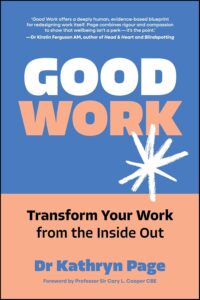 What if work could be the solution to wellbeing rather than the problem?
We’re facing an epidemic of burnout, loneliness and quiet despair at work ― not because people are weak, but because our systems are stretched and outdated. Despite more wellness apps and flexibility policies than ever, we’ve never felt more disconnected from meaning, purpose and each other.
Good Work argues that real change won’t come from quick fixes, motivational quotes or coping strategies. It comes from reimagining the way we work ― together. Drawing on decades of psychological research and stories from frontline teams to global organisations, organisational psychologist Dr Kat Page reveals a bold new blueprint for creating work that protects, fuels and connects people. Learn how to:
- Strengthen your personal wellbeing while contributing to a healthier shared culture
- Build connected, high performing teams where people speak honestly, think boldly and thrive as highly connected communities
- Create momentum for change, even when you don’t hold the power
- Navigate workplace stress while maintaining performance, connection and career momentum
Whether you’re leading others, shaping culture or redesigning your own relationship with work, Good Work is a call to action ― an invitation to influence systems, practices and norms to make good work the rule, not the exception. Not just for yourself, but for all of us.
BUY HERE
Category: Contemporary Women Writers, On Writing
Subscribe
If you enjoyed this article, subscribe to receive more just like it.