Interview with Adassa
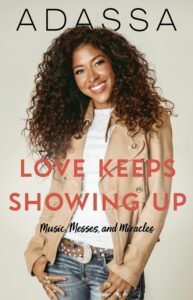 Adassa—Oscar, Grammy, and Golden Globe recipient, platinum-selling artist, and the voice of Dolores Madrigal in Encanto—invites us into her personal story of achieving her musical dreams, battling a paralyzing illness, and having faith in divine timing.
Born to immigrant Colombian parents with big dreams in their hearts but little in their pockets, Adassa learned early that making it as an artist wasn’t just about talent—it was about grit, faith, and a whole lot of improvising. Together with Gabriel Candiani, who is both her husband and her music director, Adassa paid her dues on stages in Texas and Mexico, before landing her first solo record deal. That deal catapulted her into performing alongside and collaborating with musical legends, including Lin-Manuel Miranda, Daddy Yankee, Juanes, Enrique Iglesias, Carlos Vives, Pitbull, Snoop Dogg, Flo Rida, Ciara, Missy Elliott, Luis Fonsi, Don Omar, Megan Thee Stallion, and Becky G.
From the electrifying energy of the Rose Bowl to the legendary Madison Square Garden, she was living the dream. Until life took a detour.
When COVID left her paralyzed from the neck down, Adassa faced her greatest challenge. Unable to care for herself—let alone sing—she felt like everything was slipping away. But in those darkest moments, Gabriel and their seven children became her strength. Their family clung to faith, laughter, and the unshakable belief that God was still directing their lives.
What followed was proof that God’s timing is always perfect. From relearning patience and resilience to performing live with the Encanto cast at the Oscars and sharing her voice on stages across the United States, Mexico, and Taiwan, Adassa’s journey has been anything but predictable.
Full of inspirational music—including QR codes that link to twelve original songs—unexpected messes, and undeniable miracles, Love Keeps Showing Up is a heartfelt reminder that even when life feels out of tune, faith and family keep us singing.
We are delighted to feature this interview with Adassa!
What made you decide that now was the time to write a memoir?
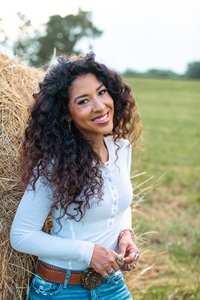
Adassa (credit Gabriel Candiani)
Encanto changed the size of the room I was standing in. Suddenly millions of people knew my voice, and many of them wanted to know the story behind it. The memoir is the answer to that question—the real one, not the press junket version.
But the timing was also personal. COVID forced a stillness I had never allowed myself. For the first time in my adult life I wasn’t performing, touring, or running a household at full speed. I was just—there. And in that stillness, I could finally see the through-line. The immigrant parents. The girl group that fell apart. The courthouse wedding in stage clothes. The paralysis. The Oscar stage. None of it was random. It was a story worth telling.
The other reason is my children. I have seven of them. I want them to know who their mother was before she was their mother—what she survived, what she believed, what she refused to quit. This book is for them as much as anyone.
How did growing up as the daughter of Colombian immigrants shape your dreams, work ethic, and identity as an artist?
My father became the man of his household at nine years old. He sold food his grandmother cooked, door to door, through the neighborhoods of Colombia. He came to the United States at 24 with a one-way ticket and went straight to work welding, cleaning offices, washing windows until he had saved enough to bring his mother and sisters over. He never stopped. He never complained. He just built.
That is the only work ethic I ever saw modeled. So it is the only one I know.
My mother was told she could never have children. She had two anyway. She traded her dream of singing for a nursing career; practical, selfless, quietly sacrificial. My grandmother Rosa had done the same thing a generation before her. Three generations of women who folded their dreams so the family could survive.
I grew up understanding that my voice was not just mine. It carried their unlived dreams. That is a weight, but it is also a fuel. When I got booed off a stage in Texas I didn’t quit. We couldn’t afford to quit, literally. When a deal fell through I found another door. That is not resilience I manufactured. That is what I watched my parents do every single day before I was old enough to name it.
My identity as an artist is Colombian at its core. The rhythm, the warmth, the food at every gathering, the faith woven into the ordinary; all of it lives in my music. For my new album, I didn’t cross over into country. I brought everything I already was and let it land somewhere new.
What were some of the pivotal moments that kept you going at the beginning of your music career when success wasn’t guaranteed?
The first was being signed at 17. I had just bombed my first competition. I was certain I wasn’t good enough. Then my brother booked me to audition for a girl group, I got in, and within months I had my first record deal. It didn’t last long but it told me the dream wasn’t delusional.
The second was (my husband) Gabriel stopping at a red light in Miami. We were two blocks from a car dealership, about to apply for sales jobs because the music wasn’t paying. He turned to me and said, “Let’s go to BMI instead.” We walked in off the street.
Someone looked up and said, “Gabriel—we’ve been looking for you. We have an artist who only wants to work with you.” That same day led to a publishing deal that led to Universal Latino. I signed as the first dark-skinned Latina to do so since Celia Cruz.
Two blocks. That is how close we came to walking away.
The third was the crowds in Mexico. We were gigging Thursday through Saturday, sometimes for three hours straight, in rooms full of people who had no reason to believe in us yet. I learned to turn a cold crowd not because I wanted applause but because if I didn’t, we didn’t eat. That pressure removed every ounce of performance anxiety I ever had. You can’t be precious about your art when rent is due.
Those three moments didn’t guarantee success. They just gave me enough reason to take the next step.
What did it feel like hearing a song you performed on become a Billboard #1 hit and cultural moment?
Surreal is the wrong word because it implies it didn’t feel real. It felt completely real. It just felt impossible and real at the same time.
The song (We Don’t Talk About Bruno) is literally about not talking and it became the thing nobody could stop talking about. It knocked Adele off the top spot. A Disney animated film soundtrack beat out every major pop release at that moment. Nobody saw that coming. Not us, not Disney, not the charts.
What I remember most is the context. I had recorded my parts from our home studio in Tennessee while I was still recovering from paralysis. I could barely speak above a whisper during those sessions. I didn’t know if I would ever fully recover. I didn’t know if the film would connect the way it did. I just showed up to the mic and did the work.
When it hit #1 I thought about my grandmother Rosa—who had a beautiful voice and dreamed of being a singer but folded that dream into practicality. I thought about my mother, who got a song on the radio in Barranquilla and called it the greatest achievement of her life before trading music for nursing. Three generations of women carrying a dream forward.
It didn’t feel like my moment alone. It felt like theirs too. Like something that had been building long before I was born finally broke through.
That is what made it more than a chart position. That is what made it a miracle.
How did your faith evolve during COVID as you were facing a paralyzing illness?
It didn’t evolve smoothly. It cracked open.
Before COVID, my faith was real but it was also convenient. I believed in God and I worked hard and things generally moved forward. I had never been in a position where working harder was not an option. Paralysis removed that option entirely.
The first thing that had to go was the question I kept asking. I was stuck on why: why now, why me, what did I miss. That question gave me nothing. It just circled. One afternoon I stopped, got quiet, and shifted to what: what can I learn, what is the purpose here. And for the first time I stopped filling the silence with my own noise and actually listened.
What I heard wasn’t dramatic. It was just steady and quiet. But it was enough.
The second shift was harder. I had built my entire identity around what I could do for God, for my family, for everyone around me. Paralysis made me completely dependent. I couldn’t walk. I couldn’t speak above a whisper. I couldn’t care for my own children. Accepting help felt like failure. A friend from church looked me in the eye and said don’t steal our blessing. That reframe broke something loose in me.
I came out of that season believing in Jesus Christ differently than I went in. Not more intellectually. More personally. The Atonement stopped being a doctrine and became something I had actually needed and actually received.
That is a different kind of faith. And I would not trade it for the version I had before.
You’re constantly evolving as an artist, now genre-bending with rhythm-forward and emotionally-driven country music. What inspires you to continue exploring new avenues as a creative?
Staying in one lane has never felt honest to me. I grew up on cumbia, vallenato, reggaeton, R&B, hip-hop, and pop—all at the same time, all in the same house. My musical identity was never singular. Trying to flatten it into one genre always felt like leaving most of myself at the door.
Country found me more than I found it. When Gabriel and I moved to Tennessee, one of our first stops was the Bluebird Café. Small room, songwriters six feet away, no production hiding anything. Just truth set to melody. I sat there and thought: this is what I have always been trying to do. Tell the real story without cleaning it up first.
The new album is not a crossover. I did not sand down my edges to fit the format. I brought the 808s, the rap cadences, the spiritual depth, the maternal grit—and let it land in a country framework. What makes it country is the storytelling and the honesty. Everything else is just who I already was.
The deeper answer is this: every season of my life has produced a different sound because every season has asked something different of me. Survival music sounds different from gratitude music. Music written from a girl group stage in Texas sounds different from music written from a bed where you’ve just finished your will. I don’t evolve as an artist by chasing trends. I evolve because I keep living, and living keeps changing the song.
How did you land on the title Love Keeps Showing Up? What does that mean to you personally?
It came from paying attention to the pattern. When I looked back across my life—the NICU, the courthouse wedding with stranger witnesses, the floor of a friend’s apartment in Mexico with a space heater pointed at my pregnant belly, the paralysis, the Oscar stage—the throughline wasn’t my strength. It wasn’t my work ethic or my talent or my persistence. It was love. Showing up in forms I didn’t order and wouldn’t have chosen, exactly when I needed it.
It showed up as a congregation fasting for our family. As a friend who said don’t steal our blessing. As Gabriel pulling me out of a bathtub when my body locked up. As a two-year-old climbing into my lap when I had nothing left. As a Disney email sitting in spam until someone had the instinct to call and check.
None of those moments announced themselves. They just appeared. Quiet, specific, exactly right.
That is what the title means personally. Love is not a feeling I chased. It is a force that kept finding me even when I was too broken or too busy or too proud to go looking for it. God’s love. Gabriel’s love. My children’s love. My community’s love. It never waited for me to have it together first.
It just kept showing up. And honestly — that is the only reason I am still here to write a book about it.
The book includes QR codes linked to songs. What inspired you to combine music with storytelling in this way?
Music has always been how I process what I cannot fully say in words. Every chapter of my life has a soundtrack. The girl group years sound different from the Mexico years. The paralysis sounds different from the Oscar stage. The songs were not written to accompany the book. They were written because that is how I have always worked through the hard things.
The question was never whether the music belonged with the story. The question was how to put them in the same room.
QR codes solved that. A reader can be sitting with a chapter about the darkest season of my life and then press play and hear exactly what that season felt like from the inside. Words get you to the door. Music walks you through it. Together they create something neither one does alone.
There is also something personal about it. My grandmother Rosa dreamed of being a singer and never got the stage. My mother got a song on the radio in Barranquilla and called it the greatest moment of her musical life. Three generations of women carrying music as a private language. This book with its embedded songs is the fullest expression of that inheritance I have ever offered. It is not just a memoir. It is a listening experience. It is the most complete version of my story I know how to tell.
I want readers to finish a chapter and feel it, not just understand it. The QR codes, the music, makes that possible.
What do you hope to leave readers thinking about after reading Love Keeps Showing Up?
That their mess is not disqualifying.
So much of what I share in this book is not polished. The courthouse wedding in stage clothes. The floor of a friend’s apartment in Mexico. The paralysis. The will written from a bed. The years of survival that looked nothing like the dream. I did not clean any of it up before inviting people in—because the moment you clean it up, you lose the thing that makes it useful to someone else.
I want the woman in the grocery store aisle at the end of her rope to read this and feel seen. I want the person in the waiting season—the one who thinks they have missed their window or taken too many wrong turns—to recognize their own story in mine and understand that the detours were not accidents.
And I want readers to leave with a specific conviction: that love is not passive. It is not a feeling you stumble into when conditions are right. It is a force that shows up in the middle of the mess, uninvited, exactly on time. It shows up as community. As grace. As a still small voice in a quiet room. As a husband who pulls you out of a bathtub. As a child who climbs into your lap when you have nothing left to give.
God’s love does not wait for you to have it together. It never has.
That is what I want readers to carry out of this book. Not my story specifically, but the courage to look back at their own and finally see it clearly.
—
BUY Love Keeps Showing Up: Music, Messes, and Miracles HERE
Category: Contemporary Women Writers, Interviews, On Writing
Subscribe
If you enjoyed this article, subscribe to receive more just like it.