I Had to Write the Story, By Jean Trounstine
By Jean Trounstine
I have always thought of myself as a non-fiction writer. After all, I worked in prison, directing plays for almost ten years, and wrote my first book, Shakespeare Behind Bars: The Power of Drama in a Women’s Prison about that work. I’ve published articles about prison and parole, and almost all of my books have been based on facts.
I wrote a book of short stories, my first fiction, but told myself it was an anomaly. I promptly went back to journalism.
So it seemed a mystery to me when I set out to write a novel. A novel? That genre belonged to those who crafted stories, who turned lies into truth as easily as I researched facts. Never, I told myself. As one of my friends said, “If you can’t write the great American novel, what’s the point?”
Then one day I read a small article about Antonia Ashford in a new Jersey paper. It read something like this, “Warden at a New York jail kills her abusive husband.” I filled in the rest, and “found herself on the other side of the law.”
When I could find no answer in the papers as to why Antonia had done it –shoot her husband point blank in the face – and when I could find no information about how she was faring in jail, all I was left with was her face: a mass of bruises, the eyes swollen and lips sewn shut. It haunted me.
I sat down and began to write in order to figure out what had happened. Joan Didion had taught me that with her “I write to find out entirely what I am thinking.” I had the gun. I had the actual words Antonia told the arresting officer: “It was either him or me.” While I might have suspected the why, what I didn’t have was the full story.
I would have to create it.
As I wrote the first lines, I could feel myself drawn into Nettie’s complicated life: Nettie was almost as still as her husband. The difference was that she had a gun in her hand.
Somewhere into the first chapter, I realized I needed more details to make my fictional Awaiting Trial Unit come alive. I turned to a friend, a woman who had been sent to prison over and over again for drugs and clawed her way out of addiction, Stacey Borden. Stacey had founded New Beginnings Reentry Services in Massachusetts when she finally got clean and was well on her way to finding the life she had dreamed of when she lived behind bars.
Every Sunday we talked and I asked her questions, writing down details that helped me remember the smells and sounds of my ten years, made more specific by Stacey’s memory.
The book began to come alive for me. When my main character Nettie met Roger, her to-be husband, in a bar, she dropped her wallet on the floor and Roger picked it up. He looked at her hot pink blouse and knew immediately she was not what his mother would want him to bring home. I’d found the title of the book: Sounds Like Trouble to Me.
Writing led to discovery. The other women in prison, the lawyer who defends Nettie, the broken family she depends on—all I created because of putting pen to paper, so to speak.
But without another true story, I could never have found Nettie’s transformation from hard-ass officer to fighter for others behind bars. Three hundred women at the Federal Correctional Institution (FCI) in Dublin, California filed claims of sexual abuse against guards, the chaplain, and the warden. With help from outside women’s prison organizations, they brought down FCI Dublin. This didn’t change how abuse permeates women’s prisons across the country, but it was a victory. And it was an inspiration for my book.
I won’t tell you the ending of my story, but I will say, without facts, I would have no fiction. I had to write fiction in order to understand the truth.
—
SOUNDS LIKE TROUBLE TO ME
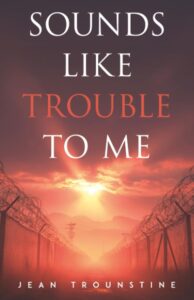 Sounds Like Trouble to Me sheds light on what happens when a corrections officer kills her abusive husband and suddenly finds herself on the other side of the law. Not only is she shocked with the systematic abuse against fellow female prisoners but confronted with the complicated history of her own abuse, she must struggle with her fragile memory to uncover what actually happened before she goes to trial. It is the women she meets that change her, and in the end, she spurs on a MeToo movement behind bars.
BUY HERE
Jean Trounstine is the author of eight books, an activist and educator, who has written extensively about the criminal legal system in America. She worked at Framingham Women’s Prison for a decade, where she directed eight plays for prisoners–resulting in her highly praised book, Shakespeare Behind Bars: The Power of Drama in a Women’s Prison. As a journalist, she writes on prison and parole for Boston Institute of Nonprofit Journalism, Truthout, Boston Magazine, and others. In 2018, she was invited to Italy and awarded the Gramsci International Award for Theatre in Prison for her 3o years of work in literature and theatre.
Her nonfiction book Boy With a Knife: A Story of Murder, Remorse, and a Prisoner’s Fight for Justice (IG, 2016) examines the moral and legal failures of sentencing juveniles to adult prisons. Following the successful release of Motherlove, her book of short stories in 2024 from Concord Free Press, Sounds Like Trouble to Me is her debut novel.
Connect with Jean:
Jean’s website: https://jeantrounstine.com/
Jean’s Bluesky: https://bsky.app/profile/
Category: On Writing
Subscribe
If you enjoyed this article, subscribe to receive more just like it.