How Family Connections Inspired My Writing by Imogen Matthews
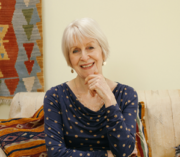
Photo by Sarah Halliday
The inspiration for my new novel The Girl with Two Names came in a roundabout way through the chance discovery of a cousin I never knew I had. Through Anita, I was able to gain an insight into my Dutch heritage and unearth wartime stories I might never have discovered, and which have made it onto the page in my historical fiction novels.
It was a perfect spring day in May 2020, when the world was in lockdown that I posted a piece on Facebook to coincide with the anniversary of the liberation of Holland from German occupation during World War Two. I wrote about my Dutch mother’s life as a young woman and her struggles to keep her family from starvation during the Hunger Winter of 1944-45. Her incredible accounts of life under the Germans have always left a deep impression on me and inspired me to write several novels based on wartime Holland.
As I was sitting outside in the sunshine, I idly checked to see if anyone had seen my post, when I noticed that one person had ‘liked’ it. No surprises there, until I realised that this person shared my mother’s maiden name. I was intrigued because my mother’s name was not a common one, so I clicked through onto their Facebook page and was astounded by what I saw.
Anita, who shared my mother’s name, had posted a long piece about her family history, going back several generations, with photographs and portraits. As I gazed at them, I realised that I knew every one of these images– because they were of my ancestors too! These were the exact same photographs that I possess in old family photo albums.
I hurriedly got in touch and tentatively wrote, ‘I think we’re related.’ Anita came straight back to tell me that we are indeed related and are second cousins. The people in the photos were our shared great-grandparents and included many other family members going back to the beginning of the twentieth century.
How could it be that I never knew I had a living relative? My mother had never mentioned that her cousin had daughters, and my sisters and I had never thought to ask. It was a mystery, but a delightful one, for I discovered that I had not one, but two cousins I never knew I had. Her cousin, Kitty, also shared the same great-grandparents as us. For me, the discovery was all the more special, because both my parents were only children, so I never had any aunts, uncles or first cousins.
Anita and I kept in touch by email, but every time we made plans to meet up in The Hague, where she lives, I was thwarted by another lockdown. It was frustrating, but when we did eventually meet in 2022 it felt as if we’d known each other for ever.
We just couldn’t stop talking. I was thrilled to find Anita as interested in our family history as I am and we spent hours at her computer filling in the gaps of our family tree.
The Oranjehotel, Scheveningen
One afternoon, she suggested we took the tram out to Scheveningen on the coast to the Oranjehotel, a World War Two museum that was once a German prison. It was one of those places that you would only know about if you lived in the area or had an interest in this period of history.
Much of the prison has been preserved in its original state and visitors can walk along the long corridors and peer through tiny windows in the orange-painted metal doors. You can even go inside one of the cells and get a sense of how small they were with the sparsest of furniture and possessions. More chillingly, are the marks and initials scratched by prisoners onto the brick walls denoting the days, weeks and months they were incarcerated.
My cousin and I spent time taking in the exhibition featuring information on life inside the hotel along with many personal stories taken from letters and diaries. Anita was excited as I was about each discovery.
One of these was an account of a young woman called Trix Terwindt, who was one of the Dutch airline KLM’s first air stewardesses. When the war broke out, she was made redundant and moved away to the country where she was recruited by the Dutch resistance to escort a British pilot across German occupied territory to Switzerland. Trix ended up in London, Piccadilly, where the Dutch government and royal family had fled into exile, and where she met a prominent member of the British government, who recruited her to work for MI9, the branch tasked with bringing back stranded British servicemen from mainland Europe.
Back at Anita’s apartment, we talked and talked and we both agreed that Trix’s story would be a great subject for one of my books. I needed more background research, but there was very little to go on online. Then I hit upon a Dutch book on the early air stewardesses for sale on a Dutch website, but I found it was out of print.
There was nothing more to be done, so I put the idea to one side and carried on writing my next novel, Only I Can Save Them, about a Jewish photographer whose photos and videos were discovered after the war, providing definitive proof of how the Germans were systematically sending Jewish people to the concentration camps. This next novel of mine was published by Bookouture in October 2025.
Months later, I received a parcel from Anita. She’d managed to get hold of a copy of Luchtmeisjes by Ingrid van der Chijs, the very book I’d been wanting to lay my hands on. It’s quite a tome and written in Dutch, but with my knowledge of the language and a great deal of patience, I extracted reams of valuable background information on Trix Terwindt, the people she met and what happened to her after she was parachuted back into Holland as a spy for the British government.
Every family has a story
It’s been said that every story starts with a single idea. Never has this been truer than with my latest novel, The Girl with Two Names. Had I not connected by chance with a cousin I had no idea I had and gone to spend a long weekend with her, I might never have heard about the amazing story of Trix, the Dutch air stewardess, who very few people knew about in Holland, let alone elsewhere.
And that is the beauty of storytelling. Being receptive and open to new ideas, whatever their source, but also mining one’s own family history.
I’m not done with mine yet. The more I delve into my past, the more snippets from my ancestors I discover. I can’t wait to find out which of these will influence my writing in the future.
Imogen Matthews is an Oxford-based, award-winning author and journalist with an interest in forgotten stories from WW2 Holland. Imogen was born in Rijswijk, Holland, to a Dutch mother and English father who moved the family to England when Imogen was very young. All her life, she listened to her mother’s stories about her life in Holland, in particular the hardships she faced during the Hunger Winter in 1944-5, which has had a profound impact on her writing.
https://www.
THE GIRL WITH TWO NAMES
 She smooths her light blue coat with trembling hands as a man approaches. ‘Felix?’ he says, and she nods. ‘We weren’t expecting a girl.’ He smiles, but panic grips her throat at what he says next. ‘Whoever you are, you’ve been betrayed…’
But when she’s ambushed and imprisoned by German soldiers posing as men from the Dutch resistance, Trix must lean on everything she’s learnt if she’s going to survive and grasp her chance at love. These soldiers see her as just a woman. But is that her greatest weapon? In war, often it’s those we underestimate the most who have the power to change everything…
Inspired by a remarkable true story, The Girl with Two Names is a totally heartbreaking and emotional World War Two novel of bravery, sacrifice and the power of hope in dark times. Perfect for fans of Heather Morris, Kristin Hannah and Fiona Valpy.
Category: On Writing
Subscribe
If you enjoyed this article, subscribe to receive more just like it.