Ephemeral Inspiration By Lya Badgley
 The ink shimmered, shifted—stirring awake like blood beneath skin.
For any creative, inspiration can feel like a half-remembered dream just out of reach: the more one tries to recall it, the more elusive it becomes. But when it finally takes shape, it feels like magic.
The inspiration for my latest novel, The Thirty-Fifth Page, began with a book, an ancient artifact, and a persistent question: what good is history if we keep repeating the mistakes of the past?
People of the Book by Geraldine Brooks is one of my favorite works of historical fiction. Centered on the medieval Sarajevo Haggadah, housed in the National Museum in Sarajevo, Bosnia, it illustrates how a single artifact can hold many stories. Each stain, repair, or doodle within its vellum pages reveals a mystery waiting to be uncovered. In her novel, I was drawn not only to the Haggadah itself, but to the space between what is recorded and what is imagined. That interplay between fact and story is where my own writing inspiration often begins. Seeing the manuscript in person during a rare private viewing several years ago made it feel tangible.
Through my Serbian husband, I have come to see the Balkans not as an abstraction defined by headlines, but as a place layered with beauty, contradiction, and resilience. It is often described as a crossroads between East and West, but that phrase has always felt too benign. It fails to convey the tension and the scars left by repeated collisions of empires, ideologies, religions, and identities that have shaped the region. The landscape carries a certain gravity—not only in its terrain, but in its stories. Family histories run like fault lines beneath the surface, and at times, the air itself feels charged with what has come before.
Generational trauma is often described as something inherited, passed down like eye color. But I began to wonder if it might also be embedded in the place itself. Could repeated violence imprint the land, the water, even the air people breathe each day? Does hate have to be passed down like a tarnished heirloom, or can its narrative be rewritten?
After telling my husband about Brooks’s novel, we discovered a striking coincidence: his father had worked for a Yugoslav publisher that produced a facsimile of the Haggadah in the 1970s. Intrigued, I spent months searching until we finally located a copy of the out-of-print book. Its illuminated artwork reminded me of the medieval-inspired fairy tales I loved as a child. I have always been drawn to folktales—they care less for realism than for deeper truths carried through symbol and transformation. A witch waits in the forest, a spirit lingers at the water’s edge, and objects hold traces of every hand that has held them.
With the help of art, historical research, and endless cups of thick Balkan coffee, I began to write my story. Writing The Thirty-Fifth Page allowed me to explore how a single object can hold multiple truths, and how a place can carry both beauty and violence without resolving the tension between them. Those who move through it must decide what to carry forward—and what to leave behind. In the end, the novel is less about uncovering a single hidden truth than about engaging with the persistence of history itself. History is not distant; it is a constant force, shaping the present in ways we may not fully understand.
Inspiration is not something I fully understand, nor something I can reliably summon. Like a half-remembered dream, it begins with an image, a question, or a wisp of a feeling that resists explanation. Only through the act of writing does it begin to take shape. There is no moment of complete clarity – only the gradual process of following what draws my attention and trusting where it leads. Meaning does not precede the work; it emerges from the act.
The Thirty-Fifth Page
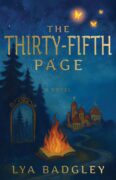 As Sarajevo teeters on the brink of war, American art conservator, Miri Adler, arrives to research the legendary Sarajevo Haggadah, a medieval manuscript that has withstood centuries of upheaval. Immersed in her work, Miri discovers strange patterns hidden in its pages—clues pointing to a truth that could unravel everything she knows. When a mysterious thirty-fifth page appears, she is drawn into a shadowed realm where history and folklore entwine, stirring long-dormant Balkan legends and a curse on the verge of reawakening.
Spanning two timelines—from a city on the precipice of conflict in 1992 to its fragile peace in 2015—The Thirty-Fifth Page unfolds as a luminous tale of inherited wounds, ancient magic, and the enduring stories that shape our identities.
Brimming with magical realism, this gothic-tinged literary suspense explores the legacy of a city caught between the scars of its past and the promise of a new beginning.
BUY HERE
—
Award-winning author of literary suspense exploring the shadows of the heart and the stories we inherit.
Lya Badgley writes internationally set fiction that blends suspense, history, and transformation. Born in Myanmar to Montana parents—a political scientist and an artist—she was raised in a home that prized both creativity and critical thought. Her unconventional path has carried her from Seattle’s music scene to covert film work with Burmese insurgents, and from archival preservation in Cambodia to entrepreneurship in Yangon.
Her debut, The Foreigner’s Confession (2022), was a finalist for the Nancy Pearl Award for Best Fiction. Her second, The Worth of a Ruby (2023), was a 2024 finalist for both the International Book Award and the National Indie Excellence Award. She lives outside Seattle and is excited to release her third novel, The Thirty-Fifth Page.
Category: On Writing
Subscribe
If you enjoyed this article, subscribe to receive more just like it.