My Journey Towards Writing “Leaving the Shore: Experiencing Poetry as Prayer” by Colette Lafia
One spring afternoon, I was browsing my inbox when an email from my agent popped on screen. The news was good. Monkfish Press had accepted my proposal for a collection of poetry that would include practices and prompts for deep reflection and prayer. At that point in time, I only had a handful of poems that were included in my proposal. Fortunately, the title poem, Leaving the Shore, was among them.
I wrote the poem, Leaving the Shore, after a spring night when I had been unable to sleep. Resting on the sofa in the quiet darkness, I felt a sense of Divine Presence gently pulsing within me, and I had an overwhelming urge to surrender to this Love. The reciprocity was palpable, but when dawn broke, a kind of fear gripped me.
As the weeks went on, working on iterations of the poem helped me to gain more trust in the spiritual experience I’d had. A poem can reveal what may be hidden, and each time I read and revised that poem, I could sense Divine Presence drawing me again, away from familiar shores and into the deeper waters of love. Leaving the Shore is a poem that has allowed me to return to and experience the call to surrender and be held by a Loving Presence, however we may choose to label it.
A Poetry Journey
Writing a book of poetry came as a surprise to me. Although I had studied poetry in college, I ended up focusing my writing efforts on nonfiction.
As a liberal arts student, I had studied creative writing at San Francisco State University and even worked at the Poetry Center there. I liked the experimental quality of language in poetry and playing with the way a poem looked on the page. But over time, I began to feel disillusioned. The poetry scene wasn’t feeding my inner world at all, and I couldn’t see how to make a living at it, anyway.
I eventually became an elementary school librarian. I met a colleague who introduced me to the teachings of the Vietnamese monk, Thich Nhat Hanh. I attended a few retreats with him and started to touch, to taste, my inner self. He always taught that whatever you’re looking for, you can most likely find it in your own tradition. His words opened the door for me to begin seeking meditation in my own Christian tradition.
I eventually discovered the teachings of James Finley, a spiritual writer and teacher, and discovered the contemplative and mystical lineage within Christianity. I could never have planned for the way it all unfolded.
After my book The Divine Heart: Seven Ways to Live in God’s Love was published, I felt myself drawn to poetry once more. I decided to enroll in an online spiritual poetry writing class. I was surprised to discover that with poetry, I felt a profound sense of following something that was also seeking me. It was similar to the experience I had in my spiritual journey. Poetry and contemplative prayer are, for me, interconnected, and it was in this spirit that the completed collection of Leaving the Shore was conceived and written.
Connecting Spirituality and Creativity
As a spiritual director and retreat leader, I felt drawn to structuring a collection of personal writing around the invitation for others to also engage and expand their own sense of spiritual connection.
As in several of my previous books, I felt drawn to amplifying how the everyday experiences of our daily lives can be gateways to spiritual connection and transformation.
As a result, I spent considerable time developing prompts for readers that are based on the Western monastic tradition of Lectio Divina (sacred reading). This slow, sacred way of reading creates a prayerful receptivity in us, making meaning through our participation. It is an invitation to sit with something long enough for a genuine and authentic response to arise, as well as an opportunity to meet our resistance, our struggles, and our places of pain.
I am truly grateful to see how the book is serving as a doorway for readers into their own spiritual experiences. I’ve had the honor and opportunity to conduct both in-person and online workshops where attendees get to interact with the poems and then create responses of their own, whether that results in a poem or simply a journal entry.
I believe that is the ultimate goal of art: to draw someone into an expansive and reflective state of mind that stirs spiritual growth.
—
Colette Lafia is an award-winning writer, retreat leader, and spiritual director living and working in the San Francisco Bay Area. She has spent decades guiding individuals into deeper contemplative practice through workshops, retreats, and one-on-one spiritual direction. A former school librarian and a regular presenter for Spiritual Directors International, she brings a rare blend of poetic sensibility, contemplative depth, and accessible warmth to her work. Her new book is Leaving the Shore: Experiencing Poetry as Prayer (Monkfish Book Publishing, 2025). Learn more at colettelafia.com.
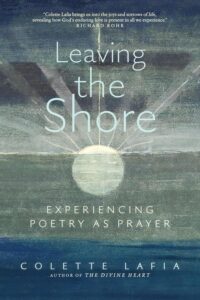 “Poetry is the voice of the soul, and in this beautiful collection, Colette Lafia brings us into the joys and sorrows of life, revealing how God’s enduring love is present in all we experience.” —Richard Rohr, author of The Tears of Things
Poems and related practices for a more contemplative life.
Leaving the Shore is a collection of poems with the intent of creating contemplative experiences for readers. The author has added guided Lectio Divina (sacred readings) and writing/journaling prompts, so that readers can pray and reflect with the poems.
Each poem is about some aspect of living the spiritual path: the desire to reach beyond what we know, the longing to step into the Divine Mystery, and the commitment to live in an intimate exchange of love with the Holy.
An experienced spiritual director, Lafia draws on her commitment to the contemplative life. These poems are an expression of contemplation in action as they explore the Holy in moments of daily living: within a marriage, while assisting a loved one dying, in the creative act of painting, and more. They are inspired by writings of the mystics, in particular Mechthild of Magdeburg and St. John of the Cross, and suffused with surrender, love, and awe. They invite the reader into prayer, self-reflection, and seeing their own lives as sacred texts.
BUY HERE
Category: Contemporary Women Writers
Subscribe
If you enjoyed this article, subscribe to receive more just like it.