AI Spams and Scams: Caveat Emptor by Jane Loeb Rubin

There is a particular, personal cruelty to scamming authors. Most of us have poured years of our lives — sometimes entire decades — into crafting stories, perfecting prose, and building the kind of literary reputation that might, just might, justify a seat at one of the country’s premier book festivals. We are not naive, but we are hopeful. And hope, it turns out, is exactly what the scammers are selling.
I know this because I was nearly taken. And if it can happen to me — after a year of watching these predators prowl the inboxes of writers everywhere — it can happen to you.
The pitch arrived polished and persuasive: an invitation to secure a table at the Nantucket Book Festival in June, one of the most coveted literary events on the East Coast calendar.
The email was warm, enthusiastic, and — most dangerously — flattering. My work was praised in specific, knowing terms. Whoever composed this message understood that writers, however seasoned, are never entirely immune to genuine admiration. We live for readers who get it. The scammers had done their homework, and they knew exactly which buttons to push.
But after a year of fielding these approaches — daily, sometimes hourly — my instincts had sharpened into something closer to radar. Something buzzed. Something was off.
So I decided to play detective.
The first clue was hiding in plain sight: a single letter. The email spelled “Nantucket” as “Nuntucket” — swapping the ‘a’ for a ‘u.’ A small thing. Easy to overlook, especially if you’re reading quickly, which is precisely how scammers want you to read. But I had spent the past two weeks in deep editing mode, and my eye was trained to catch exactly this kind of slip. It was a hairline fracture in an otherwise smooth facade, and I pressed on it.
I asked for references — authors who had previously participated, organizers, whom I could contact independently. The response came back in under thirty minutes: four polished paragraphs, apparently from a well-known, extraordinarily busy author. Now, I respect that author’s work enormously. But I do not believe, for a single moment, that any writer at that level of demand and visibility stops what they’re doing to compose a lengthy, effusive testimonial within half an hour of a stranger’s request. No one’s publicist works that fast. No one’s assistant does either.
That response had the unmistakable fingerprints of an AI content generator running at full clip.
My third test was simple: I asked for a phone call. A real one, with a real person, in real time. It never happened. Excuses materialized. Scheduling conflicts bloomed mysteriously. The phone call — the one thing that no chatbot can convincingly simulate — was the one thing they could not provide.
When I informed them that I intended to contact the actual Nantucket Book Festival organizers directly to verify the arrangement, the emails stopped. Completely.
The entire elaborate hoodwinking of flattery and urgency simply collapsed and vanished. Here’s the hitch: these scammers are sophisticated, iterative, and patient. Over the course of a dozen or more back-and-forth exchanges, these operators built a nest of correspondence — a paper trail dense enough to answer nearly any question, deflect nearly any skepticism, and maintain the illusion of legitimacy. They applied time pressure expertly, framing every decision as urgent, every hesitation as a missed opportunity.
And woven through all of it is the flattery — relentless, specific, targeted flattery that is almost impossible to resist because it speaks directly to the thing every author secretly fears: that their work might not be worth the sacrifice.
The cruelest part is the demographic they have chosen to
target.
Most authors I know operate with tight, carefully considered marketing budgets. We are not corporations with dedicated promotional departments and unlimited resources. We are individuals who have made a calculated bet on our own creative work, and we spend every marketing dollar with one eye always on return on investment.
A table at a prestigious literary festival is exactly the kind of opportunity that might justify a meaningful expenditure — meeting readers and well-known authors, connecting with booksellers, building the kind of word-of-mouth that no algorithm can manufacture. That is precisely why these scammers dangle such things. They know what we want. They know what we’ve worked for. And they exploit it without a flicker of conscience.
This is not only deceptive. It is predatory. It is, as I have come to think of it, stealing from the poor — targeting people who cannot easily absorb the loss, financial or psychological, of being deceived.
So what do we do? We slow down. We verify independently, never through the contact information provided in the original email. We ask for phone calls and insist on them. We check spellings — all of them. We remember that genuine festival organizers, legitimate publicists, and real literary professionals do not need to manufacture urgency or shower us with praise to make their case. The real opportunities speak for themselves.
And when we spot a scam, we talk about it — openly, publicly, loudly — so that the next writer who gets that email is already armed.
The scammers are counting on our silence. Let’s disappoint them.
—
A cancer diagnosis unveiling a genetic defect, together with a lifelong fascination with the history of medicine, propelled Jane Rubin to put pen to paper. In 2009, then a healthcare executive, Jane poured her energy into raising research dollars for ovarian cancer, the Ovarian Cancer Research Alliance (OCRA), while learning more about her familial roots. Her research led her to Mathilda (Tillie), her great-grandmother, who arrived in New York City in 1866 as a baby, lived on a Harlem farm, at sixteen, married a man twelve years her senior, and later died of “a woman’s disease.” Then, the trail ran cold. With limited facts, she was determined to give Tillie an exciting fictional life of her own. Jane was left imagining Tillie’s life, her fight with terminal disease, and the circumstances surrounding her death.
Her research into New York City’s history, restrictive reproductive laws, and period medicine led to her award-winning historical trilogy. Across the series, engaging characters face shifting roles of midwives, pregnancy risks, the infamous Blackwell’s Workhouse, and the challenge of achieving financial security. The timeline opens with In the Hands of Women (5/23 Level Best Books) and its prequel, Threadbare (5/24 Level Best Books), both acclaimed by historical fiction fans. Over There (6/25 Level Best Books), the third installment, moves to 1917 as medically trained members of the Isaacson family travel to France during World War I. It was Shortlisted by the Historical Novel Society’s 2024 First Chapters Competition and is a Finalist for the Chanticleer Hemingway Award for Twentieth Century Wartime Fiction.
Mayhem in the Mountains (6/26 Level Best Books), the fourth book in the series, follows the survivors to the Catskills in the summer of 1924, when bootleggers, gangsters, and the KKK disrupt the peaceful ambiance of the region.
Jane’s other publications include an essay memoir, Almost a Princess, My Life as a Two-Time Cancer Survivor (2009 Next Generation – Finalist), and multiple magazine articles. She writes a monthly blog, Musings, reflecting on her post-healthcare career experiences and writing journey.
Ms. Rubin, a University of Michigan (BS, MS) and Washington University (MBA) graduate, retired after 30 years as a healthcare executive to write full-time. She lives in Northern New Jersey with her husband, David, an attorney. Together, they have five adult children and seven grandchildren.
Find out more about Jane on her website https://www.janeloebrubin.com/
Mayhem in the Mountains: A Gilded City Series
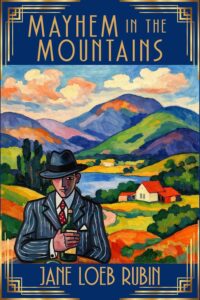 1924 in the Catskills sizzled with chaos. The region’s turbulent history during that era could easily have erased any trace of the Borscht Belt’s grand hotels. Prohibition fueled bootleggers and whiskey stills—Dutch Schultz ran an underground distillery in nearby Ulster County. Meanwhile, the Ku Klux Klan stormed north after WWI, targeting new immigrants they viewed as threats to the American way of life. Amid the turmoil, the Isaacson family stood their ground, fiercely defending their land, livelihoods, and each other.
BUY HERE
Category: Contemporary Women Writers
Subscribe
If you enjoyed this article, subscribe to receive more just like it.