On Writing My Three Fathers, A Memoir: A Window That Turned Out To Be a Door
My Three Fathers, in some ways started as a love letter to my father Juan—the opening section is implicitly addressed to him. And it’s a letter of reckoning: this is what you missed and yet helped create by your absence. But also, here, I have made this for you.
By the time I met my biological father, he had become like a mythological character in my mind. I visited him where he lived on an old wooden yacht, Isabella, harbored in Ballard, Washington on Lake Union. We met there many times over what would be the last ten years of his life. Under the guise of understanding him through understanding his experience emigrating from Cuba as an unaccompanied minor during the Cold War, I read books about Operation Pedro Pan—the Cuban Children’s Program and anti-Castro operation between the CIA and Catholic Diocese in Miami; I interviewed him on camera and via audio and written recordings.
Eventually, I came to know him better and understand his attachment wounds and extenuating limitations, which not surprisingly, mirrored my own. Eventually, I began to dismantle the mythologies of him, and of myself, and to weave a new narrative.
In Seattle at the Kiss café, not far from the marina where he lived with Mambo the dog, Juan asked me what my thesis was about. I was overwhelmed by the sounds closing in around us: thumps of glasses set down, tink of silverware, rumbles of conversation and piercing laughter.
Two attractive women passed, smiling at Juan and leaning down to pet Mambo, a caramel-colored Brittany Spaniel who Juan was closer to than any of his children. I wondered if it were obvious we were father and daughter. I looked more like him, and so much like his mother, than his other children, who I’d only seen pictures of so far—they looked more like their white mothers. I blushed, embarrassed to tell him: It’s about you. It’s about us. It’s about getting to know you through understanding your experience.
When I told Juan what I was writing about, he smiled and said, Write your truth. Don’t worry about what anyone else thinks. And I hope to read it one day. He still had a Cuban accent though he had lived in the States most of his life.
I met his other grown children for the first time at Tampa airport while they searched for his lost luggage, which contained cancer treatment meds and his mother’s ashes that he planned to repatriate in the Lorente family tomb. We were on our way to his Motherland—his first time back since leaving as a boy.
In Cuba, I began to love him whilst reconciling the impending loss of him, knowing he was sick. To know him and to risk losing all we had built—some resounding echo of a relationship that never was but still could be—was an impulse I could not ignore. In a town circle in the center of Remedios, he apologized for not asking why I was living with my grandparents when I was fourteen, which was also when he and I met for the first time. We didn’t see each other for another twenty years after that. You were young, he said. I was just a fool.
I was embarrassed to realize he had found an audio recording on the internet of an essay I had written about that first time we had met when I was fourteen. What would happen when I put this book into the world, but more importantly, what would happen when my family read it?
Juan, but also my Iranian stepfather, Hamid, who despite our early hardships, I’ve grown close with.
My mother, a poet, has long been a cheerleader of my writing, and still I was afraid to hurt her. She’s witnessed me writing since I was a child when I wrote a book about a girl who had something stolen (her beloved bicycle) and about her attempt to recover it.
At that time, my mother was married to Kurt, the first father I knew, who had adopted me by signing his name on the blank space next to Father_____ on my birth certificate. The book was bound and awarded at the Young Authors Fair. I was in second grade and didn’t yet know about metaphors.
To whom to be loyal—the calling, the art, or family? There was this calling I couldn’t ignore but this question I grappled with (like any memoir writer). A need to make meaning of the fragments of my life and my fraught relationship with Father. But we cannot hedge our bets here.
Juan never got to read this book, and this is one of my biggest regrets, that I was too afraid. That sharing it with him felt too vulnerable, at the time. This was a missed opportunity for us to come closer to the truth of one another. I thought we had more time. If the only thing we can regret when we lose someone (from this plane), is that we didn’t have even more time, this is a good thing. But regretting not showing someone who we are, not taking the beautiful and inherent risk to be closer than we were, that is something to reckon with.
This calling, this pull to risk all to be known. The call to obliterate my life, to risk exile. It’s self-destructive, but it’s also birth. The birth, death and rebirth cycle.
—
Jamie Leigh Lorente is a Cuban-American writer, veteran, and advocate. She writes to reclaim the body and reframe the narrative of survival. Her work appears in My Teeth Don’t Chew on Shrapnel, the Anthology of Veterans Writing, Afterwords: The Real Me, and Poetic Prosthesis: Trauma and Language in Contemporary Veterans’ Writing (Edinburgh University Press, 2022). She teaches writing at San Francisco Film School and facilitates veteran writing workshops in Portland. Her short documentary, My Body Is explores the healing power of poetry.
MY THREE FATHERS: A MEMOIR
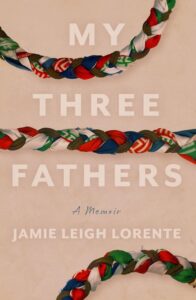 A memoir of reckoning, forgiveness, and the fragile work of choosing what to carry forward.
My Three Fathers follows a ten-year journey of discovery as Jamie questions her choices in life and in men. She patches together the origins of those choices through reconnecting with her three fathers: her biological father, a Cuban exile, her Cherokee-Jewish stepfather, and later, her Iranian stepfather.
The story starts in girlhood and interweaves with her early marriage years—and the question of what led her to marry so young and to the wrong man. When she begins to get to know her biological father, a Cuban exile living on an old wooden yacht, she grapples with understanding her own identity in relationship to men, and ultimately, apart from men.
As she dismantles the mythologies she has held and carried most her life about her father, herself, and her relationship to and with men, she recognizes patterns she has recreated in her life, including a sense of loss and abandonment for her sons, even though all she ever wanted was to create a sense of stability for them that she never had. As she reconciles with each father, she learns eventually to open up, to soften her heart, and to advocate for herself.
BUY HERE
Category: On Writing
Subscribe
If you enjoyed this article, subscribe to receive more just like it.