Writing Authentic Female Characters Across Three Generations
A teacher told me at a young age that I had empathy. Empathy—the ability to understand and share the feelings of another. That holds a lot of weight for a young person, that a person of authority recognizes something inherent in them. I had never thought about it before, but I found it true. Whenever someone did something—good or bad—I always thought about why they acted this way, what was going on for them? I was proud that an adult recognized this in me. I think I’ve based my life on this idea.
I tried to teach my three girls as they grew that it was important to consider other people’s views and that it was important for them to try to understand the people around them. Those people would always have their “stuff,” but what was important was who my kids were as people; how they dealt with other people’s drama mattered. Soon, my girls were in high school and college, and as a stay-at-home mom, I found myself with some time on my hands. I got it into my head that writing a book and sharing my ideas was a good idea.
I thought about how I could show my daughters how to be decent and how to understand that other people were going through things in their lives to make them act a certain way by putting myself in other people’s shoes. Also, it occurred to me that there were similarities in circumstances between women of all ages.
How important for my girls to know that they would grow and become another version of themselves. The best way I felt to do this was to write from the perspectives of various ages of women. I started by writing about a character, about ten years younger than myself. It was the most similar age to mine. I had been this age, I knew her and what she had accomplished at that time. But my story wasn’t only about her. I had been a teenager and knew what that was like. I had been this girl, too! So I started writing a story about her. But what about an older woman—someone I haven’t been yet? I based this character on my own grandmother.
I think it all goes back to empathy. What did these people feel?
For my main character, Mona, the woman in her late 30s, I felt what her day would be like and how she would go through it. But I wanted to keep with the idea that she still didn’t have it all together. It was a way to show my girls that she was still learning and growing. She becomes very insecure about herself, yet by the end, figures that only she can make herself into the person she wants to be. A valuable lesson.
For Grace, I’ve been a teenager like her, and she was at a period in her life most resembling my daughters. While Grace doesn’t have the experiences that my kids had, I wanted to show that not everyone had it easy. I remember being a teenager and feeling left out (without the stress of social media, seeing everything that I was missing). I remember what it was like to be in high school, and it was not always comfortable or fun.
For Esther, the woman in her 80s, I don’t have experience with that age yet, so I could only imagine. I thought about my grandmother. I remember how she would tell me about the woman who lived down the hall from her and the drama with her. I thought that even as we age, we are still the same inside—fighting to belong.
I paid attention to older people everywhere, and I aged, as well. I’m in my 50s now, but still feel the way I did in my 30s—inside, I feel that we are the same people we’ve always been. The character of Esther is based on someone who has been a teenager and through middle age. She’s had experiences and learned from her actions throughout her life, yet still was messing up and learning from her mistakes.
If we’re fortunate enough to grow old, isn’t it true that we’re all these versions of ourselves in one lifetime? The teenager, the middle-aged person, the older person. As we grow, we continue to evolve and hopefully learn, yet there are always mistakes to be made. I tried to make my characters be real people, based on my own feelings and imagination. Hopefully, these people are familiar, so that the reader (and my girls) can imagine being in their shoes. It all goes back to empathy. Being able to understand the feelings of another.
—
Gerilyn Bass Greenberg graduated Magna Cum Laude with Highest Distinction from the University of Illinois, but nothing could have prepared her for the rewards and challenges of being a stay-at-home mom. She and her husband raised three daughters, now grown. When she’s not traveling or playing racket sports, Gerilyn is chasing after Sammy, her spirited Wheaten Terrier, and dreaming up new stories. She lives in suburban Chicago with her husband.
—
DRAMA DRAMA DRAMA
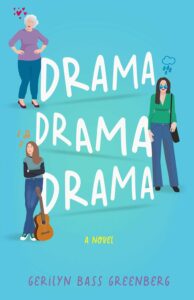 For fans of Marianne Cronin and Clare Pooley, a warm, witty, page-turning tale of belonging, identity, and girl drama at every age centered on three generations of suburban Chicago women.
Mona is living the dream . . . until, at thirty-eight, her busy stay-at-home-mom life is upended. Her grandmother moves into assisted living, her teenager, Grace, doesn’t need her anymore, her charity work kicks her to the curb, and none of her friends are showing up for her.
Suddenly, Mona has no purpose—unless you count stress-eating. But she’s the only one struggling. Shy Grace—ignoring her mother’s dreams for her to join the “it kids” in drama club—is off finding her voice (and a new band) at Bubby’s retirement home and making friends. Even Bubby’s too busy fending off resident mean girls and finding romance to pay Mona much mind. Then, on top of it all, Mona’s twenty-year high school reunion goes viral for all the wrong reasons, leaving her convinced she’s wasted her life. But when tragedy strikes, she is forced to face the truth: The only person who can make you feel small is you—and sometimes you have to lose everything you thought defined you to find what truly matters.
Heartfelt, funny, and refreshingly honest, Drama Drama Drama is a celebration of second acts, self-worth, and learning to skip the drama and live your own life.
BUY HERE
Category: How To and Tips
Subscribe
If you enjoyed this article, subscribe to receive more just like it.