The Inspiration for The Camp Muralist by Jacqueline Sheehan
Author’s Note
 The woods in the Connecticut town where I grew up were filled with treasures and it was our childhood our mission to uncover them. A secret path through woods near my house led to an abandoned cemetery from the 19th Century filled with headstones melting into the ground.
We squinted at the barely legible names and dates and saw that entire families had died in the 1800s including babies and children, and yet another headstone marked the grave of a man who lived through his 80s. Stone walls outlined old pastures that had given way to woodland thick with maples.
If we dipped into the woods closer to the valley where the Housatonic River ran on its way to Long Island Sound, we could find arrowheads left by the Pootatuck people who had thrived on the abundant lands prior to the arrival of Europeans.
Still, my friends and I lamented that nothing ever happened in our small town. Surely nothing important. I moved away from Southbury, first to college in Colorado, later for decades in Oregon, New Mexico, and northern California. I returned home as often as I could to visit my family, and it was on one of these visits in early 2000 when my sister mentioned that there was going to be a lecture at the local library about some sort of camp that existed in town prior to WWII.
“Where was the camp?” I asked.
“About two miles from here.” She described the section of woodland that we had frequently explored as children.
“What kind of camp?”
“Something called a German Bund Camp. But they were run out of town because they were Nazi supporters.”
You could not have shocked me more. I attended the lecture and listened with amazement as I learned that not only had a camp with Nazi sentiments tried to settle in what was then our small farming town, but similar camps had popped up, mainly along the eastern seaboard. Somehow our little town had been chosen with the goal of promoting the ideals of Adolf Hitler.
What was even more startling was that the history had faded away after WWII, the way that history can, turning to dust. I had grown up in Southbury, attended twelve years of public school and never once heard of the Third Reich in our backyard.
This was the perfect fodder for a novelist’s imagination to spiral out. I read everything I could about the German Bund camps, the links to Nazi Germany, the goals for an Aryan race in America, the sorting out of Jews and Negroes, all of which happened before WWII and before anyone could have dreamt of Hitler’s Final Solution. It was far more than “sorting out”; it was extermination.
Historical fiction gives us an imagined front row seat to events in the past. We are there, parachuted in like time travelers, engrossed in the daily emotions and passions of the characters. For many readers, like me, it is the exact doorway into history that we need to then learn the documented history.
In The Camp Muralist, I fictionalized the town and the characters, with the exception of Fritz Kuhn, the Bundesfuher of the German Bund in America, who was quite real.
I began to wonder, what if? What if a young woman, politically naïve, came toe-to-toe with a commander of the German Bund Camp in a town called South Falls? A woman who was stretched thin by the Depression, looking for a new start. What if he offered her a job? What if things got a lot worse?
I had a bit of family lore to inspire me when I created Emily, the young woman who tangled with the camp commander. My family has owned property near the actual German Bund Camp for over 100 years. It was summer cottage until the second half of the 20th Century, without running water or electricity. Long before I was born, my parents had a spat about where they should live; either with my maternal grandmother in New Haven, or in their own rental. My mother drew a line in the sand and told my father that she was moving to the isolated cottage until he found a house. Which is where she lived for a year, including riding out the 1938 hurricane. Her resolve gave me insights into a daring young woman. Yes, she also happened to be a nurse, yes she painted, but no, she would never have ridden a motorcycle or modeled nude. The knowledge about nude models was all me, something I did when I was an art student in Colorado.
Aside from fictionalizing a historical event, documented details needed to be shuffled around to braid with the plot. For example, two major events took place: the expulsion of the German Bund Camp in 1937 and the cataclysmic hurricane of 1938. I had to choose one or the other and continually remind myself that this was fiction. The hurricane won out. I suspect I will be hearing from historians on that point.
—
THE CAMP MURALIST
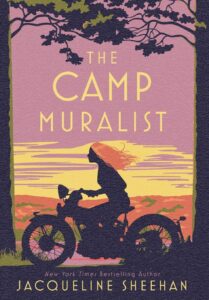 Two women are separated by fifty years and one dark American secret.
In 1938, aspiring artist Emma Lundgren is hired to paint a mural at a German American youth camp bordering her rural Connecticut home. Seeking a chance to practice her craft, she soon befriends a mistreated young boy inside who doesn’t seem to fit the “ideals” the camp demands. With every stroke of her brush, Emma uncovers a chilling devotion to the Third Reich, risking everything to bring attention to the Nazi agenda rooting itself in American soil.
More than half a century later, celebrated chef Lily Milan is picking up the pieces of her fractured life when a shocking revelation threatens to upend everything she knows: Her entire identity is a lie, built on a mysterious adoption. Her quest for answers leads her to Emma-the grandmother who has spent decades searching for her.
As past and present collide, Lily becomes the key to unearthing a sinister history. Together, they face the enduring echoes of fanaticism, proving that even the longest shadows of trauma can be shattered by the resilient power of love.
BUY HERE
Category: On Writing
Subscribe
If you enjoyed this article, subscribe to receive more just like it.