Seeds & Roots of A Hidden Fate By Carol Efron
The seed of my novel arrived unbidden, wafted toward me in a dream ten years ago, carrying with it a compulsion to help it grow into a tree. I hadn’t gone looking for a writing project; the story somehow had found its way to me.
Now that my tree is waving its branches, asking for attention—A Hidden Fate is published by She Writes Press on October 27—I’ve realized the soil enabling its growth was being enriched long before I picked up my pen.
Switching metaphors, various streams fed the river of the novel. The first came from my work as a psychiatrist at Johns Hopkins Hospital in the mid-1980s. I was the clinical director of the Huntington’s disease clinic right when presymptomatic testing for this fatal illness first became available. I witnessed people struggling with whether they wanted to know their future. If they chose to uncover what could be devastating news, there was nothing available to delay the onset or lessen the destructiveness of the disease. The dilemma was daunting: once you knew your fate it could never be unknown. I sat with patients as they weighed their choice, and I wondered what I would do in their shoes. That question never left me.
Other rivulets fed in. Decades later, when I treated people who sank into major depression after using 23andMe and learned, without any counseling, that they carried a gene that doubles the risk for Alzheimer’s disease. An email arrives with a result you can click on, maybe when you are running from one task to another. But one click can upend your life. I haven’t chosen to test for the Apo E4 gene myself, but I think about it as I age.
My story sprung from imagining a young woman who learns that her father has lied to her about an illness that killed her mother, lying to keep her from being crippled with fear about her own chance of inheriting the genetic disease. As a young adult Julia is still struggling with grief at losing her mother. She longs for a child to recreate what she had with her beloved mother from the other side of a relationship. I knew Julia would have to choose whether she wants to face what is hidden in her DNA, but I didn’t know what she would decide. I wanted to set the story in 1986, and that Julia would in Baltimore with some interaction with the Hopkins clinic – because I knew those setting well, but also for some other more complex reasons.
My own story of struggling to overcome my grief about losing my mother to lupus when I was fourteen was another rivulet feeding into the novel. Mom was a groundbreaking physician; watching that awful disease attack her brilliant mind along with many of her organs was horrifying. For years I wanted to stay far, far away from hospitals—and yet, I worked through my grief enough to come to some peace and become a doctor myself. In my novel, I write about some of the essence of that journey, in a transmuted form. Julia is me and she is not me at the same time.
More fuel for the novel: as a psychiatrist, I helped many people overcome traumas of different kinds—“Big T” traumas, like those of the war veterans I worked with at the VA, or the loss of a child; and “little t” traumas, like childhood bullying or unrelenting panic attacks, which are not in fact minor at all.
A Hidden Fate is at its core an unusual love story—not of girl meets boy but of what happens to passionate love when people unexpectedly face huge medical threats and don’t agree on what paths to take. I collaborated with dozens of couples’ therapists while in private practice and did direct couples counseling in acute situations. What I saw about couple’s conflicts, about what exacerbated the hurts, and about what worked in healing their rifts also found its way into my novel.
I became a writer later in life, and luckily I could draw from my lifelong exposure to great literature. As a child, I read under the covers late into the night with a flashlight, so I could finish engaging stories. Fifteen years ago, when our youngest child left for college, I started a moms’ book club where we talk about great fiction every month. The work of writers I love, like Barbara Kingsolver, Claire Keegan, George Eliot, and Tolstoy—I could go on and on—changed me as a person and again, later, enriched me as a writer.
Once my story found me, I took writing courses, went to conferences, and read constantly. It was a strange apprenticeship. As a doctor I was used to being an expert; suddenly I was a novice, learning structure, scene, dialogue and so much else. I was humbled, but it’s brought great joy and invited amazing people into my life.
What Julia finally decided is hers to tell. What I would have chosen, sitting in that clinic at Johns Hopkins, I still don’t know. The question has kept me company for decades. The novel is the closest I’ve come to living inside it. I hope my novel will let others live inside these questions too; with advances in genetic testing, the questions are intruding into most of our lives, or will soon.
—
Carol Efron is a writer and a physician. Her novel, A Hidden Fate, published in October 2026 by She Writes Press.
Efron was the clinical director of the Huntington’s clinic at Johns Hopkins when genetic testing for this fatal genetic disease was first offered in the United States. Not everybody at risk for incurable illnesses wants to know their fate.
Efron’s novel stems from her experiences at Hopkins in the late 1980’s, and from decades of practicing psychiatry in the SFO Bay Area. Carol enjoys hiking, cloud watching, and gardening. She and her husband live in Silicon Valley with their feral cat, near their two grown children and three young granddaughters.
A Hidden Fate
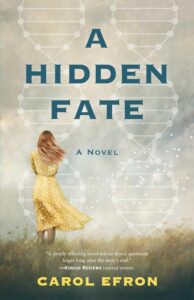 A poignant novel of love under fire about a woman who must find the courage to face an uncertain future—and an impossible choice.
Baltimore, 1986. Julia and Matt are newlyweds, in love and eager to begin graduate school. Julia longs to leave behind haunting memories of her mother’s devastating decline in Maryland, but she unexpectedly learns the truth her father has hidden: Her mother died of a fatal genetic illness. Julia now faces a 50 percent chance of inheriting the same fate, and every child she longs to have will carry the same risk.
When an unplanned pregnancy rocks their careful plans, Julia and Matt face agonizing uncertainty and impossible choices. Desires and convictions pull them toward starkly different paths, each possibly leading to misery.
As the couple struggles to protect the fragile, fierce love that first bound them together, they face the cost of secrets and the ache of betrayal—but they also discover the hope of forgiveness.
BUY HERE
Category: On Writing
Subscribe
If you enjoyed this article, subscribe to receive more just like it.