The Monster Is the Memory by Cynthia Pelayo
 Every culture maintains two accounts of history, one that is written, archived, and taught in schools. The other history is heavy with pain, and rarely appears in full. These are events that have been erased but not fully forgotten. History can be hidden away, but sometimes when it emerges it does so wearing a monster’s face.
I believe fairy tales hold snippets of true crime events. I also believe folklore, legend, and myth aren’t just stories meant to frighten. Fairy tales hold a thread of truth of what really happened.
What this tells us is sometimes we have to go searching for the real story. And sometimes when we look closely what appears are monsters tucked in memory.
I grew up hearing stories about La Llorona, the weeping woman who was damned to wander eternity in search of her children she had drowned. When I first heard this story, I didn’t know whether to be frightened or heartbroken. The very nature of her curse; wandering in search for them, shows she did care for her children, at one point. And so, what I always wondered: ‘What really happened that caused a mother to drown her children?’
La Llorona is often believed to be an indigenous woman and the father of her children a Spaniard who would go on to abandon her. It was this abandonment that became her and her children’s death sentence. Today society is beginning to understand postpartum depression, postpartum psychosis, and the effects of abusive relationships. Additionally, we are also beginning to understand the history of abuse and exploitation women throughout the Americas suffered at the hands of colonizers.
Today I interpret La Llorona’s story as one about a woman’s pain and grief. A grief that ran so deep it poured into legend. And this legend contains layers of caution. The legend of La Llorona can be interpreted for its gendered violence, seduction as predation, abuse of indigenous and poor women. This legend also allows us to consider how unhealed maternal wounds can harm future generations.
We can also look at El Cucuy, the Latin American boogeyman who is said to live inside closets or beneath beds. El Cucuy has been invoked in millions of households at bedtime: ‘Go to sleep or El Cucuy will take you,’ many a mother has said. We can dismiss this as a tactic. Yes, a terrifying one, that encourages little ones to fall asleep. However, it’s also a warning to children to not get up and wander.
A culture does not sustain a child-taking monster for centuries unless … children are actually taken, but the cruel reality is that children have been taken. El Cucuy can be interpreted as a folkloric residue of disappearances due to conquest and slavery. So, when abuela says ‘Careful, the Cucuy can take you away,’ she is not talking about a mythical monster. She is instead translating the real monster (man) into a form a child can understand. Because to speak the real truth to a little one may just be too horrific for their ears.
When I edited Something Followed Us Home, I read the work of Latin American authors who proved just how far these warnings have gone. The collection includes zombies and vampires, creatures that deceive and lure, and ghosts from the past begging the living to remember. Ghosts and monsters are records, and the collection highlights this.
Throughout Latin America we have stories of trolls and werewolves and demons and more. However, I don’t believe any of the tales I’ve been told are random inventions. Each of them has something useful tucked within its words, and what I’ve found of use is the warning.
I was told a story about how gold coins could be seen glimmering in the water along the shore in a small town in Mexico. Yet, locals knew never to reach down for that money. They believed if they did, a mermaid would appear, dragging the person to their watery death. A warning about real mermaids? Or, a warning about the dangers of drowning? Perhaps both. It’s because of stories like these that I resist the idea that supernatural tales are frivolous. Every ghost story that has been passed down can hold truth. This is why I tend to look at official history with a critical eye, always asking myself: ‘Who is telling us this story? Who is being forgotten?’
The Brothers Grimm, who collected hundreds of fairy tales from women, knew these stories could hold truth. In many of those stories we are told how women should take caution. Be careful when walking alone at night. Be careful of envious eyes. And more. And many of these tales were spun into stories recited around tables, or when tucking little ones to bed. Women have maintained these records throughout history because for so long their accounts were dismissed. So they had to warn one another someway and they did it with stories.
Today, when women writers adapt the story of La Llorona, they consider the full record, the cruelty and abuse she suffered. And today, women are writing their own accounts in fiction and non-fiction. These narratives weave fear, rage and truth into their sentences, because for so long the record was maintained by others.
So when someone asks why the monster endures, perhaps it’s because they haven’t yet been defeated. For so long women’s stories about abuse and harm have been muffled and silenced. But I hope not anymore. Women have taken to writing histories, telling stories, and shining a light on monsters that we hope one day can be defeated.
Until then, we will continue to tell our stories and we will refuse to forget.
—
Cynthia Pelayo is the USA Today Bestselling, Bram Stoker Award–winning author of Forgotten Sisters, Children of Chicago, and The Shoemaker’s Magician. In addition to writing genre-blending novels that incorporate fairy-tale, mystery, detective, crime, and horror elements, Pelayo has written numerous short stories, including the collection Lotería, and the poetry collection Crime Scene. The recipient of the 2021 International Latino Book Award, she holds a master of fine arts in writing from the School of the Art Institute of Chicago. She lives in Chicago with her family. For more information, visit www.cinapelayo.com.
SOMETHING FOLLOWED US HOME
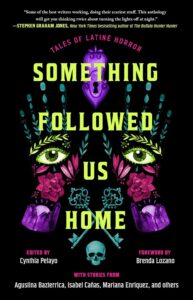 An instant USA TODAY bestseller! • A Barnes & Noble Best Horror Book of 2026 • 2026 International Latino Book Awards Gold Medal Winner for Best Collection of Short Stories—English
“Insightful, humane, and original, Something Followed Us Home features the most exciting voices in dark fiction today and is a must read for any weird/lit/horror fan.” —Paul Tremblay, New York Times bestselling author of Horror Movie and A Head Full of Ghosts
Dive into the chilling depths of Latiné horror with this groundbreaking anthology, edited by Bram Stoker Award winner Cynthia Pelayo, where each story reimagines immigration, colonization, faith, and folklore as the fears we inherit and carry across borders and generations.
Something followed us home. It crawled in with our prayers, slipped into our beds, watched from mirrors, waited in water, and learned our names.
Gathering chilling work from some of today’s most acclaimed Latiné voices, this horror anthology moves through haunted households, brutal landscapes, sacred spaces turned dangerous, and bodies claimed by forces both ancient and intimate. The dead murmur behind locked doors. Bones rebuild themselves under merciless suns. Love becomes a doorway for demonic hunger. Blood, devotion, and memory intertwine as the past presses back with teeth.
Something Followed Us Home is an unnerving, visceral, and impossible-to-shake collection that proves that what is carried forward does not remain quiet, and what follows us rarely leaves without taking something in return.
Featuring stories by: Agustina Bazterrica, Isabel Cañas, Gerardo Sámano Córdova, Zoraida Córdova, Ann Dávila Cardinal, Mariana Enriquez, Carolina Flórez-Cerchiaro, Xochitl Gonzalez, Leopoldo Goût, Ananda Lima, Juan Martinez, Mónica Ojeda, Daniel José Older, Cynthia Pelayo, Lilliam Rivera, Diana Rodriguez Wallach, Alex Segura
Category: Contemporary Women Writers, On Writing
Subscribe
If you enjoyed this article, subscribe to receive more just like it.