On Writing A Memoir in Essays by Karen Paul
Early in the year that my husband was dying from glioblastoma, a friend came to stay with us to give me some relief from round-the-clock caregiving. I took the gift of one of the days and made my way to The Torpedo Factory, an artists’ collective in Alexandria, Virginia. When my mother used to visit us early in our married days, we liked making a day trip there, strolling through the galleries and having a nice lunch by the water.
That day, alone, I passed a jeweler’s window and spied a beautiful ring, thick and round, with several twinkling gemstone chips embedded in its hammered silver. I tried it on and without thinking about the price, bought it for myself. As I wore the ring home, it felt like it was radiating through my fingertip into my memory bank. It channeled my mother, dead for over 10 years by then, and I felt her comforting me as I struggled through Jonathan’s illness. I had often thought it was better that she wasn’t alive to see us all suffering. But that day, I needed her desperately.
Later, I took the ring off as I kneaded the Friday night challah for dinner, deep in thought about what needed to be done to take care of both my husband and our children. When I wrote about that day, I described that moment as kneading, needing, kneading, needing.
I wrote throughout Jonathan’s illness, his death, and my early years of widowhood. The blogs were my way both of communicating our situation to our community as well figuring out for myself what I was feeling. As Joan Didion once wisely noted, “I write to find out what I’m thinking” and the writing did, indeed, help me parse my circumstances in real time.
About a year after Jonathan died I began to turn the blogs into a memoir. It started as the story of his illness, death and what had happened to me in its wake. Over many months I wrote and rewrote, playing around with chapters, fragments, timeline, structure. By the time 25 pages of that memoir was submitted as my application to an MFA program in writing, I had written the book four times. Once in school I recognized that, in fact, writing a linear memoir was not playing to my strengths. And that the story I needed to tell was my own. My late husband, a journalist, had not lived to tell his own story, but I now knew that I wasn’t going to tell it for him. I had to wade through my own narrative waters.
Throughout my two years in the program, I worked to improve and strengthen my essays. My blogs were strong and well written, but essays require an even deeper plunge into both subject matter and form. I had always understood that I needed to tell the stories I knew and had lived, and now I worked hard to bring them to life through a series of braided, longform essays.
It took several more years to compile the essays into a framework that told the story of my early widowhood. I knew that the intimidating process of finding a publisher for the book itself was the next step. Early in my search, a friend who is a lauded author told me that no one would publish a book of essays, no matter how well written, from an unknown writer. I was shattered. It took me several days to recover and remind myself that I needed to continue believe in my writing and trust what I did best.
I also knew that I wouldn’t self-publish – I wanted the validation of a publisher believing in me. I spent a year querying and submitting to independent and university presses with no bites. Then a writing friend suggested I try She Writes Press, a hybrid press that focuses on bringing women’s voices into the literary world. I submitted my application and was yellow-lighted, meaning that after some developmental editing they would be willing to look at it again. The general feedback was that it was too hard and sad. As grief memoirs often are, I thought, with slight irritation, as I searched for an editor.
My editor reviewed the book and quickly decided that what it needed wasn’t more editing but an advocate. She went directly to the publisher of SWP and encouraged her to take another look. The publisher agreed to look at new pages, and soon after she read them, I had a contract. I feel very lucky to have found someone willing to go to bat for me.
Today I am waiting for the launch of my first book, Cartography of Loss: A Widowhood in Essays, to be published by She Writes Press at the beginning of December. It is the dream of my writing life being realized. And while the loss and grief that gave birth to the book is something I’d prefer to never have experienced, I am grateful that by writing it, I figured out what I was thinking.
I wish that my mother was here to see it. But I still wear the ring with the twinkling gemstone chips, and when I am spending quiet time with it on my finger, channeling her, sometimes kneading and sometimes needing, I know she knows.
—
Karen Paul is the author of Cartography of Loss: A Widowhood in Essays, focused on the caregiving, loss, and grief around her husband’s terminal illness, publishing December 2026 by She Writes Press. Over a 25+ year writing career, she has had essays and short stories appear in numerous outlets, including the New York Times Modern Love column, Washington Post, Lilith Magazine, Boston Globe, Pangyrus, San Antonio Review, Modern Loss, Motherwell, Red Wheelbarrow, Open Secrets, and Grace and Gravity, the anthology series highlighting the works of women writers in the DC region. Karen graduated with an MFA in creative nonfiction from Vermont College of Fine Arts and runs a consulting practice that works with nonprofit organizations to improve their fundraising.
https://substack.com/@karendpaul
https://www.facebook.com/karen.paulstern
https://www.instagram.com/karendpaul/
Cartography of Loss: A Widowhood in Essays
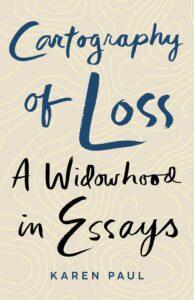 For fans of Jenny Lisk’s Future Widow, a tender memoir-in-essays about rebuilding after losing a spouse to brain cancer, Cartography of Loss explores caregiving and reveals how life after loss reshapes everything, even new love.
When her husband is diagnosed with glioblastoma, Karen Paul becomes a full-time caregiver overnight. Their marriage, the landscape of which had always shown fractures, is instantly and radically transformed. Years after the long vigil of illness and his death, Karen faces the uneasy recalibration that follows and a new identity she never asked for: widow.
Told in three parts, Cartography of Loss chronicles the very particular and personal—from hospital corridors and hospice visits to tattoos and the strange circumstance of falling in love again. Along the journey, readers bear witness through stages of early widowhood, life’s continuance in spite of unbearable grief, and the echoes of losses compounded over a lifetime.
Exploring how a widow must learn to map out her life in new ways after devastating loss, Paul’s is more than a grief memoir, it’s a clear-eyed, often funny exploration of how loss rearranges a life—and proof that even after the unimaginable, there is a way forward, one essay at a time.
PREORDER HERE
Category: On Writing
Subscribe
If you enjoyed this article, subscribe to receive more just like it.