What to Expect When Publishing a Book
I’ve always said that one of the critical drivers of my success over my life is that I can write really well under substantial time pressure. My high school English teachers should be credited for that, and it got me through high school and college and even my PhD with a whole lot less pain and suffering than less skilled or more tortured writers. After graduate school, I worked for four years in the policy arm of the White House, where I honed that ability even more, given that something I wrote over the course of 15-20 minutes might immediately end up on the desk of the President.
But when I left the White House and started a consulting firm, my writing became much less central to my success, and to my day-to-day work, and I missed it. When we sold the company, I found myself drawn to writing—without an express purpose, just because it was therapeutic as I navigated a new phase of my life. Eventually, I realized that all this writing might actually make a decent book, and I set out to make that a reality.
But it turns out that the business of writing is very different than writing for business (or policy, or academia). So… a few of my lessons learned from this new venture of being an author rather than just a decent writer:
A good editor is critical: Solid, useful, and well-received short-form writing can easily happen in one sitting, without substantial structural planning or deep dives into the meat of the material. While every writing piece can benefit from at least a second set of eyes reviewing it, the pace and expectations around articles, stories, social media posts, or similar allow for one author to sit down and bang it out quickly.
Not so for books of any genre.
I was shocked at how much structural change I made over the course of writing the book, and how much wrestling I did with the concepts in the book to make them work across the long-form writing. I couldn’t have done that without a sounding board throughout the entire process. I couldn’t have done it without either a professional editor—a developmental editor, not just a copy editor—who challenged and pushed me to think critically across the entire concept of the book.
Book publishing is, first and foremost, a business: Writing a book, even an academically-driven non-fiction book, requires creativity, for sure. But the entire book industry is a for-profit business and requires you to take a business perspective to playing the publishing “game.” You need to understand the players and their own individual incentives within the industry. Agents, publishers, public relations firms, bookstores, speaking bureaus… all have their own place within the business of writing and selling books (and the inevitable outgrowth of books like speaking and consulting).
Know what YOU want out of the book: As an author, you have to understand your own incentives for publishing a book.
As I was told by one of my mentors—a repeat New York Times bestselling author—that even successful books aren’t lucrative; an author needs to know what they’re using the book to drive outside of the book itself. So, are you using it to speak? Or sell your consulting framework? Or just to cap off a wonderful career? Just know what you’re looking to get from the publishing journey.
Writing the book is just the start: The actual writing of the book proposal, and then the writing of the book itself was so much harder than I expected, but I truly enjoyed the entire process. But that same mentor told me that the book marketing process was much less fun, and boy, was he right. I love the process of talking to and connecting with potential audiences—both for the book and for other speaking engagements. However, the process of planning out the social media campaigns, the political game of book lists and book signings and pre-sales, and all of the things that make up the business of book selling are necessary—but for me they’re a whole lot less fun than the writing and the interacting with the audience itself. Buckle in for the process, and recognize that some of it is just never going to be your favorite.
Don’t be insufferable: My dad was always the one to review all of my papers as a kid. I didn’t turn in a single paper from elementary school through my PhD dissertation that hadn’t gotten his red pen (with usually more red than black on the page when he was done). So, with my first draft, I gave him the first two chapters of the book to get his feedback. He sat me down the next time I saw him and told me that I was going to be competing with a whole lot of “insufferable” authors. I asked him if that was a good thing, since hopefully I wasn’t insufferable… and he just looked at me. Ouch.
Get yourself a truth teller who can give you the honest feedback that nobody else feels comfortable providing. My editor was amazing, and she was trying to steer me in the right direction, but she was entirely too nice about it. I needed the unvarnished truth from someone who both knew what they were talking about and loved me enough to try to make me the best version of myself.
I have had a wonderful (if challenging) time reinventing myself as an author. My early visions of publishing a book were definitely not consistent with what the actual business of writing was, but I’m still glad that I set out on this journey. Although maybe check back in with me after the book tour to see if I still feel the same!
UNRULY
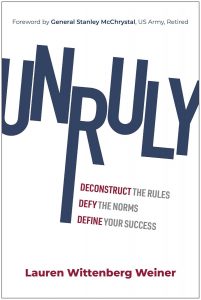 When the rules stop working for you, Unruly is the guide to navigate your authentic path to personalized success.
Rules are necessary for a functional society, but many “rules” we follow are simply conventional wisdom, norms, or limited interpretations. We’re expected to play along by conforming, following the crowd, and steering toward comfortable paths. But viewing rules as a starting point rather than as an endpoint opens worlds of opportunities for your success.
Unruly is your manual to identify your best maneuvers in the gray areas that allow you to authentically create and secure your own path to success. Lauren Wittenberg Weiner, a powerful speaker and business leader who has upended barriers on her journey toward extraordinary success, teaches readers in any industry how to:
- Navigate your own space within the rules while remaining in compliance and maintaining a strong moral compass.
- Convert fear and imposter syndrome into a superpower.
- Determine when it’s time to stop listening to what people think you should or could do to find what you can do.
- Use your power to be a gateway, not a gatekeeper, for others.
Borrowing from concepts in psychology, law, business, and the military, Unruly uncovers a deep understanding of rules and where they bend to equip readers for personalized success.
Category: On Writing
Subscribe
If you enjoyed this article, subscribe to receive more just like it.