
Finding My Righteous Rage, or How a Political Spark and Ancient Archetypes Shaped My Book
 I always knew I had a book inside me, but I didn’t know what it would be or when it would appear. Both my parents were authors; my father wrote a novel at the age of 21, and my mother wrote a couple of novellas later in life. Neither of them had any formal writing instruction, but both of them felt instinctively drawn to the craft. I had so many more opportunities than they did—a college education, writing workshops, a stint as a wellness writer for a local newspaper—but I still hadn’t written a book. With some chagrin, I must admit that I didn’t want to feel outdone by my parents, especially given the multitude of advantages I enjoyed.
Following my mother’s death, I finally started writing a memoir exploring our relationship alongside mother-daughter dynamics in general. But about halfway through, my husband left the marriage. Plunged into a period of acute grief and deeply distracted, I put the memoir aside and never returned to it.
Time eventually healed that initial grief, bringing me to a completely unexpected turning point in 2016. I was sitting in my living room watching the presidential debate between Donald Trump and Hillary Clinton. When asked about the Access Hollywood tape, Trump dismissed his comments as mere locker room talk. Normally an even-keeled person, I was enraged by his cavalier attitude toward admitting he had “grabbed women by the pussy.” My anger boiled over, transforming into the exact motivation I needed to write about the modern backlash against women’s rights.
My book, Righteous Rage: Why Feminism Needs the Fierce Goddesses, was finally coming to fruition. It was the project I had been waiting for, the book I knew I had inside me, which had finally found its shape. I have always believed, as the old adage goes, that the pen is mightier than the sword; my anger moved me to take action to write a book that would vindicate and support women’s rights at a time when they were under siege.
In the course of writing, I explored my personal journey from a “good girl,” raised to be accommodating and agreeable, to enraged woman standing her own ground and speaking truth to power. This personal transformation became the scaffolding on which I could hang the rest of my book. The introduction and conclusion became the before-and-after benchmarks of this evolution, which I shared to help other women embark on similar journeys in defense of their rights.
Because I originally assumed I would self-publish, I did not look for a literary agent. Instead, I hired a developmental editor through NAIWE, and later a copy editor I had worked with in my newspaper days. During my work with the copy editor, I discovered he also edited for Chiron Publications. It seemed to me that Chiron would be the perfect home for my manuscript, as it specializes in Jungian psychology and archetypal studies. My book, which explores rage as an emotion lying dormant in the collective unconscious (a construct developed by Jung), fell squarely within its purview. I asked my copy editor if he would put in a good word for me with Chiron, and he generously agreed. Soon after, the general manager of Chiron requested a copy of my manuscript. Not long after that, I received word that my book was accepted for publication. I was absolutely ecstatic that everything had fallen into place so seamlessly. Securing a contract with a traditional publisher exceeded my wildest expectations, especially since I didn’t have to endure the grueling rejection process. Many authors note the role of luck in publishing; it certainly operated in my favor.
My book, though nonfiction, blends several different sub-genres: memoir, feminist scholarship, and psychological insights culled from my career as a clinical psychologist. Weaving these distinct approaches together was a challenge, but the combination creates a rich, varied lens for exploring contemporary feminist issues. I also sought to embrace dualities by uniting the political with the spiritual (invoking ancient, fierce goddesses who fight for justice) and anchoring modern political struggles in timeless archetypal figures. Uniting opposites in such ways offers a deeper, more layered approach to the question of where feminism is headed.
Many people today question whether feminism is dead or simply lost. My hope is that by reclaiming their ancestral anger against injustice, women can rejuvenate the women’s movement. The fierce goddesses, living in the collective unconscious, have carried women’s wisdom through the ages. If we are willing to listen to them, they will provide a fresh infusion of energy for the fight ahead to protect our rights and cast off the yoke of patriarchy.
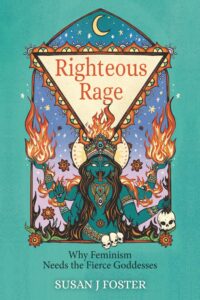
Righteous Rage: Why Feminism Needs the Fierce Goddesses
Version 1.0.0
With the backlash against feminism and reproductive rights since Roe v. Wade was overturned, many people are asking whether feminism is lost, if not dead. With so many rights on the chopping block, including rights to contraception and IVF, Righteous Rage helps inspire women (and their male allies) for the fight ahead. And although the feminist movement cannot be reduced to the fight for reproductive justice (with issues such as maternity leave, equal pay, childcare, healthcare, and violence against women still on the table), banning abortion has become the tip of the patriarchal iceberg.
Righteous Rage can reinvigorate the women’s movement by invoking the fierce energy of the dark, or fierce, goddesses of ancient times. These goddesses represent an archetype of female rage against injustice. They carry a primordial energy of destruction of those systems and paradigms that no longer serve us, such as patriarchy. They also have the power to create new non-patriarchal structures that promote wellbeing and align with justice. These archetypal figures reside in what Carl Jung called the collective unconscious—the deepest layer of our psyches that contains ancestral wisdom passed on through the generations. The dark goddesses have been submerged in our psyches, but they serve as a repository of fierce energy which, if tapped into, can rejuvenate the flagging women’s movement.
—
About the Author:
Susan J Foster, PhD, has worked as a philosophy professor, clinical psychologist, and journalist. She has published articles on the Feminism and Religion website and has been a writer and wellness editor for a local newspaper. As a longtime advocate of women’s rights, she has taught courses in women’s and gender studies. She currently has a private psychotherapy practice.
Righteous Rage can be ordered through Chiron Publications or Amazon.
Category: On Writing
Subscribe
If you enjoyed this article, subscribe to receive more just like it.









Although in the course of my life, I’ve felt and encountered rage many times, I’ve never really known what to do with it. I’ve never mastered finding the good. I wish I’d had the ferocity that is needed. I hope enough women do. Congratulations on your book.