Why We Need Historical Fiction Written by Women
by Patricia Furstenberg
 While I wrote When Secrets Bloom I asked myself, what happens when women take history into their own hands, pen first? In this deeply personal post, I explore why historical fiction written by women matters more than ever, especially when it brings to light forgotten voices from war and the medieval past. From research and doubt to discovery and conviction, this is the story behind the stories we tell.
My latest historical fiction novel grew from this very conviction. Set in 15th-century Transylvania, it follows a Saxon healer who dares to challenge the silence imposed on women like her; those who knew too much, felt too deeply and remembered too well. Her story isn’t just about superstition or betrayal, it’s about what it means to speak, to heal, to defy. In writing Kate’s journey I didn’t just uncover a chapter of history, I restored a voice.
And I believe we need more such voices, now more than ever.
Over time I found myself irresistibly drawn to writing fiction grounded in fact. Perhaps the seed was sown when I read The Name of the Rose and confirmed, again (as if confirmation was needed) just recently with the tale of Lady Chiajna of Wallachia whose steel will and political cunning stirred something deeper than curiosity. But it was the travelling, long hours on winding roads through fog-laced forests and ancient citadels of Transylvania,that truly rooted my imagination in the soil of the past. My past.
Historical fiction, long sidelined as “just a genre,” often battles an unfair reputation, dragging behind it a train of clichés and the lingering perfume of over-romanticized pasts. And yet, at its best, it does what no textbook can: it shows how history shapes, wounds, implicates. It opens the door to those locked out of the official record: women, dissenters, forgotten names etched not in stone but in silence. It doesn’t just reconstruct events; it breathes into the cracks. It asks not only what happened, but what it felt like. What it cost.
My own journey into this form took shape through fascination with the unspoken: the untold layers behind battle standards and family crests, the quiet courage of those whose stories never made it into chronicles. I was moved by the lives of women who endured, defied, and remembered. By the loyal shadows of war dogs at their masters’ sides. By the moral weather of choices made in times when survival was an act of rebellion.
And so, the path led — inevitably, it now seems — to medieval Transylvania. A land where borders shifted so many times like mist, where faith and fear entwined, where every silence held a secret. Fiction brought me there, but history wouldn’t let me leave.
When I began writing When Secrets Bloom, a fictional account inspired by fragments of history and the silences between them, I was struck by how few novels about war, exile, and survival were written by women. And even fewer that centered women’s voices. Across centuries, men have written more often, and more freely, about conflict. They weren’t “supporting characters” either. They were the story.
But women were there too. In the shadows, at the margins, in footnotes. Tending, enduring, rebelling.
Historical fiction, more than any other form, makes space to recover those erased lives, let them speak. I don’t write to merely reconstruct events. I write to feel the heartbeat beneath them.
A historian lays out the facts. A novelist invites you to live them. Shall we?
I want to enter the past not as a cold museum, but as a living world. Through fiction, I search for the emotional interior of history, the tension between what is remembered and what is lost, what is documented and what was deliberately buried. I want stories that breathe. Characters that bleed. And truths that linger long after the final page.
It is no accident that some of the earliest recorded writers were women and that many of them chose to write history. Enheduanna, high priestess of Ur more than 4,000 years ago, composed hymns that shaped the political and religious consciousness of her time. Anna Komnene, daughter of Emperor Alexios I, wrote the Alexiad to document the Byzantine world not just from a courtly distance but with a strategist’s mind and a daughter’s devotion.
So why, then, has their voice remained a whisper in fiction?
To write historical fiction as a woman is to reclaim that whisper and let it swell into an echo that refuses to be forgotten. It means insisting that history is not only written in treaties and triumphs, but embroidered into sleeves, etched into recipes or buried in the breathless hush after loss. History was not lived solely in palaces and battlefields. It was endured in birth beds and border crossings, in silences between words, in the daily, stubborn act of surviving.
A woman’s gaze lingers differently. She watches not just the clash of armies but the shadow that grief casts over a household. She sees the weight in a soldier’s slumped shoulders, the defiance in a mother tucking a forbidden relic into her child’s coat. Her telling is not softer, but deeper. She does not write just what happened; she writes why it mattered and to whom it left scars.
Writing historical fiction as a woman means reclaiming those whispers and turning them into echoes that refuse to fade. And it isn’t just about battlefields. War is not waged solely with swords and guns. War is felt in kitchens and cradles, in empty doorways and letters that never arrive. A woman’s eye lingers differently. She sees the aftershock in a soldier’s silence, the hunger in a child’s hesitation, the courage tucked inside folded linen or buried in the root cellar. Her voice tells not only what happened, but why it mattered.
When I write historical fiction, I begin not with dates, but with consequences: famine, exile, unraveling lives. But I also think of the small, human truths: the mother who hides a page from a banned book under her bodice, the girl who dares to gather herbs when medicine is outlawed, a widow who stitches her losses into every seam. These are stories too, , shaped the past and they deserve to be told. Writing about history from a woman’s perspective doesn’t mean softening it—it means deepening it.
Because writing historical fiction is not just about recovering voice. It is about bearing witness. It is about responsibility.
Historical fiction ought to continue that legacy, especially for women. It allows us to reimagine what was silenced. To step into lives shaped by power, faith, fear and resilience. With When Secrets Bloom, I wanted to bring to life not just a distant time, medieval Transylvania, but a deeper truth: that survival, love, betrayal, and healing are not bound by century or border. They are human. And they are timeless.
Historical fiction is a genre built on a delightful contradiction. Readers demand meticulous research, aching authenticity and the kind of historical accuracy that would make a museum curator weep with joy. But they also expect drama, emotion, and characters who do more than just recite grain prices from the year 1437. We’re expected to dress the bare bones of history in silk and sorrow, mud and mischief, and somehow make it walk and talk like someone you’d follow for 300 pages.
Done well, historical fiction makes the past feel richer and more complete, filling in the gaps mainstream history tends to skim over. It digs through the forgotten drawers of daily life, curious about what people ate, feared, whispered, and stitched into their clothing. It’s history with heart and a bit of imagination tucked under its bonnet.
Let’s be honest: historical fiction has long worn a divided cloak. On one side, we’ve had men marching through epic battles and swashbuckling adventures, sabers flashing, empire expanding. On the other? Women quietly — but powerfully — unraveling the inner lives of those history books often forget: midwives, daughters, herbalists, outcasts, survivors. One camp stormed castles; the other embroidered truths into silence.
Historical fiction is about more than just whose story gets told, it’s about why those stories matter. Over time, the genre has morphed to meet the needs of its culture: building national pride, upending worn-out clichés, and drawing sharp contrasts between a “dark” past and our supposedly enlightened present. Sometimes it holds up a mirror to reflect ourselves, other times it wields a magnifying glass to reveal what’s been overlooked.
Why do readers still flock to historical fiction today? Perhaps because we’re still grappling with ghosts; colonialism, patriarchy, racism, persecution. Not relics of the past, but forces that shape our present. Historical fiction offers more than a window to another time; it offers a mirror for understanding. It invites us to look beyond the corsets and castles, to confront uncomfortable legacies, ask fresh questions, and — especially for women writers — to reclaim the voices that history tried to silence, sideline, or reduce to mere footnotes.
But writing historical fiction isn’t only about reclaiming voice, it’s about responsibility. So why, then, has her voice remained a whisper in the pages of historical fiction?
Historical fiction gives women writers a rare opportunity: to right wrongs, to revive forgotten names, to ask what if and why not with a pen rather than a sword. We don’t need permission. We need resolve.
It means doing the work. When Secrets Bloom, my most recent novel set in 15th-century Transylvania, was one of the most uphill journeys I’ve taken as a writer. It demanded more than just research. It demanded that I live alongside my characters. I travelled, I read, I wandered museum corridors until closing. I stood at the base of medieval walls and listened. I traced the folk stories, the rhythms of rural life, the subtleties of Saxon customs and Hungarian spell-work. I grew with my protagonist, Kate — a healer in Kronstadt branded a witch — until her story no longer felt like fiction, but memory. Hers. Mine. Ours.
Writing about medieval Transylvania is more than capturing superstition or evoking mist-shrouded forests. It is about restoring nuance to a misunderstood past. It is about women accused of witchcraft not for conjuring storms, but for knowing too much about birth, about pain, about power. It is about remembering that fear has always had a shape. So has love.
And it is love that carries our stories forward. Love for truth. Love for the unsung. Love for a past that still presses against the present like a folded letter, waiting to be read.
Historical fiction isn’t history, but it listens where the record falls silent. It steps beyond what can be footnoted to uncover the emotional truths tucked between the lines, the kind that official archives often overlook. It allows us to reach back. Not to glorify the past, but to understand it, to feel its breath still warm on our necks.
In When Secrets Bloom, this is the path I follow: into the lives of women who were never handed the pen, yet shaped the world with every choice they made in kitchens, convents, and shadowed doorways. Writing their story is a way of asking—who were they, truly? What did they fear, hope, carry, and risk? And what of us, still grappling with exile, grief, silence, and resilience—what of our echoes?
After all, who better than fiction to call history back to the table and say, “Now, let’s talk.”
Because the past still breathes through us.
And we will write it.
~~~~
Patricia Furstenberg is a writer of historical fiction inspired by the forgotten corners of the past, where truth and legend entwine. With a medical degree and a heart rooted in Transylvania, her stories often explore resilience, hidden truths, and the quiet strength of women. She is best known for her travel blog, war fiction Silent Heroes and her hot new release, enchanting When Secrets Bloom.
WHEN SECRETS BLOOM
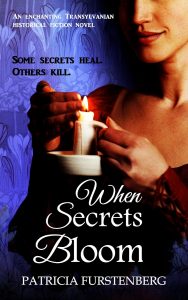 Transylvania, 1463
Some secrets heal. Others kill.
Kate Webber, a 28-year-old Saxon healer, has long walked the line between reverence and suspicion. Trained in the healing arts under the guidance of Lord Vlad Dracula, she has learned that skill alone cannot protect a woman in a city ruled by fear. Her marriage to the powerful but secretive Magyar promised stability, yet left her silenced and watched. On a bitter Advent night, when a mother and her newborn face death, Kate defies her husband’s command and steps into danger — for life, not reputation.
When Kate succeeds, the city notices. Some with awe. Others with fury. The town physician, threatened by her talent and humiliated by her success, seizes his moment. And as rumors flare into accusations, old alliances stir. Iancu, Kate’s childhood friend and now captain of the Militia, comes to her aid during the perilous birth — rekindling memories of freedom, laughter, and trust, before marriage shackled her to duty.
Back in her workshop, a girl appears, pleading for a love potion. But Margit brings more than need. She leads a mob. Elsewhere in the city, Moise, a Jewish apprentice at the printing press, notices a cloaked figure drifting across the square: a Shaman whose presence draws whispers of Magyar’s hidden dealings. When a rare manuscript disappears from the press Moise begins to uncover a darker purpose: a sought-after book. On the day of execution Kate performs a final act of defiance, she saves another child, while Moise is framed for more than he could have ever imagined.
Kate and Moise’s fates, as well as the map’s legacy, unfold as some secrets must be read not in books, but in the hearts of those who hide them.
***
Kate is a fictional character, yet through her eyes When Secrets Bloom offers a vivid, textured glimpse into 15th-century life in Kronstadt, Transylvania (today Brasov). From the daily rhythms of a fortress ruled by Saxon and Szekler men to the endearing hopes of Vlach and Jewish communities; from the quiet power women wield behind closed doors to the looming shadow of the Church and to whispered fears of plague and heresy, this novel immerses the reader fully in a world both beautiful and brutal. The presence of Vlad the Impaler’s memory — observed not through myth but through Kate’s wary, intimate lens — adds a haunting tension to the tale. It’s the kind of historical fiction that doesn’t just tell a story, it transports you into its bones.
Fans of rousing historical fiction with a feminist bent will find much to love in When Secrets Bloom.
BUY HERE
Category: Contemporary Women Writers
Subscribe
If you enjoyed this article, subscribe to receive more just like it.