The Martians Never Came, But Quito Still Went to War
By Lorena Hughes
Humans have always been fascinated by other worlds, particularly by the possibility of life on Mars and the question of whether such beings might visit us one day. Nowhere was this fascination more evident than in 1940s and 1950s pop culture: pulp magazines and comics filled with alien encounters, songs like the popular cha-cha “Los marcianos llegaron ya,” and, of course, the legendary Orson Welles’ radio dramatization of The War of the Worlds, which terrified thousands of Americans into believing Martians were invading the U.S. The broadcast, in particular, would go on to inspire a strange global phenomenon: radio stations in other countries also began adapting and airing the show.
In Ecuador, this phenomenon resurfaced in 1949—eleven years later—in the nation’s capital. But in Quito, the consequences were far more dire. Accounts from that night in books and articles describe citizens throwing mattresses into the streets, running aimlessly, crashing cars, women going into early labor, people suffering heart attacks, and more. There’s even talk of a priest giving mass absolution to his parishioners. It’s well documented that fear is contagious, and in an era when people didn’t yet distrust the media as we do now, they took what they heard on the radio at face value. When the hoax was finally revealed as nothing more than a radionovela (a fictional radio drama), people in downtown Quito erupted in fury and turned on the very building that had broadcast it.
Growing up in Quito, I often heard stories about how Radio Quito was burned down in the aftermath of that now-infamous transmission. The city’s largest newspaper, El Comercio, was housed in the same building and suffered major losses, including serious damage to its expensive printing press. For nine months, another newspaper—El Día—lent them their equipment so they could continue publishing. My mother, who lived nearby as a small child, didn’t witness the fire herself, but the roof of her elementary school was reportedly used to help some of the radio staff escape the blaze.
It wasn’t until recently that the idea of using this catastrophic event as the inciting incident for my latest novel struck me. Naturally, there had to be more to the story, so I began wondering about the motive behind the broadcast, especially since a similar transmission had already caused panic in the United States. I read everything I could on the subject, including a novelization written by the man responsible for the dramatization in Quito. But my novelist’s mind couldn’t help but spin its own web of conspiracy and deeper motivations.
Whereas in real life both outlets were owned by the same family, I chose to split them apart and fictionalize them entirely, so I could explore the tensions that might arise between two separate but intertwined legacies. From my imaginings, two families were born: the Monteros, newspaper owners, and the Anzures, owners of the radio station. In my version, their businesses (whose real names have been changed) share the same building, but bitter animosity rises between the families after the events of that night, not all of it tied to the infamous broadcast.
Eight years later, their children—Valeria Anzures and Matías Montero—are all grown up. Valeria dreams of becoming a photojournalist for the Montero newspaper, and of reuniting with Matías, her childhood love. But her uncle has other plans: an arranged marriage to save the family from ruin. Meanwhile, Matías carries his own questions and regrets about that night of chaos. As the two of them strive to uncover what really happened, they’ll discover that the hatred between their families runs deeper than they ever imagined, and may make a future together impossible.
I invite you to enter a world where fact and fiction blur, where one night of panic ignites years of secrets, betrayals, and transgressions. What really happened behind the closed doors of that building in 1949? Why did a dramatization spiral into tragedy—and who might have wanted it that way? Step inside, and discover how the past refuses to stay buried.
THE NIGHT WE BECAME STRANGERS
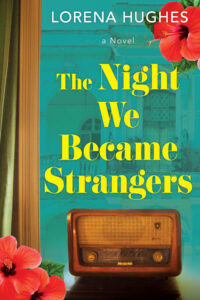 An immersive, historical novel based on true events: In 1938, Orson Welles’s legendary radio dramatization of H.G. Wells’s novel The War of the Worlds terrified Americans into believing Martians were invading. Eleven years later, an Ecuadorian radio station adapted the show—with catastrophic consequences. Now, two young journalists are determined to uncover what really happened to their families that night–even as secrets endanger their future.
1957: Aspiring photojournalist Valeria Anzures returns to her hometown of Quito with a secret purpose: to discover the truth about how her parents really died. The disastrous 1949 War of the Worlds show caused a mob to torch her family’s radio station—and the newspaper run by their closest friends, the Monteros. The tragedy shattered the families’ relationship—and left the station on precarious financial ground. Now, expected to save her family’s legacy through an arranged marriage, Valeria will risk everything to find out the truth. Even if it means allying with the man she’s always loved—but who now treats her like a stranger.
For Matías Montero, the scars of that night run deep. He saved his mother but blames himself for not rescuing his father. As a journalist, he views Valeria as a rival. Still, they’re both on the same mission. Perhaps, together, they can unearth the past their families and friends would rather remain buried.
Valeria and Matías soon find trusting each other is as dangerous as the attraction they can’t resist. Between their families’ mutual hatred, duplicitous witnesses, and insidious lies, and ruthless manipulations, exposing the real story will put their future on the line—and ignite revelations no one saw coming.
PREORDER HERE
—
Available September 30th.
Lorena Hughes is the award-winning author of The Queen of the Valley, The Spanish Daughter, and The Sisters of Alameda Street. Born and raised in Ecuador, she moved to the United States when she was eighteen to study fine arts and mass communication & journalism. Her novels have earned acclaim from outlets such as The Washington Post, Ms. Magazine, Publishers Weekly, Booklist, Woman’s World, The Christian Science Monitor, BuzzFeed, PopSugar, and Bustle. The Spanish Daughter is an Amazon Editors’ Pick, an Amazon Unforgettable Reads book club selection, and one of Reading Group Choices Most Popular Books of 2022. Her latest novel, The Night We Became Strangers, will be released in the fall of 2025. When she’s not writing, she works as a family photographer.
Category: Contemporary Women Writers
Subscribe
If you enjoyed this article, subscribe to receive more just like it.