Some Notes on Writing
By Barbara Benish
Writing is not my primary communication nor form of expression: it is visual arts. Learning the magic of lines-drawing- was, like for most children, my primary experience of making. But I do remember vividly the magic of learning to read and write, of putting letters together to make meaning. It’s one of the explosions in the brain that one carries forever as a fantastic discovery. As we learned sentence structure, composition, grammar and the other accoutrements of English in school, it did not get less interesting to me. Rather the structure of language, building paragraphs and arguments into a cohesive essay was empowering. As someone who could never quite gather her thoughts clearly in a public lecturing situation (despite decades of teaching, and not being a particularly shy person), the written word has always been my backup.
Visual arts are abstract, as the form is another material (although concrete poets and word artists sit somewhere in between the genres.) The structural components of visual art: composition, color, line, medium adhere to long-held traditions of making, even if they conceptually negate or create chaos within those rules (thinking conceptual art, the Space and Light artists of California, installation art, etc, not unlike Joyce, ee cummings, or Jenny Holzer and Barbara Kruger.)
Writing is more of a secondary communicator for me, saying things in a language that perhaps the general audience of my visual work is not yet fluent in. That said, the more I write and publish, the more confidence I have in the practice of putting words into the computer. Or rather, the trust to release them into the public sphere. Journaling for over five decades helps keep the thought process limber, not unlike sketch books. Art teachers always assign students the practice of drawing every day, just as athletes do warm up exersizes before a workout. It’s part of the ritual of making things, to keep the brain and heart in sync, the hand limber. The coordination between what an artist feels and sees is just one part of the process, the final step is how to deliver it out into the world. We might call this imagination or creativity. But there are many great artists who cannot take that final step of rolling it all up into a pretty package with a bow to give to the world. Perhaps this is just a mechanical training, a structure, discipline.
Fearlessness should not have to be called in, but unfortunately in times when women are burned at the stake, literally or figuratively, there is a certain trust in ourselves that needs to be conjured in order to create. This last book, my first one that is solo-authored and not “academic”, would not have seen the light of day without an open and progressive publisher, Lynn Elizabeth at New Village Press. That was just luck. The writing flowed for several years, on and off, as I tried to record a sort of handbook for
making art in an increasingly authoritarian environment, be it the gendered political or environmental destruction around us. The propelling emotions were joy and anger. I’ve been fortunate enough to love what I do, blessed with an early morning zest that allows me several good hours of writing between 3 AM and dawn, when the world sleeps and the stars are my only company. This schedule is left over from raising children in the solitary environment of an old mill in rural Bohemia, with extremely long winters and no neighbors nearby.
This was the time when I could hear myself think and draw or write. The solitary time an artist needs to create. Later, as the children turned into functioning adults with prolific lives, my body morphed into menopause and again sleepless nights were turned into creative flow. One flow stopped and another began. Once I wasn’t teaching in an institution anymore, my time became my freedom, and the excessive night work could take over without any morning obligations. All the worldly things usually get done in the afternoons, in broad daylight, in world that is not dissimilar to another non-native speaking Czech, Franz Kafka.
Writing seems to be a pendulum between those emotions of joy and anger, feelings that women, and other marginalized people seems to share. The pen is indeed a sword, a tool that can bring us together into a community of shared understanding. And this is one of the ironies of art, that while often created in solitude, it has the potential to build community. Our stories, perhaps the oldest artform to humanity, were passed on orally for generations, enhanced with the fireside glow and the whisper of wind. Putting those stories into words can be magic and carries a certain responsibility.
The Czechs have a wonderful word for “witch”. Čarodějnice, translates roughly into “She who draws/makes lines”, and thus “Čáry-Máry”, comes into the English language as a phrase for casting spells. Women have long held the place for making words have meaning. In remembering our power and responsibility, our inspiration will flow. We may work in the night alone at the computer, jumping up if the baby cries or the crow flies, but we are all connected. Sharing our words is a vital transference of wisdom and inspiration. It is not about the author. But all about the listeners, the readers, the audience, the next generation sitting around the fireside anxious for the stories.
—
Barbara Benish is a California-born artist and writer inspired by the ocean environment, the Mexican deserts, and surrounding Indigenous cultures. At University of Hawai’i in the early 1980s, Benish’s work in art and ethnology grounded her understanding of the intrinsic connection of environmental protection with social justice, and the relationship of Colonialism, sovereignty and stewardship. The Czechoslovak Revolution in 1989, in which Benish was involved, gave her first-hand experience in social change ignited by the arts.
In 1992 she moved from L.A. to Prague as a Fulbright scholar after co-curating the first cross-cultural exchange between the U.S. and Czechoslovakia in decades. She founded ArtMill in 2004 in rural Bohemia, an international eco-art center. From 2010–2015, Benish served as Advisor for U.N.E.P. in Arts & Outreach and, since 2015, is a Fellow at the Social Practice Arts Research Center (U.C. Santa Cruz). Benish has co-authored two books on art and the environment (Routledge), dozens of essays on art, most recently finishing a visual collaboration with political philosophers Michael Shapiro and Sam Opondo (U. Manchester, 2024). Her mixed media art has been shown in hundreds of international exhibitions including museums such as P.S.1 (MoMA) in New York, the Getty Museum in Los Angeles, Stadtgeschichtliche Museen in Nürnburg, Germany, and the National Gallery in Prague, Czech Republic, to list a few.
ArtMill: A Story of Sustainable Creativity in Bohemia
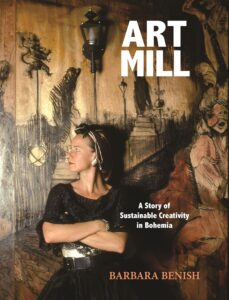 The story starts in totalitarian darkness (Czechoslovakia before 1989) and gradually lays out a groundwork for how creativity within community can influence and change society. All of this is rooted in the connection to the natural world, be it local sustainable farming practices, rural innovations, or international policies with governmental bodies on the global level. The book is a success story for a female artist (the author) who found a way to build a life in a rural, posttotalitarian, foreign country, with virtually no income, through her love of the place. It is a testament to the resilience of the people of that small nation that was sacrificed in the tumultuous chess game of colonial superpowers dividing up Europe after the devastation of WWII. It is a textbook protocol on how to instill civil society from the ground up, so that democratic life can thrive. This is a story that has been told in small pieces over the years in essays, catalogues, lectures, and radio and television interviews but needed the deeper context of a fulllength book.
BUY HERE
Category: On Writing
Subscribe
If you enjoyed this article, subscribe to receive more just like it.