On Story Work: The Art of Living (and Writing) the Questions
By GG Renee Hill
“Be patient toward all that is unsolved in your heart and try to love the questions themselves, like locked rooms and like books that are written in a very foreign tongue. Do not now seek the answers, which cannot be given to you because you would not be able to live them. And the point is, to live everything. Live the questions now. Perhaps you will then gradually, without noticing it, live along some distant day into the answer.” – Rainer Maria Rilke
In Rainer Maria Rilke’s famous quote, he asks us to live the questions, to be patient toward all that is unsolved in our hearts.
In my thirties, I was haunted by a chorus of questions:
What’s wrong with me? Did the impact of my mother’s mental illness ruin me? Am I destined to repeat the patterns I grew up with? Will life always feel like such a struggle? Is it okay not to be okay?
I turned to writing, not necessarily expecting answers, but hoping to find some relief. After a few years of writing, venting, and circling the same questions again and again, I realized they were all pointing me towards the past. Offering me snapshots of a childhood that I had long tried to make myself believe didn’t hurt me. I still wasn’t sure I’d find answers there, but I began to hope that I might find some wisdom.
So I started a memoir journaling project, writing down as many childhood memories as I could conjure. This is how my book, Story Work, began.
Initially, my recollections were few, and what I did remember was vague and shadowy. The effort was like trying to hold onto the details of a dream after waking up and being confronted with the current reality all around you. Still, something inside compelled me to keep going.
Guided by Dr. Linda Joy Myers’s book, The Power of Memoir: How to Write Your Healing Story, I broke my life down into decades and identified the significant memories that surfaced for each one (0-10, 10-20, and so on). I focused on beginnings and endings, peaks and valleys, milestones and moments of change and disruption. Trusting the memories that came to my mind and not worrying about the blanks and gaps, I began building a story bank to hold these fragments.
My goal was to work on telling myself these stories one at a time. One of my fears was that opening this Pandora’s box would release a flood of pain that I would no longer be able to suppress. So I approached the past with a conscious commitment: to seek out the good without bypassing the hurt, and to hold space for both to exist. I love a good story, and I was driven by the awareness that the most powerful ones include this complexity.
For years, I had blurred over my past and written it off as dysfunctional, wrought by silence, avoidance, and painful patterns that only seemed to prove my brokenness. No wonder life felt like such a struggle to me. I was battling with myself internally every single day, telling myself I was fine when I wasn’t. For this project, I imagined myself as the main character in a story, carrying an invisible burden but seeking a new path forward—a creative vision for my life.
The questions leading the project were:
What meaning am I making from my past? Is the story I’ve been telling myself lifting me up or pulling me down? What do I want my story to be about? Struggle or hope? Fear or love?
I didn’t want to keep avoiding the hard questions and believing that it was too late for me, that my story was already written. I realized this project wasn’t just about finding a pathway to healing for myself; it would be a pathway to others seeking to find hope in their stories too.
After a few years of working on this project, I had a patchwork of memories and reflections and a clear throughline about overcoming defeated narratives and reclaiming the stories we tell ourselves. I knew I wanted to organize these stories into a book structured by theme rather than chronology, creating an arc that showed the journey from victimhood to vision. As the pieces came together, I was guided by questions like:
How does the past shape the present, and how does the present reshape the past? How do the stories we tell ourselves influence our choices? What mindsets and actions are needed to reclaim our narratives and find new meaning in our lives? What does it take to be okay?
As I continued to write, the healing narrative fell into place, and the tone became conversational. No longer just a dialogue with myself, I imagined I was sitting in a storytelling circle, sharing notes from the field. Each chapter weaves together my personal stories, research from psychology, philosophy, neuroscience, and spirituality, and creative writing methods I use as a coach when working with clients.
Story Work became not only the reclamation of my own story, but also a framework to help others reclaim theirs. It reflects the guidance of living the questions: cultivating curiosity and openness, and learning to question the narratives we carry that leave no room for hope.
What began as questions born of pain grew into questions rooted in possibility. And still, the questions continue. As Rilke reminds us, we don’t need to rush the answers. We can simply love the questions, live our way through them, and let them guide us toward the stories that reflect the hope and possibility that is available to us all.
—
GG Renee Hill is the author of Story Work: Field Notes on Self-Discovery and Reclaiming Your Narrative (Broadleaf Books, 2025). Her books have helped thousands of people overcome the emotional obstacles that keep them from living fully expressed lives. She has taught at The Writer’s Center in Bethesda, Maryland, The Carnegie Library of Pittsburgh, Maryland Citizens for the Arts, REWRITE London, Scottish BAME Writers’ Network, and other places. Read more of her writing on Substack, Writing the Layers.
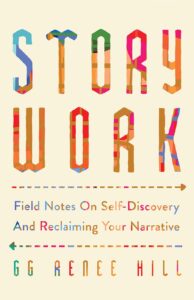 A guide to understanding the stories we tell ourselves and the actions needed to reclaim power over our narrative.
We absorb the world around us through stories. It’s how we make sense of our surroundings, our communities, and ourselves. There’s often truth and validity in these stories. But the stories we tell ourselves are not an end-all, be-all. Instead, they’re all part of a larger, ongoing, unfinished narrative–one that we must continually refresh, expand, and contemplate to stay soft and open-hearted.
Here’s the thing: we can choose to keep these stories open to possibility and imagination–or we can choose to keep them closed. That’s where Story Work comes in. Through essays and prompting questions, GG Renee Hill invites readers to breathe new life into the stories we carry. She leads by example, by penning the raw material of her own life: an upbringing raised by a mother with schizophrenia, and a lifetime of internal and external forces trying to minimize that impact. It was a long, old, heavy story Hill silently carried with her–the powerless girl who lost her voice in the wreckage of her mother’s condition — until she turned to writing and began to change the meaning she’d assigned to her experiences. And she doesn’t stop there. Hill invites readers to the transformative practice of creative self-discovery through storytelling — treating our life experiences as creative material that we have the power to shape. For the person searching, Story Work is the answer that enables us to live with an open-hearted curiosity–one that both fuels and grounds us.
Category: On Writing
Subscribe
If you enjoyed this article, subscribe to receive more just like it.