Authors Interviewing Characters: Andrea Simon
By Andrea Simon
DID YOU HAVE THE LIFE YOU WANTED
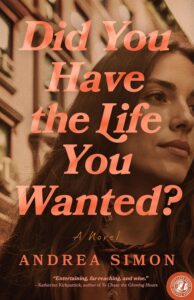 Did You Have the Life You Wanted? spans the generations from 1968 to 2019, highlighting the late 1960s to 1970s when diverse female friends come of age against the turbulent backdrop of racially charged school strikes, the Stonewall Inn and Attica uprisings, and the nascent feminist movement. As a young writer and resident of Greenwich Village, Anita Rappaport grapples with gang violence, career restrictions, and gender stereotypes, as well as the corrosive nature of familial secrets and regrets. Through the years, Anita marries, has children, becomes an entrepreneur, faces severe health issues, and takes on new educational and career opportunities that challenge her feelings of self-doubt.
As a septuagenarian, Anita asks herself and her friends the profound question: “Did you have the life you wanted?” with often surprising and heartbreaking responses. Reflecting the big psychological and societal ideas of modern times, Did You Have the Life You Wanted? is a sweeping multigenerational novel, rich in period detail and multifaceted characters, always valuing the restorative and life-affirming power of female friendship.
The following is an interview with the author, Andrea Simon, and the protagonist, Anita.
Author: How did your parents influence your education and career choices?
Anita: My mother was an immigrant who escaped religious persecution in Eastern Europe and came to America as a child. My father, though born in New York, was also guided by his immigrant parents, who began their careers in a sweatshop. As a couple who married shortly before the start of World War II, my parents were shaped by their backgrounds and events of the times; as such, they focused more on survival than personal choice. They didn’t direct my educational decisions and assumed I would follow the path of my contemporaries and go to college. As for a career choice, my mother wanted me to be a teacher because it represented a secure future. There was no effort to ask me about my creative interests.
Author: You had a horrible experience when you were a caseworker during the Ocean Hill-Brownsville strike in 1968. How did this brutal attempted gang rape influence you professionally and emotionally?
Anita: Professionally, I left my job as a caseworker, determined never to go back to the “field” in Brownsville. I then searched the want ads and followed calls for English majors and took a job as a copywriter. Emotionally, I became agoraphobic and withdrawn, and this experience probably had a lifetime effect on my sense of personal vulnerability.
Author: Now, looking back on your life as a woman coming of age in the 1960s and 1970s, how did you respond to the sexism of the period?
Anita: During those years, I didn’t conform to the life choices of many of my contemporaries. I avoided the possibility of marriage, and I longed to have a creative path in my professional life. I entered publishing because it had openings for women, though they were at a low level. I was very attracted to the growing feminist movement, and my life changed enormously when I joined a consciousness-raising group where we shared our common frustrations and formed a long-lasting support system.
Author: Who were the most influential people in your life?
Anita: There were so many. Of course, my parents and my brother were important influences, but often negatively as they either criticized me or squelched my natural desires. The most positive people were certainly my female friends, especially those in my formative adult years. They were and continue to be sources of inspiration and support.
Author: How did the revolutionary events of the times (school strikes, feminism, Stonewall, Attica, Vietnam) influence your life, and how do these events compare to modern times?
Anita: In retrospect, living through those years helped me become the woman I am today. Certainly, the school strikes affected me not only because I was attacked, but I personally experienced racial strife in the city. Stonewall occurred on the street where I lived, and it was exciting to see the birth of the gay rights movement literally under my first-floor window. Attica and Vietnam were pivotal events that formed my attitudes, showing me the plight of suppressed people outside of my realm. The spirit of revolution was ripe in our lives, and as young people we were adventurous and believed in the possibility of change. Nowadays, even though many young people (and older) are involved in protests, they don’t seem to expect those in power to implement real change. There is a growing sense of futility.
Author: Can you answer the titular question: Did you have the life you wanted?
Anita: This has been a lifelong question that I didn’t feel entitled to fully tackle until I was a mature woman. I’ve begun to ask my contemporaries this question. A few said “yes,” and then qualified it with “I’ve had the life I had.” Some said “no,” and others were disturbed by their recollections of the past. For me, it’s still complicated. During the past twenty or so years, I’ve been trying to correct or redirect my former life choices. The clearest answer I can now give is “yes, and no.”
BUY HERE
Andrea Simon is the author of the award-winning historical novel “Esfir Is Alive,” the memoir “Bashert: A Granddaughter’s Holocaust Quest,” now in a paperback edition, the novel-in-stories, “Floating in the Neversink,” the 2020 New York Indie Author Project winner, as well as several published stories and essays. She is also the editor and contributor of the anthology, “Here’s the Story: Nine Women Write Their Lives.” Her latest novel is “Did You Have the Life You Wanted?,” an anthem to the life-affirming power of female freindship. The recipient of numerous literary awards, she has won the Ernest Hemingway First Novel Contest, two Dortort Creative Writing Awards, the Stark Short Fiction Prize, the Short Story Society Award, and the Authors in the Park Short Story Writing Contest. She holds an MFA in Creative Writing from the City College of New York where she has taught writing. An accomplished photographer, her work has been featured in international publications and galleries. Andrea lives in New York City.
Category: On Writing
Subscribe
If you enjoyed this article, subscribe to receive more just like it.