Should Authors Read Their Own Book Reviews?
By Susan Wands
 Your book is published – hooray! Now it’s time to read your reviews – oh no!
As an author, you live mostly on a one-way street, with an occasional visit from an editor, proofreader, writing group member or beta reader. In your creative nook, your chosen team provides feedback. After countless rewrites, revisions and edited pages, you finally publish! And now, here come the reviews.
If you’ve asked other authors to write blurbs for your book, you already know the hard process of requesting reviews. After being published, you must, or should, submit your writing to reviewers.
Maybe you sign up for book giveaways to venues like GoodReads or promotional book clubs or Instagrammer/TikTokers, all in the hope that they might review your work. Perhaps you’re considering submitting your book to established periodicals. Will it be a reduced critique, a dreaded one-star pan or ecstatic five-star rave? Maybe you get a thumbs down or a thumbs up icon? There is the possibility of a misunderstanding of your characters or, worse, a literary take down that will lead you to question why are you writing.
What’s an author to do? Launching a book isn’t like putting Moses in a basket in a river and watching it float downstream to a wealthy family who will launch an acclaimed prophet. It’s more like smuggling a five-year-old orphan out of the Dickens’ workhouse and putting them to work in front of a loom to weave coarse linen or fine tapestry.
I’ve received some great reviews with praise I’ve dreamed of (and yes, I’ve dreamed of getting literary praise) as well as pans from high-end, high-status publications where a reviewer wrote something along the lines of “Susan Wands is not the person to be writing this book.” And yes, I paid for that Kirkus review! I’ve never used that quote, but I share it to take the sting out of it. That reviewer is not my target reader, I’m not writing for them. I’m writing for the readers who like my way of expression.
So why read reviews? There is the pressure to have thirty or more reviews on Amazon to “help the algorithm.” To count how many reviews you have online, you will see the listed ratings and given stars on your Amazon page. You also see condensed review titles.
I was not prepared to read review titles like: “with a made up last name of Wands,” or “so many genres mixed, pick a lane.” These made me laugh, as Wands is my real name and I like writing in a mixed genre. You shouldn’t take this kind of criticism personally when those reviewers can’t appreciate your take on things. Now, I think of my writing as a car gleefully swerving all over the genre highway, picking up hitchhikers like “New Age,” “Magical Realism,” or “Fantasy,” when I started out with just one passenger, “Historical Fiction.” As for taking criticism to heart, I think of what my grandmother Goldie Wands would say, “Take it with a pinch of salt.”
Then there are the GoodReads type of reviews to be considered. It has been said that GoodReads is a kind of “mean girls” club where other authors read your work just to take you down, rather than critique your work for other readers. Their averaged points of reviews pro or con can inspire or deflate you, but in the long run, it’s word of mouth that sells books, not necessarily reviews or prizes. They can help, but they can’t ensure a book’s success.
The publishing business is a business. It’s not a fan club or a family support group or even friends. Consumers pay money for a book and they are entitled to recommend or pan your efforts. My philosophy is: take what inspires or directs you from these reviews. As Henry Irving said of having both raves and pans for the Lyceum Theatre productions, “you need a little pepper with the salt.” (Obviously, I have salt on my mind.)
So, why read reviews? Is it to cull good quotes for social media promotion? Is it to get an understanding of how your book is being perceived? Or is it to compare yourself with other more established writers?
If you have invested in a marketing or PR campaign, it may behoove you to see how your investment is doing, so read them. If you’re in an emotionally secure place and want to know how your book is received, read them. If there is more marketing that you may need to do and you need quotes from favorable reviews, read them. But if you are going to be devastated by harsh feedback, get someone else to read them. But use the reviews to your advantage.
For me, organic non-paid reviews are different. Reviews generated by word of mouth, or from fan-based reactions are the best. But will reading these reviews help you? Maybe they will inspire or discourage you. By the time your work is published, etched in ink, critical feedback will not change the written text. But reviews could help you understand your reading audience. And maybe it will inspire your future writing. For me, inspired by reviews, I’m cruising down that genre highway and that Alternate History Fiction hitchhiker may be getting a lift.
—
Susan Wands is a writer, tarot reader, and actor. A co-chair with the NYC Chapter of the Historical Novel Society, she helps produce monthly online book launches and author panels. In London, she has lectured at Watkins Books for their Recorded Authors series, at Atlantis Books, for the NYC Yeats Society and for the Occulture Conference in Berlin on numerous occasions. Ms. Wands’ writings have appeared in Art in Fiction, Kindred Spirits magazine, and The Irving Society journal, FIRST KNIGHT. Her series of books, Magician and Fool, High Priestess and Empress, and Emperor and Hierophant, make up her Arcana Oracle Series, is based on Pamela Colman Smith, creator of the best-selling tarot, the Waite Smith deck.
EMPEROR AND HIEROPHANT
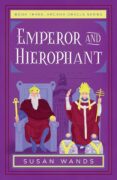 The next installment in the thrilling Arcana Oracle series finds heroine Pamela Colman Smith kidnapped, imprisoned, and fighting to protect her tarot deck from Aleister Crowley once again.
On tour with the Lyceum Theatre in Manchester, Pamela Colman Smith is kidnapped by a mysterious force. In captivity, she begins a relationship with her mute keeper, a strange creature at the beck and call of her nemesis, Aleister Crowley. Experiencing visions and visitations from other ethereal beings, Pamela works to escape her prison before Aleister harms another one of her muses over the ownership of her magical tarot deck.
Meanwhile, her guardian and mentor, Bram Stoker, tries to find her as he tours with the stars of the Lyceum Theatre, Pamela’s muses for the Magician and Empress cards. Alerted to Pamela’s plight, Ahmed Kamal, Pamela’s Egyptologist friend, joins Bram to come to her aid. Plotting against the mysterious forces who abducted her, Pamela must outwit and out magic Aleister, as he tries to destroy her muses and tarot deck. Learning the lessons of her Emperor and Hierophant, she must free herself and command the power manifesting from her tarot deck.
BUY HERE
Category: Contemporary Women Writers
Subscribe
If you enjoyed this article, subscribe to receive more just like it.