The World’s Wealthiest Women: Fascinating Biographies of Heiresses, Royals, Entrepreneurs, and Entertainers: Excerpt
We are delighted to feature an excerpt from Fortunes and Fates—The Untold Stories of the World’s Richest Women by Marlene Wagman-Geller!
 Where wealth meets destiny, tragedy often follows.
Heiresses have always dazzled with their unimaginable wealth, the cornucopia of fortune spilling opportunity at their feet. Yet, The World’s Wealthiest Women reveals through intimate historical biographies that the fates of these women were often woven with threads of tragedy by the weaving sisters of destiny.
Gilded cages or golden destinies? Whether these women amassed their billions through inheritance, marriage, or sheer ambition, their vast fortunes shaped lives that were anything but ordinary.
From the author of Behind Every Great Man, The World’s Wealthiest Women unveils the stories of women destined for privilege through birth or marriage, only to face lives rivaling the sorrows of Russian tragic heroines. These are the nonfictional Richard Corys—women whose silver spoons often rusted, far from happily ever after.
- Hetty Green: Known as “The Witch of Wall Street,” her wealth rivaled the Gilded Age’s Robber Barons, but her miserly ways outshone even Scrooge.
- Helena Rubinstein: From a Polish shtetl to the throne of a global cosmetics empire, this diminutive giant redefined beauty and power.
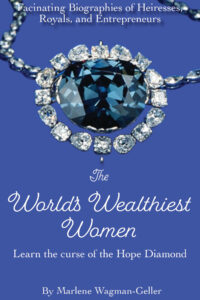
- Evalyn McLean: Her Great Dane once roamed her mansion with the Hope Diamond on its collar, a glittering symbol of her opulent yet cursed life.
- Basia Johnson: A Polish refugee maid turned mega-rich heiress, her rags-to-riches tale inspires, though not without its shadows.
- Honey Sheran: Married to pharmaceutical titan Barry Sherman, her sweet life ended in tragedy as Canada’s tenth-richest couple fell victim to a double homicide.
- Wendi Deng Murdoch: Fleeing China’s Bamboo Curtain, she secured a fortune through marriage to media mogul Rupert Murdoch, crafting a life of limitless horizons.
- Clare Bronfman: Heiress to the Seagram fortune, her $100 million gift to NXIVM led to a six-year, nine-month prison sentence for her role in the cult.
The World’s Wealthiest Women is a riveting exploration of privilege, power, and the poignant realities behind the fortunes.
Preface:
What God Thinks of Money
Since time immemorial, the wealthy have played a starring, societal role. The Queen of Sheba dazzled Solomon as she entered the gates of Jerusalem at the head of a procession “with camels bearing spices, and very much gold, and precious stones.” The Queen’s fabled treasure added panache to a love story that has endured for 3,000 years. Had the affair been between servants, their relationship would have evaporated in the desert sands.
The rich have received a bad rap since ancient times. Greek slave Aesop wrote his famous fable as a metaphor warning of the danger associated with greed. King Midas was the ruler of Phrygia in Asia Minor whose fatal flaw was avarice. When Dionysius, the God of wine, offered to grant him one wish, Midas requested everything he touch be transformed to gold. He was thrilled with his power until he no longer had the ability to eat, to drink, to love. When his daughter, Marigold, embraced him she turned into a golden statue.
The New Testament also cautioned against avarice. Jesus warned of the evil of mammon with His words, “It is easier for a camel to pass through the eye of a needle than for a rich man to enter The Kingdom of God.” And then there was the episode when Christ expelled the money changers from the temple, referring to them as a “den of thieves.” Timothy reinforced the concept by preaching, “For the love of money is the root of all evil.”
Piggybacking on the biblical theme of the evil inherent in the pursuit of wealth is William Shakespeare’s The Merchant of Venice. Shylock, a banker, loaned money to the merchant, Antonio, with the caveat if he defaulted, he would literally have to forfeit a pound of flesh. The play is a denunciation of usury, an anti-Semitic portrayal of the money-grubbing Jew.
Throughout the millennium, the public has been mesmerized with royalty partially due to their castles and crowns. Queen Letizia takes the cake for the most expensive royal wedding gown whose price tag was a whopping $8 million. But even the Spanish royal did not swallow a pearl to prove her wealth. Cleopatra bet Mark Antony, her Roman lover and partner in world domination, that she could spend the equivalent of 60,000 pounds of gold on one meal. During the dinner, it seemed no more lavish than others and Antony assumed he had won the wager. His smugness disappeared when the wily Cleopatra took off her pearl earring–the world’s most valuable–and dropped it in a cup of vinegar. After the jewel had dissolved, the Queen of the Nile drank the mixture. Antony was left to eat a banquet of crow.
A further episode involving the Queen of the Nile and pearls–the oyster’s misfortune–occurred when another of Cleopatra’s lovers Julius Caesar invaded Britain in 55 B.C. to scavenge Scotland’s rivers that had a plentiful cache of the milky gem. Elizabeth I used pearls to cement her image as both the Virgin Queen and the absolute monarch. A portrait by Marcus Gheeraerts the Younger showcases the ruler whose gown is enshrined with hundreds of the precious adornment. A storied gem is La Peregrina, a fifty-one-carat pearl, discovered in the 16th century, once the possession of French and Spanish royals. In 1969, Richard Burton gifted the storied jewel to Elizabeth Taylor. Moments after, one of her Lhasa Apsos decided the treasure was edible; fortunately, she was able to pry the present from its mouth. In 2011, Christie’s Auction house sold La Peregrina for $11. 8 million. As First Lady Jacqueline Kennedy pronounced, “Pearls are always appropriate.”
Insofar as weddings go, even more elaborate than big, fat Greek weddings are those held in India. In 2018 Mukesh and Nita Ambani threw a gala for their daughter Isha. The proud papa was able to pick up the $100 million bill, as his personal fortune is $122 billion, (give or take a few billions). How many celebrations can boast of entertainment provided by Queen Bee Beyoncé? How many wedding-planners have provided jewel-bedecked elephants and 5, 500 drones? Guests included Mark Zuckerberg, Bill Gates, Ivanka Trump, the king and queen of Bhutan. The celebrations entailed venues such as Mumbai and Lake Como. The event was on par with the Ambani’s 27-story residence that towers over Mumbai. The $1 billion palatial dig boasts a six-level parking garage and three helipads.
Those who did not have to rely on imagination to understand the realm of the rich hailed from various countries. The profiled women dwelled in the world’s ritziest zip codes: Betsy Bloomingdale, America, Marcella Agnelli, Italy, São Schlumberger, Portugal, Basia Johnson, Poland, Lily Safra, Brazil, Barbara Conrad, England, Honey Sherman, Canada, Princess Gloria Thurn und Taxis, Germany, Wendi Deng, China, Zsa Zsa Gabor, Hungary, Imelda Marcos, the Philippines, Ivana Trump, Czechoslovakia, Queen Marie Chantelle, Hong Kong, and Athina Onassis, Greece.
The World’s Wealthiest Women is a sequel to Women of Means insofar as both revolve around fabulously rich women and their singular destinies. However, there is a major difference. My earlier book dealt only with the “poor little rich girls” those who had lives that delivered all the unhappiness that money can buy. My current book does not hold that distinction as some of the heiresses made it to the finish line without misfortunate trailing in hot pursuit.
Both volumes raise the overreaching question: what is society’s knee-jerk reaction to the chosen few who dwell in the economic stratosphere? For some rubberneckers, they harbor the utmost disdain for those who possess the lion’s share of the pie, leaving everyone else to claw for the remaining slices. They view the oligarchs, tycoons, and heirs as scavengers, zealously guarding their kill. To those peering through the peepholes of the mansion with open-mouthed respect, they are avid fans of the commanders of the best of everything and lap up media coverage of their storied lifestyles. Celebrity blogger Hung Huang stated that those who cast aspersion on those in better circumstances are best described by the Chinese phrase, “xianmu-jidu-hen,” which translates to “envy-jealousy hatred.”
Two twentieth century wits held different philosophies regarding money. Sophie Tucker stated, “From birth to age 18, a girl needs good parents, from 18 to 35 she needs good looks, from 35 to 55 she needs a good personality, and from 55 on she needs good cash.” Rather than idolizing money, Dorothy Parker’s take, “If you want to know what God thinks of money, just look at the people he gave it to.”
PREORDER HERE
—
About Marlene Wagman-Geller:
I was born in Toronto, Ontario, where the severity of the Canadian winters turned me into a life-long bibliophile. My love of reading led to my dream of becoming a writer; however, first I had to discover a way of earning my daily bread. I taught high school English and history in Toronto until I moved to San Diego where I worked for decades in National City, California. After school, I raised my daughter, Jordanna, and put my dream of authorship on the back burner. My moment of “dreams don’t just have to be for sleeping” arrived in 2008 with the publication of the first of my books-Once Again to Zelda: The Stories Behind Literature’s Most Intriguing Dedications. My thirteen publications have given me purpose and fulfillment, have turned the black and white of everyday existence to technicolor. Reviews from my books have appeared in The New York Times, The Washington Post, and The Chicago Tribune. When not researching/writing, I am binge-watching the British variation of The Gilded Age- Downton Abbey- with my reluctant husband- a Soprano fan.
Category: On Writing
Subscribe
If you enjoyed this article, subscribe to receive more just like it.