Past is Present: The Inspiration for The Meaning of Fear
By Laura Hulthen Thomas
 Sometimes a novel is what happens when you just can’t let things go. My inspiration for The Meaning of Fear came from the same impulse the novel’s main characters battle against–a failure to leave the past in the past. A few years back, I published a short story collection about characters in a Michigan community struggling to come to terms with upheaval in their families and their way of life.
Usually once I publish a story, the characters feel all grown up and ready to make their way in the world. But two characters, a behavioral researcher dedicated to studying the fear response while coping–badly–with her own fears, and a cop whose marriage is crumbling despite his best efforts to be a hero to his wife, wouldn’t let go. Although they appeared in separate stories and their struggles and personalities were wildly different from one another, they both nagged me like kids begging for more attention.
Around that time, a good friend and I were reminiscing about our first get-together while our kids went crazy at the local bounce house joint. I recalled how we were sitting in a bar, swapping the usual get to know yous – where we were born, where we grew up, our children’s ages. We’d barely drained our first glasses of wine, I reminded her, before we were deep in an emotional conversation about the family challenges we’d experienced as kids. I told her how amazed I’d been that, although we were almost strangers, we so quickly shared so much hurt in common.
Our kids came tumbling down an inflatable slide, all tangled up in each other and gasping with laughter. My friend told me she hadn’t been amazed at all. “People in pain from their pasts have a way of finding each other,” she told me, as if our friendship had unfolded exactly as she expected it would.
I realized then that my nagging characters weren’t begging for my attention, but for each other’s.
So I gave in. As soon as I put the characters who would become Lea and Paul on course to meet one another, I was driven to find out what happens when people in pain, even those who have every reason to distrust each other, find they are drawn to one another before they understand why.
But I was then faced with telling the story of two stubborn characters who, to put it mildly, lacked the nuance that literary fiction often favors. I quickly found that Lea and Paul refused to slot into neat trauma bomb back story narratives that would explain why they are who they are. They were also not the redemption arc types who necessarily were going to end up forgiving their abusers.
And nuancing what happened to them as kids would end up blunting their pain and the long-term consequences of their trauma. As I wrote, I understood the questions they were demanding answers to had to be met with an unflinching gaze. What happens to characters who are fundamentally good people, who try to move on, who work to bring out their better natures that were so damaged by the past, only to find that they can’t? What happens when hurt simply refuses to heal, or comes back with a vengeance when life sets you back?
What happens when forgiveness doesn’t help?
Not that there isn’t a place for nuance in fiction! I’ve written these stories myself. But Lea and Paul meant for me to bear uncomfortable, even scary, witness to what has brought these characters to experience the world the way they do. I decided that to stay true to them, The Meaning of Fear would document traumatic events and allow the characters’ confusion and pain to play out in the moment.
The novel’s deep dive into the way Lea and Paul think and feel, and some of the hyper-reactive scenes they engineer despite their best intentions, attempt to capture how surreal, consuming, and even absurd it can feel to walk in the world always on the highest alert for the next threat, having learned early on how hurt can ambush you from the most unexpected sources.
When I first started working on Lea’s character in particular, I wanted to write about what would happen to someone who, in the wake of childhood trauma, had built a careful, controlled, and fairly happy life as an adult, only to see that life challenged so severely she had no choice but to deal with her past in a deeper way than she had been doing.
The recession of 2008 coincided with an ongoing slump in federal funds for independent research labs. Setting the novel in that time of economic crisis meant that both Lea’s lab and her new home, both of which had been places of security, would be in jeopardy. The stressors on both places also meant that Lea would be forced to face what she’d been avoiding.
I was interested, too, in having Lea explore whether, despite what morality and ethics may teach us, vengeance can ever play a role in healing. I wanted to frame her as a modern female Heathcliff, of Wuthering Heights. What would it look like to take revenge on a tormentor? How would a girl go about that, and later, an adult woman?
With Paul along for much of her journey, Lea puts her career and her heart on the line to discover whether leaving the past behind is ever possible, or even, in the end, healthy. The Meaning of Fear’s unsparing eye may not pull any punches, but what Lea and Paul taught me is that the real work gets done when the writer gives in.
—
—
THE MEANING OF FEAR
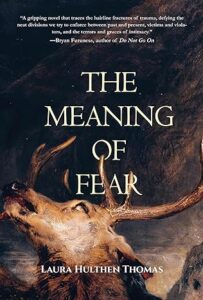 Amid the turmoil of the 2008 recession that threatens her career, Lea Johnson, a behavioral researcher dedicated to curing post-traumatic stress disorder, is also struggling to save her marriage. When her husband, Jay, is brutally attacked during an attempted robbery, Lea is shaken to realize that being an expert in fear doesn’ t make her an expert in healing her own husband’ s trauma. Things take a dark turn when Jay confronts a young trespasser outside their home, only for the boy to be reported missing shortly after.
Lea begins to suspect that Jay is hiding something, and as she feels a growing attraction to the sympathetic cop investigating the case, she’ s torn between her loyalty to her husband and the urge to uncover the truth. When an unexpected opportunity arises for Lea to confront her own childhood assailant, the lines between healing, revenge, and forgiveness blur. In a battle with her past and her husband’ s potential secrets, Lea must decide whether her affair will be the catalyst for healing or the final fracture in a marriage already on the brink.
BUY HERE
Category: On Writing
Subscribe
If you enjoyed this article, subscribe to receive more just like it.