The Full Catastrophe, One Year Later: Unexpected Gifts
By Casey Mulligan Walsh
When I began writing personal essays fifteen years ago, one of things I valued most was forming close connections with other writers. Having lived a life filled with an unusual amount of loss and trauma, topics we still don’t discuss openly in our culture, learning that my earliest readers—primarily critique partners—were emotionally affected or saw themselves in a piece of my experience confirmed I had a story to tell.
In 2017, having churned out dozens of essays circling the same topics of seeking belonging in the face of repeated loss, navigating uncertainty, and living decades on holding space for both grief and joy, I did what felt like the next right thing—sketched out a rough chapter outline of what might one day become a memoir.
Six years later—after publishing essays, a few of which drew attention in the creative nonfiction and grief spaces—I signed a contract with Motina Books, and in February 2025, The Full Catastrophe: All I Ever Wanted, Everything I Feared was released.
Life goal achieved. Or so I thought.
Of course, I knew I’d continue composing essays, hoping to place them in literary journals and mainstream outlets. My Substack, Embracing the Full Catastrophe, also provided me with an outlet for my writing. But now there was pre-launch preparation and the book talks, podcasts, interviews, and other opportunities that followed. I hoped this memoir would keep me busy for a very long time.
What I hadn’t prepared for was the emotional weight—and the unexpected reward—of having the whole of my story out in the world.
I’d lost both parents within a 10-month span when I was 11, then 12, and my only sibling when I was 20. More than two decades later, my marriage ended in a contentious divorce. During this already dark time, my son, eldest of three, died in a single-car crash at age 20. Grief and trauma had become the through line of my life.
As reviews and emails rolled in and discussions happened at book events and elsewhere, I often found myself wiping tears. Readers’ words spoke not only to me, the writer, but to me, the wounded little girl. I, like many of them, had lived most of my life holding early loss and trauma inside. An empath, I’d been skilled at reading the room from an early age, knowing how uncomfortable these topics made most people. Better to smile and stay under the radar. “I’m fine” became my mantra, “Fake it till you make it” my guiding principle.
But now, published reviews cut through whatever was left of that façade and helped me realize what all the writing had been for.
“Walsh has carried the pain of bereavement, the fear of loss, and the desperate desire for family and belonging…her memories and reflections will serve as a light for others in the darkest of times.”
“Walsh transforms her life into one that mirrors peace, joy, and meaningful living… [recommended] for readers navigating many treacherous ups and downs in their own lives.”
“…a testament to human resilience and releasing control in the face of heartbreak, and that over time, one can hold the full catastrophe of one’s life—the grief, the joy, and the in-between.”
Yet these thoughts directly from readers have perhaps affected me most:
“Sometimes we feel alone in our grief, but reading this book made me feel understood.”
“… helps me connect to my own experiences of grief and transformation… A story that every human, each in our unique experiences of grief, will understand.”
“If you wonder how you can forge on despite loss and self-doubt after the life you worked so hard to cultivate falls apart, this story is for you.”
That I’ve kept my son Eric alive for others has been another unexpected gift of putting my story into the world. As Ernest Hemingway famously wrote, “Every man has two deaths: When he is buried in the ground and the last time someone says his name.” Since most of the important people in my life these many years later never knew my son, comments like this—“Eric remains in my thoughts, even though I’m no longer turning the pages of his mother’s book”—have meant everything to me.
Nowhere has this been clearer to me than in the Emerson College creative writing class taught by memoirist Morgan Baker that I join virtually most semesters. Students read essays I’ve published in a variety of formats—second person, braided, hermit crab, compressed flash—parts of which are included in The Full Catastrophe—each centering on Eric’s life and death through a different lens. Recently, we talked about how grief writing can increase empathy in those who haven’t had experiences like our own or help those who grieve feel less alone.
A few days later, Morgan called to report what had happened in the next class. Of 15 students, a third (at least, those willing to share) had experienced trauma or loss. One, whose brother was struggling, had shared a piece with her mother, who said she’d never read anything that so closely mirrored her own struggle. A student’s close friend had died four years earlier, though she’d had a hard time talking about it; two had lost a parent at an early age. The discussion broadened to pet loss and the many losses that don’t involve death. The students had connected with Eric’s story—a boy they never knew, though in some way, they did now—and to my own.
If we listen to those around us—one person at a time—we’ll see. Grief is universal; trauma and loss are everywhere. I knew this before, of course, but there’s nothing like lifting the façade of “I’m fine” in your own life to allow others to lift theirs.
Next month, I’ll be trained as a grief coach. Again and again, discussion of The Full Catastrophe leads to questions about living through loss. This has been the gift of writing, of spending years learning the art of storytelling: it sharpens the lens through which we see our own lives, and in turn, the lives of others. I have no idea where this will lead. But—like in my own story, like in all of life—all we can do is the next right thing.
—
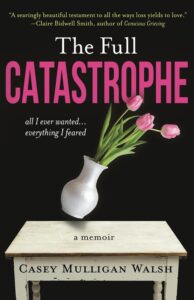 Casey needs a family of her own: the joys and the sorrows, people who love her, and a place she belongs—what Zorba the Greek called “the full catastrophe”—and she’s determined to make it happen.
Adrift in the world after losing her father to a heart attack when she was eleven and her mother to cancer soon after, the death of her only sibling eight years later strengthens her resolve.
Casey marries, has three children, and though she struggles with grief and a shaky sense of her place in the world, she thinks she’s found the life she’s longed for. But soon it’s clear her marriage isn’t the dream she envisioned. When her husband’s behavior shifts from troubling to destructive, a contentious divorce and custody trial propel her family into a catastrophe she never imagined. Searching for meaning, Casey embraces the spirituality she’s sought in various forms since her youngest years. Then the unthinkable happens—her twenty-year-old son Eric dies—and she’s left to make sense of her family’s collapse and the sudden yet somehow inevitable loss of her beloved boy.
A profoundly moving tribute to the power of love, The Full Catastrophe is the story of a life of loss and sorrow transformed into one of hope and redemption. With hard-won wisdom, Casey shows us how peace and belonging can only be found within ourselves.
BUY HERE
—
Casey Mulligan Walsh writes about life at the intersection of grief and joy, embracing uncertainty, and the nature of true belonging. Her award-winning memoir, The Full Catastrophe: All I Ever Wanted, Everything I Feared, was released from Motina Books in February 2025. She has written for The New York Times, HuffPost, Next Avenue, Modern Loss, The Manifest-Station, Hippocampus, Barren Magazine, and numerous other literary magazines; her essay, “Still,” published in Split Lip, was nominated for Best of the Net. She is a founding editor of In a Flash literary magazine and serves as Board member and ambassador for the Family Heart Foundation. Casey lives in upstate New York with her husband, Kevin, and too many books to count. When not traveling, they enjoy visits from their four children and ten grandchildren—the very definition of “the full catastrophe.” Learn more at www.caseymulliganwalsh.com.
Category: On Writing
Subscribe
If you enjoyed this article, subscribe to receive more just like it.