Interview With Jessica Handler
Jessica Handler is the acclaimed author of award-winning novels and celebrated nonfiction, with features on NPR, in Tin House, Electric Literature, The Bitter Southerner, The Washington Post, and elsewhere. Her latest novel, THE WORLD TO SEE, is coming out May 24th.
INTERVIEW WITH JESSICA HANDLER
Tell us about your beginning, where are you from?
I was born in Harrisburg, Pennsylvania, and lived very briefly in Oak Park, Michigan for kindergarten (one of my few memories of that time is a tunnel of snow from the sidewalk to the front door!). My family moved to Atlanta, Georgia in 1965 and I grew up here. I left to go to college in Boston, then worked in Los Angeles, Boston, and Baltimore before I came back to Atlanta thirty-some years ago. My parents and sister had moved away by that time, but Atlanta is where much of my chosen family was and still is. I married and made my home here in the city where I grew up.
How did your childhood impact the writer you’ve become?
That’s a big one! My parents were both big readers and very literary – my mother was a magazine editor later in her career – and I grew up being read to from a very early age. Some of my first memories are of poetry being read to me; Gwendolyn Brooks, T.S. Eliot, Shakespeare, as well as authors like A.A. Milne and of course, Maurice Sendak. I sometimes walked the few blocks to elementary school while reading a book, and I wonder now how I didn’t trip and fall. When I was growing up, both of my sisters were terminally ill, and our father, whose work as an attorney was centered in the social-justice movement, had addiction issues. I began keeping journals around this time, and have kept journals almost daily since then. More than fifty years of them fill a floor to ceiling bookshelf and a closet in my house. Reading, listening, and writing were how I learned to frame the world around me during a sometimes difficult childhood.
When did you decide you wanted to be a writer?
I don’t know that I ever “decided,” per se. Writing was and is how I make sense of the world, the lens through which I examine beautiful things and difficult things. To entertain my friends in high school, I wrote weird stream of consciousness accounts of our various escapades. I worked behind the scenes in the television industry after college, but left that profession after several decades because I felt the need for a change. I started writing freelance features for magazines, which led to a position as managing editor for a Jewish lifestyle magazine here. I went to the (sadly, now defunct) Iowa Summer Writers’ Program to try my hand at focusing on my own writing, which led to my earning my MFA at Queens University of Charlotte in North Carolina.
That in turn led to the publication of my first book, “Invisible Sisters: A Memoir,” which tells the story of my sisters and me and what it means to live into adulthood without them. That book, and then “Braving the Fire,” “The Magnetic Girl,” and “The World to See,” as well as essays, showed me how much I agree with Joan Didion’s famous observation that “we tell ourselves stories in order to live.”
How has writing changed you as a person?
I have always valued the ways that language conveys a changing world. My husband and I often read passages aloud to one another from the books we’re immersed in (sometimes two or three at a time) and we marvel at how the writers we admire do what they do. Reading and writing is an ongoing guide to understanding myself.
What inspired you to write THE WORLD TO SEE?
I’d been reflecting on friendships lost, friendships gained, and what makes a person a good friend. I started to think about the times when I’d sought inclusion in the orbit of what’s called an “alpha friend:” a charismatic peer whose attention we crave. Once we’re in that friend’s circle, though, what did we give up to get there? What makes that person so compelling to us, and what are they like when they’re not so shiny?
What was your road to publication like?
I’m so pleased that “The World to See” found a home with Regal House Publishing. I met Jaynie Royal at a SIBA (Southern Independent Booksellers Association) conference when “The Magnetic Girl,” was coming out. Later on, when I was pitching this new manuscript, I reached out to Jaynie. Her care and support in chaperoning this novel through the publishing process has been a delight.
What would be your 6-word memoir? For a long time, up to and after writing “Invisible Sisters,” I thought my six word memoir would be, “I am the only one left,” but lately I’m more inclined toward, “slow down and say thank you.”
What is the best writing advice you’ve ever had, and the worst?
The best? Read widely across genres. Read as a writer, which means allow yourself to welcome surprises about what you admire or want to emulate. The worst? “Write every day” isn’t great advice for me. Some days are busy with meetings, or family responsibilities, or a professional task unrelated to writing. A writer should stay in touch with their work on the days they’re not at the desk by thinking about their project or sending themselves an email or a voice note with an idea, but “write every day” can be unrealistic.
What is your writing process like?
I’m a slow writer. I take a long time to understand what a particular creative idea means to me, and I need to stand firmly in that space before I can comfortably immerse myself in a project. For example, “The World To See” began with my thinking about a photograph of my mother as a young woman at the beach near where she grew up in Massachusetts. That photo, in my mind, became an image of a girl able to breathe underwater. My mother is not a character in “The World To See,” but solitary swimming in the ocean is a key aspect of the story. I don’t write every day (see “advice,” above) but when I’m in that “in love” stage with a project, I try to get in at least three hours most afternoons.
Are you part of a writing community or a writing group?
I’ve been privileged to be a part of two terrific writing groups; the first for almost twenty years, the second going on two years now. There are four of us in the current group, five in the prior group, and since we’re all local to Atlanta, we try to meet in person about twice a month. Our meetings involve dinner, either at a restaurant or at one of our houses, with some time for social/professional catch up (gossip! professional news! family joys and troubles!) and then we get down to business.
We read each other’s submissions of ten to twenty pages usually a week in advance, which generates very in-depth, craft-focused conversations. In addition, I have two beta readers: my husband, Mickey Dubrow, who’s a novelist and my first reader, and my friend Peter McDade, who is also a novelist. Trusted writers’ groups and beta readers can help catch the plot holes and character hiccups in a manuscript that the writer simply doesn’t see.
What is your experience with social media as a writer? Do you find it distracts you or does it provide inspiration?
Social media, if we use it well, can be a form of literary citizenship. I tell my students to consider the bookstores, musicians, visual artists, culture-makers, and political thinkers who matter to them, and to not only follow them on social media, but read or listen and support their work in real life — “IRL—” when they can. The question for me with social media is how best to use it to inform and share accurate resources. When social media is purely an exercise in narcissism, that’s exhausting to perform and to witness, and serves no greater good.
Who are your favorite authors?
This is a daunting question! I’ll point to poets Louise Glück, Adrienne Rich, Natasha Trethewey, Beth Ann Fennelly, Ada Limon. In nonfiction, there’s an entire wall of books in my office. Kathryn Schulz, Abigail Thomas, Janisse Ray, Joni Tevis, Rebecca McClanahan, John Jeremiah Sullivan are some of my favorites, but I hate to leave out so many others. Fiction? Brad Watson, Ron Rash, Marianne Wiggins, Katherine Dunn, John Sayles, Kent Haruf… going back to classics, Willa Cather is a big one for me, as is Tillie Olsen. Come with me into an independent bookstore and I’ll point out favorites all day long.
What are you reading currently?
I facilitate two literary book clubs here in Atlanta, so my reading list is always changing. For my own pleasure reading, I’ve lately enjoyed Lisa Borders’ entertaining “Last Night at the Disco,” Daniel Mason’s remarkable “North Woods,” Patricia Lockwood’s stunning “Will There Ever Be Another You,” and in poetry, Ashley M. Jones’s “Lullaby for the Grieving.” I was glad to have finally gotten to Louise Erdich’s “The Sentence,” and Maggie O’Farrell’s “I Am, I Am, I Am.”
—
THE WORLD TO SEE
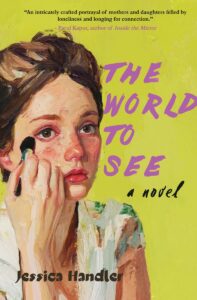 When teenager Nadine Harvey helps her best friend hide a disturbing secret, she’s also concealing her own deepest truth: she’ll do almost anything to be wanted. Five years and three thousand miles later, Nadine is thrilled when her idol, Celeste—a rock singer known as “the oracle”—befriends her.
As Celeste’s career begins to falter, she launches a bold program encouraging women to speak their truths. Nadine eagerly becomes her business partner, but as their ambitions clash, their alliance starts to unravel.
Determined to hide their growing rift, Celeste and Nadine invite their mothers to a high-profile awards gala. When painful histories resurface, each woman must confront how she sees herself—and how the world sees her.
Praise for The World to See
“Handler brings her trademark scything gaze and compassionate understanding of human nature to this vivid tale of two women navigating their relationships with their mothers, their entwined histories, and their music. Her nuanced exploration of how art, lies, and community shape female identity is lived out by characters so real, I had to remind myself that they were fictional. This is a powerful, compulsively readable story that will stay with me for a very long time.”
—Joshilyn Jackson, New York Times bestselling author of Never Have I Ever and With My Little Ey
BUY HERE
Category: Interviews, On Writing
Subscribe
If you enjoyed this article, subscribe to receive more just like it.