New Collection Offers a Testament to the Power of Teens to Transform Pain into Creative Expression and Isolation into Connection and Community
 Young people deal with a constant barrage of social media messages, relentless academic and peer pressures, and the threat of violence, including school shootings and ICE raids, on top of their own shifting hormones. No wonder the rates of anxiety and depression among teenagers continue to rise. Imagine the added burden for teens who have suffered the trauma of having a parent or other loved one locked up behind bars or permanently expelled from the United States.
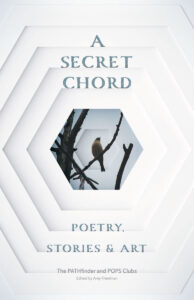
Across the country, the PATHfinder (Paving a Trail of Hope) and POPS (Pain of the Prison System) Clubs provide high school students with a safe, nurturing space to express their fears, outrage, hopes, and dreams in writing and art. The eleventh annual collection of creative outpouring from young people affected by incarceration, deportation, and injustice, A SECRET CHORD: Stories, Poetry, and Art (Out of the Woods Press; May 19, 2026; ISBN: 978-1-952197-18-5), reflects a common yearning for compassion and connection, even amid the increasing need for secrecy to protect vulnerable families from loss and devastation.
For this anthology, editor Amy Friedman, a criminal justice activist and cofounder of POPS the Club, was drawn to the theme of music. As she received submissions, the lyrics of a Leonard Cohen classic kept rolling through her mind. “In Cohen’s ‘Hallelujah,’ the secret chord refers to moments of truth, revelation, understanding, and connection,” Friedman reflects, “and it was truth, revelation, understanding, and connection that kept appearing in the poetry, artwork, and stories submitted.”
As The Pathfinder Network executive director Leticia Longoria-Navarro notes, A SECRET CHORD exists “because of the courage, honesty, and ingenuity of young people who dared to speak their truths—and the communities that made space for those truths to be heard.”
An Interview with Amy Friedman, Leticia Longoria-Navarro, and Victor Trillo, Jr., editors of A SECRET CHORD
You argue that teens need a “secret chord” to survive this moment—what happens to a generation when that chord is never heard, or is deliberately silenced by stigma and fear?
We used the term “a secret chord” because of the song, Halelujah, by Leonard Cohen. It’s a song that took him years to write and that was, initially, rejected by most—and now it is a beloved song around the world. In Cohen’s version, the secret chord symbolizes the chord we all seek. We think it means the chord that reflects the true meaning of life. In describing the song, Cohen has said that “the world is full of conflicts and things that cannot be reconciled. But there are moments we can reconcile and embrace the whole mess, and that’s what I mean by ‘Halelujah.’” It seems a perfect concept for these confusing, frightening, disorienting, stigmatizing times when too many people are afraid to speak their truths not only because of what people might say about them, but of what the actual harm they might cause. I believe every generation can hear the secret chord, but it requires listening and being heard, and that is what The PATHfinder and POPS Clubs strive to make space for.
Many of the young people in this anthology live with the dual secrecy of incarceration and deportation in their families. How does secrecy shape identity—and what does it cost a teenager to keep family trauma hidden at school?
In a way, this question is an extension of the first because yes, so many of the young people whose work is represented in A Secret Chord live with the stigma they have endured because of incarceration, detention and deportation; many also live in fear that loved ones might be deported. Keeping secrets of this kind cost a teenager everything and is a key reason for the existence of our clubs where, in safety, they have an opportunity to fully explore their true stories—in conversation and in writing and making art. These communities nurture the whole person and diminish anyone’s sense of needing to keep secrets or tell lies. Club members honor each other’s truths, and honor silence as well. We also have never felt more strongly about giving youth an opportunity to be published while also keeping their names private. That said, healing begins in the creation, and though the outside world may not know who the writer or artist is, the creator knows that they have been strong enough to reveal their true humanity, their whole self.
This book frames creativity as a survival tool, not a luxury. In schools facing budget cuts and security fears, why should poetry and art be treated as essential infrastructure for teen mental health?
It is in writing poetry and stories and in making art that youth find an outlet for self-expression, for reducing the stress that is inherent in keeping secrets and ultimately finding a way to cope and thrive through the challenges and adversity. Writing and art-making fosters self-discovery, perhaps the most important aspect of learning. There is deep pleasure in discovering things about yourself, even if those things are painful. Indeed, the very act of making art of any kind helps the creator to process and make sense of complex emotions and memories. Neuroscientific studies have shown that artistic activities of any kind—drawing, sculpting, writing, even decorating cakes or scrapbooking, knitting–stimulate a sense of well-being and allow the creator the space to envision and imagine possibilities for a future beyond the present moment.
You’re asking policymakers to prioritize youth well-being at a time when discipline and surveillance in schools are increasing. Are we investing more in controlling teenagers than in listening to them?
Yes, too often we do not listen to what teenagers are trying to tell us, what they actually think and feel, need and want. And we’ve discovered that so often when we invite them to be open and honest, they help us adults to see the world in a new light, to understand the world in a deeper way. Structure and expectations are important—for instance, we give the youth a deadline for submission of their work, and if they miss the deadline, they need to wait another year before they see their work in print. Our promise is this: That it will be in next year’s book.
What surprised you most in the submissions—was there a moment where a teen’s work fundamentally challenged your assumptions about resilience, anger, or forgiveness?
What surprised us most was how often resilience showed up quietly, not loudly. We saw restraint, tenderness, resilience, and deep moral intelligence. There were pieces where a young person wrote about profound loss or injustice and chose not to accuse, not to explain, not to resolve the story for the reader. Instead, they sat with complexity. Some expressed anger without letting it harden into other levels of feelings. Others wrote about forgiveness not as an ending, but as an ongoing, unfinished process they were still negotiating with themselves.
One moment that stays with us is realizing how many teens refused the narratives adults often project onto them. They were not asking to be rescued. They were asking to be understood. Their work challenged the idea that resilience is about “bouncing back.” What these submissions show is that resilience can look like staying open in a world that keeps giving you reasons to close down.
Some critics say encouraging teens to write about trauma risks retraumatizing them. What evidence or lived experience suggests the opposite—that expression can be protective rather than harmful?
Well, here’s the story: We don’t ask teens to write about trauma. We ask them to write, or draw, or photograph, or paint about things/people/places/memories/dreams that interest them. This sometimes, of course, leads them towards something that may have been traumatic—the death of a loved one, a deep heartbreak, the deportation of a father, a difficult illness, a prison guard who was insulting, a romance that went sideways, an accident—and almost always when expressing something feels too painful, the creator will move away from that subject and onto something else. Sometimes, though, another person’s story shared will remind them of what might be considered a traumatic experience but with an angle of looking at that story in a different light. The process of creative expression in community helps create meaning and likely healthier coping.
One story comes to mind: a young woman who had been severely depressed since she was five years old and her father was deported, seldom said a word in club, and often sat and wrote quietly but didn’t share her work. And then one day she turned in a piece about all the years she was so sad but thought she couldn’t tell anyone, and so she would go into the bathroom and take a shower and weep in privacy. She never came out of the shower until she had stopped weeping and wiped her eyes thoroughly dry so no one would know. She was going to therapy—for years.
The day after she turned in that piece, she told us that for the first time she went home and instead of taking a shower and weeping, she sat down and began to write more of her favorite memories of her father. She wept while she wrote. She missed him still. But she said that afterwards she felt like she had healed a wound that nothing else had ever healed. People write (or draw or tell a story) when they are ready; and again, listening to them is important. If it’s not time to write something, it’s not time.
How do PATHFinder and POPS Clubs navigate the political realities teens face—ICE raids, incarceration, racial profiling—without turning classrooms into battlegrounds or putting students at risk?
PATHfinder and POPS Clubs navigate political realities by being values-driven and creating space that reflects that. We do not ask young people to debate policy, take positions, or disclose information that could put them or their families at risk. We focus on creating a stable, trauma-informed space where youth can tell their stories on their own terms or choose not to tell them at all. Safety, consent, and choice are non-negotiable.
We acknowledge the realities young people are already living with—ICE raids, incarceration, racial profiling—and recognize their emotional and human impact. The clubs are structured around listening, creative expression, and community norms that honor both voice and silence. No one is required to share. No one is pressured to explain themselves. Confidentiality and anonymity are built into our practices, including publication. Facilitators are trained to hold space without probing, to redirect when needed, and to center care over disclosure. What makes this work possible is trust. When young people feel protected, they can create. And in that creative space, they are not being politicized—they are being humanized.
In a culture obsessed with metrics and test scores, how do you measure the impact of something as intangible as a student finally feeling seen?
We believe feeling seen is not intangible. It is measurable. It just requires us to measure what matters. We look at both qualitative and quantitative indicators. We gather data on belonging, emotional expression, self-efficacy, and connection to school community. We track attendance, retention, and continued participation year over year. We assess whether youth report feeling safer sharing their voice, more confident in their identity, and more connected to peers and trusted adults.
We are currently engaged in a national longitudinal study funded by the National Institute of Health called the SHARE study with our research partners at California State University-Northridge. We are following thousands of teens who are in our clubs and who are also not participating in our clubs and administering surveys to understand the impact of our clubs as well as teens’ experiences. The preliminary data suggests that after just six months in our clubs, youth are able to catch up with their peers who haven’t experienced the impacts of incarceration, detention, and deportation in key developmental asset domains that ensure positive health and social outcomes.
We also measure impact through publication itself. Being published is not symbolic. It is developmental. When a young person holds a book that contains their words, it disrupts stigma. It builds narrative agency. It says, I exist. My story matters. That is not a soft outcome. That is a protective factor.
What does this anthology reveal about how teenagers perceive the justice system—and are adults prepared to hear those perceptions without becoming defensive?
The perceptions about the justice system among the hundreds of youth who participate in clubs varies widely—as widely as perceptions in any and every group. And perceptions change over the years, as well. This is what we’d like readers to understand—that teens, no matter their status, ethnicity, race, age, experience, home life, advantages or disadvantages—are different from each other, and part of the beauty of these collections is that they allow all those differences (and similarities) to be on display. No defensiveness on the part of the reader needed—and we think that the intelligence, tenderness, generosity, humor, kindness, vulnerability, and yes, even anger and hurt, will open peoples’ minds and hearts.
Many of these teens are children of incarcerated or deported parents. What do they want the public to understand about loyalty, love, and stigma that we consistently get wrong?
What most people who are not impacted by the justice system consistently get wrong is that people detained, incarcerated, deported and their children have bonds with each other that are as complex, as deep, as varied, as rich and sometimes confusing and ever-changing as anyone’s parent/child bonds. It’s the complexity, the depth of feeling, the connections and disconnections that ought to connect us all to each other, that ought to deepen our empathy for each other. And part of what we hope these books offer is a window in to unfamiliar worlds that will enhance empathy.
For educators and community leaders who feel overwhelmed, what is the single most radical but practical step they can take tomorrow to create the kind of safe space these clubs provide?
One person, one word, one conversation, one act of kindness can be life-changing. It might be helpful to think back to a memory from your own past of something someone once did for you that made a difference, something someone said that you’ve never forgotten. In this way, you can better understand the tiny lift required to help a kid who is struggling. One small act of unexpected kindness and generosity can be radical; can be life changing. A recommendation: Write one letter to one of the youth whose work appears in A Secret Chord. It will likely be an act that person will never forget.
You’ve expanded from one club in Los Angeles to a national network. What resistance have you encountered—from school systems, communities, or even families—and what does that resistance reveal about how society handles youth pain?
Schools and community partners are often worried about what might surface if young people were truly invited to speak. Families worry about exposure, safety, or reopening wounds. Systems worry about liability. Those concerns are understandable, and they reveal something important about how society handles youth pain: we are far more comfortable managing it quietly than making space for it to be seen.
The resistance we have experienced taught us that youth pain makes adults uncomfortable when we do not feel equipped to hold it. Too often, the response is to avoid, minimize, or over-structure. What we have learned instead is that when adults are trained, supported, and clear about boundaries, young people do not spiral. They stabilize. They create. They connect.
All of this has reinforced why this work is necessary. It shows us how urgently we need spaces where young people are not asked to carry their experiences alone, and where adults are willing to stay, listen, and bear witness with care and accountability. One of our earliest and most important lessons was learning how to introduce the clubs thoughtfully. This work cannot be dropped into a school or community center without preparation. Leaders need to understand that consistency is not optional. Showing up every week matters. Being present matters. And if a leader has to step away, it is essential that someone trusted steps in. Young people notice absence. Inconsistent adult presence can do harm.
How do you protect teens’ authenticity while also protecting their safety, especially when sharing stories about incarceration, immigration status, or family separation could expose them to real-world consequences?
When we feel something might expose someone to harm, we discuss with them the idea that they might make changes to the work and/or consider offering their piece anonymously.
If the teenagers in A SECRET CHORD could directly question lawmakers, school boards, and media producers, what uncomfortable questions do you think they would ask—and are we ready to answer them?
The big question would probably be why judge another person until or unless they have walked in that person’s shoes.
They might also wish lawmakers and school officials and media producers to understand that EVERY child deserves an opportunity to be seen and heard, to be educated and cared for, to be honored for who they are and who they wish to be and most especially for where they come from.
The current political climate in the United States is failing far too many kids in this regard.
BUY THE SECRET CHORD HERE
—
THE PATHFINDER NETWORK is a Portland, Oregon-based nonprofit that provides justice-system-impacted individuals and families with the tools and support they need to be safe and to thrive in our communities. In 2023, The Pathfinder Network assumed responsibility for the operations and management of all POPS the Club programming that began in 2013.
LETICIA LONGORIA-NAVARRO is the Executive Director of The Pathfinder Network. Having been personally impacted by parental and family incarceration, Leticia is an expert on the profound impact of incarceration on the whole family. She is an advocate and founding team member of The PATHfinder Club.
VICTOR TRILLO, JR. is a founding team member of The PATHfinder Club and works as the Program Manager for The PATHfinder and POPS Clubs, employing his deep understanding of the impact of incarceration on individuals, first as the son of a man who was in prison throughout Victor’s childhood, and later incarcerated himself. He is a powerful advocate for children of the incarcerated.
AMY FRIEDMAN, an author and criminal justice activist, and her husband, DENNIS DANZIGER, a writer who worked as a high school teacher for 24 years, launched POPS the Club in 2013 as an inclusive space for young people who have been stigmatized and silenced by their experiences with the prison system. From a single club at Venice High School in Los Angeles, POPS the Club expanded to schools across the country. Amy is the editor of eleven annual collections of stories, poems, and art from members of POPS and The PATHfinder Clubs.
Category: Interviews, On Writing
Subscribe
If you enjoyed this article, subscribe to receive more just like it.