How a Garden Taught Me to Write by Alexis Lathem
“It occurred to me while picking beans, the secret of happiness” – Robin Wall Kimmerer
It was the year I stepped out of one life and into another. Over the last summer I lived in the city, I began to volunteer on weekends at an organic vegetable farm just outside of New York City. I picked baby lettuces and all kinds of greens I did not know the names for but soon learned: arugula, radicchio, frisée, mizuna, escarole, mâche, claytonia, sorrel, purslane. I slept in a beautiful stone cabin and cooked in a summer kitchen surrounded by rows of salad greens, beans, peppers, and squashes. I wrote at night in my journal by candlelight and rose at dawn with the song of the mourning doves and the white throated sparrows.
It was also the year – I see this now as I look back on my journals from that time – when I emerged as a burgeoning writer from a lifelong fog. Images began to surface on the pages of my journal from a miasma of abstraction. Thirty years later (I long ago quit the city for good) I would publish a book of essays about setting down roots on a small farm in Vermont, caring for sheep and chickens, growing fruits and vegetables, where I became a member of a larger community of life, both human and more-than-human. I see now how my life has come full circle.
It was through learning the names of flowers and grasses, by leaning into a shovel and digging into a very particular soil, that I learned to use concrete language and this is what saved me. In the tradition of an Occidental liberal arts education, I had studied the Greeks, the mystics, the theologians. I fell hard for the myth of the solitary thinker, who doesn’t see that she is thinking with layers of rootedness—in place, in culture, in family– or that trees and animals, beans and maize, not only books, could be our teachers. I had allowed myself to be lost in abstraction and alienated from the physical world, so much so that I lost my footing altogether.
And then I found it. There I was, my hands in the dew-covered mint, newly awash in images. I would, in time, grow roots, and I would write – poems, stories about this earth, my pages filling up with weather, with the sounds of song birds and the raucous calls of gulls.
I had read George Orwell’s “Politics of the English Language,” but it was not until I began to write about the physical world around me – the rows of summer basil and nasturtium, the penumbra in the sky behind the mountain ridge at dusk – that I began to understand his words. Orwell would teach generations of writers to use concrete language as a guardrail against the vagueness and insincerity of inflated speech.
Near the end of his short life, the author of Animal Farm and Homage to Catalonia lived on an island in the Hebrides where he grew fruit trees, roses and lupin, cabbages and potatoes. He shot rabbits, he milked goats, he fished, he cut his own peat for fuel. He had to walk eight miles from the nearest road to his home. He was raising his son on his own after his wife died. Orwell himself was dying, but before he would die, he would plant lupins, roses, apple trees, cherries. He would write 1984.
Though we may not think of roses when we think of Orwell, Rebecca Solnit wrote a whole book on Orwell and his roses. She attributes his fidelity to the concrete and the particular, his abhorrence of ideological abstraction, and his commitment to independent thinking, to his milking goats by hand and tending roses.
Creative writing classes, by encouraging young writers to use particulars, can serve to ground them in the truth of their own stories, to draw them out of the theoretical realm where as students we spend so much of our lives. I give my students prompts designed to ground them in the real, material world: where they might be drenched by rain, smell the aroma of bread baking, or hear the sounds drifting in through an open window on a summer afternoon. They are learning to give things their proper names: Rugosa rose. Velvet leaf. Silver-spotted butterfly.
These things cannot lie. They cannot be faked. What we crave is reality, Thoreau had said. In a time of so much digital fakery and political lying, we will need to be grounded in the reality of the soil and the rain and the life that feeds us.
I suppose that what happened to me that summer was that I fell in love with the world. Books had been my first love, but it was my immersion in the natural world that quickened a love of language into something that would grow into a writing life.
–
Lambs in Winter: Sketches of a Vermont Life Through Seasons of Change
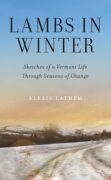 Finding hope in a small farm, an engaged community, and an age-old connection to the earth
After half a lifetime spent moving from place to place, Alexis Lathem at last settled down with her husband on a small farm near Vermont’s largest city. The lyric essays of Lambs in Winter take readers through the seasonal cycles of raising sheep and hens and growing fruits and vegetables while confronting the challenges of winter storms, summer floods, invasive weeds, and pests and diseases.
Ever conscious of her place in a historically colonized and ecologically degraded landscape, Lathem wrestles with ethical questions that come to many rural dwellers who—following Thoreau—set out to “live deliberately,” in a time of climate crisis, persistent racial inequity, and growing economic inequality. Likewise, she grapples with the moral complexities of small-scale animal husbandry. Through her efforts at self-provisioning, without holding illusions of the self-reliant individual, Lathem finds herself deeply embedded in the community and reliant on others, especially as her region deals with repeated catastrophic flooding brought on by climate change.
Through elegant prose and insightful investigations into pressing contemporary issues, Lathem evokes the world of her farm and the surrounding countryside with a spiritual awareness of the human journey on this earth. Living in place, attuned to the unfolding changes in the world around her, gives her much to grieve, but the pages of Lambs in Winter are luminous with moments of joy and beauty.
https://www.umasspress.com/9781625349019/lambs-in-winter/
—
ALEXIS LATHEM is the author of Lambs in Winter: Sketches of a Vermont Life Through Seasons of Change (University of Massachusetts Press 2025), the poetry collection Alphabet of Bones and two chapbooks. Her work has been supported by the National Endowment for the Arts, the Vermont Arts Council, the Black Earth Institute, the Bread Loaf Writer’s Conference, the Marble House Project, the Michael Steinberg Nonfiction Prize, and the Chelsea Award for Poetry. She has worked in food and environmental justice organizations for many years and taught writing at the Community College of Vermont. Her essays and poems have appeared in About Place, AWP Chronicle, The Hopper, Hunger Mountain, Gettysburg Review, Solstice, West Branch, and elsewhere. She lives on a small farm in the Winooski River Valley in Vermont, ancestral land of the Abenaki.
Category: How To and Tips
Subscribe
If you enjoyed this article, subscribe to receive more just like it.