My Book, My Teenager by Megan Williams
(Some answers to the question of what it is like to have a book out in the world).
“It must be incredible to have One Bad Mother published,” people say. “What an accomplishment.”
“Mmmm.” I want to tell them that it much like having teenagers. And that I don’t always love it.
In many of these conversations, people also mention how amazing it is that Gus and Grace are graduating from high school. “You’ve done it,” they say.
“Raised my children without eating them?”
“No,” they laugh. “You must just be so relieved it’s over.”
Except that it isn’t. The worries have changed—I no longer worry that Gus will turn blue because he has forgotten how to breath and drink at the same time. Today the worries loom large, but different. I worry about my daughter, college parties, and roofies. I’m afraid Gus will be lonely, that he will fail at something and have no one to hold his hand. Basically, I worry that my children will have to become adults and live the hard parts of life, as we all have.
Having a book out in the world is very much like having a teenager. You never know what is going to walk through your front door on a given evening. It could be a kid who is late because she was face-painting special needs kids at a basketball game; or the kid could be late because the car ran out of gas on your street; or she could have gotten a face tattoo, or worse. The list of things it could be these days is long and terrifying.
After the initial honeymoon phase of release and promotion, a book lives in the world independently. There is nothing I can do when it acts poorly. As a writer, I have done the work. As a parent, I have to hope that I have prepared my teenagers to be good citizens. I have zero control over what either my book or my children will do. My teenagers, at least, have the excuse of having the pre-frontal development of mollusks.
Much like a teenager, a newly released book has no sense that it is accountable. Early on in the promotion for One Bad Mother, a friend e-mailed to say she was really pissed off by the heartless way I talked about depression in my book. Her comments gave me this pervasive sense of wrongness, that I had done something beyond bad. “I always wanted my reader to know that I’m deeply sympathetic to those who struggle with mental illness, that I’d really struggled,” I wrote back. But what I wanted to convey didn’t matter.
How could I have gotten the writing so wrong, I asked myself. Luckily, we were still in galleys, and I was able to change the passage, but this was the first time I’d actually thought that my book could hurt someone. Even worse than it not having an impact, of it remaining unread, was the fact that it could wound. Its printed words would exist, in perpetuity, on the page. There was nothing I could do to change their impact on an individual.
As One Bad Mother has lived in the world, I’ve been surprised by the ways different generations of women have responded to it. A few months after release, I was running on the track with a thirty-something-year-old teammate. Her husband was walking in lane five with their screaming baby.
“How are you doing?” I asked, even though her face told me the answer. Her skin was grey, her eyes trapped—ping-ponging between her baby and the track.
“It’s been a little rough,” she admitted.
“I hear you. I wrote a whole damn book about it.”
“Yeah.” She motioned for me to pull behind her for the next repeat. “But you gave birth a long time ago.”
“Yep. Old as dirt over here.” I pulled my Boston Marathon 2016 t-shirt away from my body. At least it wasn’t cotton. She probably didn’t need to know that my kids were now full-blown teenagers. If I collapsed on the track and called them, there was a fifty-fifty chance either would pick up. I tried again. “I just didn’t want anyone to feel as alone as I did—”
“My generation is different. We’ve figured things out.”
How nice for you, I wanted to say, but didn’t.
In contrast to the self-imposed isolation of the new mothers I meet, the response from older women has been one of the greatest gifts and surprises my memoir has given me.
“I can’t believe women your age are still going through the same bullshit we did,” my aunt e-mailed. We hadn’t talked in twenty years, but somehow she’d bought my book and was passing it around her retirement community.
And my mother: “Here we are, women in my generation, thinking feminism solved so many things, that we could do it all, get the advanced degrees, go back to work, and raise a family, but women today are still struggling in the exact same ways we did.”
“But what about the fact that today’s mothers don’t want to hear my story?” I asked.
“Your book really is a teenager,” my mother said. “The person who likes it the best is the grandmother. Not the people who have to live it every day.”
“Well, that’s even more depressing.”
“Not really,” she said. “What could be better than getting two generations talking, about pulling mothers and daughters together?”
—
Megan Williams is the author of One Bad Mother: A Mother’s Search for Meaning in the Police Academy (2024). After graduating from Haverford College, Megan received her Ph.D. in English from Temple University and taught at Lafayette College and Santa Clara University. She lives in the Pacific Northwet with her husband, who runs Blue Dog Bakery and keeps their teenage twins, rescued cat, horse, and mastiff full of treats. Her next book is a memoir about a house and family in Bar Harbor, Maine. It is forthcoming in the Spring of 2027.
ONE BAD MOTHER
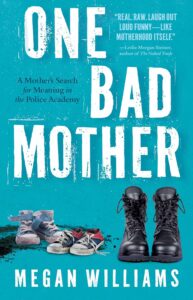 After her six-year-old daughter puts a hammer through a wall, Megan Williams decides to abandon a career as an academic and become a police officer.
It’s not lost on her that she may have applied to the Police Academy to escape the realities of mothering twins born via IVF at twenty-nine weeks. As the twins grow and test her endlessly, she feels she is failing. She needs a win.
During a grueling application process, Megan measures herself against the other candidates and confronts the normative notions of what it is to be a good mother. The paralyzing fear that she is a bad mother looms large in her head, as does the real possibility that she might not make the cut at the Academy. With its intertwined narratives of police recruitment and motherhood, the memoir provides an unflinching journalistic view of big-city law enforcement, set atop a personal journey during which Megan learns gratitude and makes peace with a motherhood far different from the dream sold to her by our culture.
BUY HERE
Category: On Writing
Subscribe
If you enjoyed this article, subscribe to receive more just like it.