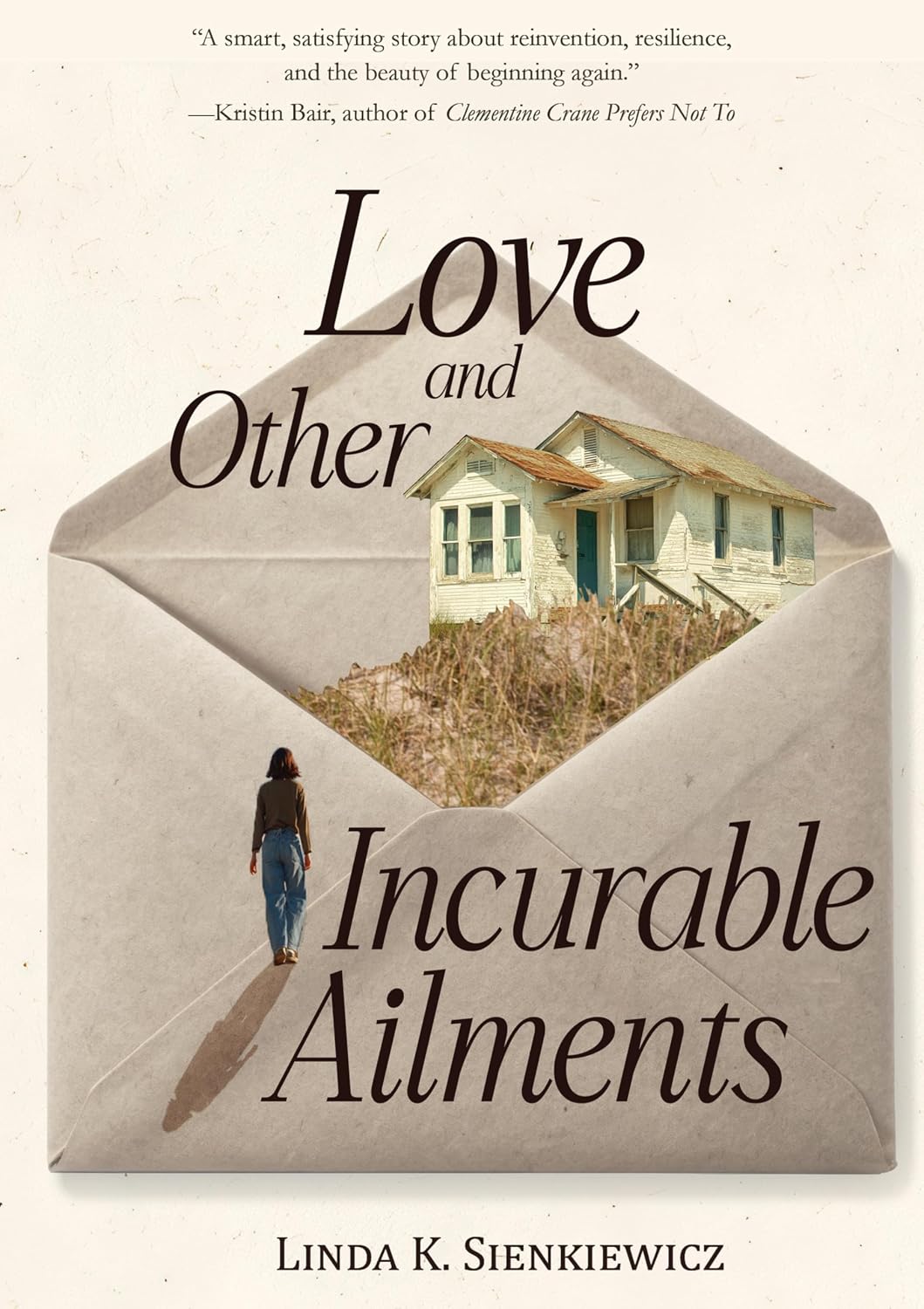
Why I Filled My Novel with Unlikely Friendships and Eccentric Characters by Linda K. Sienkiewicz
You Can Be a Disaster and Still Get Invited to the Fish Fry:
At the beginning of Love and Other Incurable Ailments, Serenity Tomczyk doesn’t emerge from loss with newfound wisdom or enviable resilience. She nurses a cat. She attends group therapy. She catastrophizes every headache with a late-night Google search. Years after losing her parents and watching her engagement implode, she’s convinced that disaster is lurking just beyond the horizon.
Then she finds a box of discarded love letters in a dumpster.
Instead of moving on like a sensible adult, Serenity invents a story around them. She becomes obsessed with the mysterious stranger named Birdy, packs up her carefully contained life, and boards a ferry to a tiny island in the Outer Banks. She thinks she’s traveling to save someone else. As a writer, I knew Serenity was really trying find a way to save her from herself.
What she discovers isn’t the grand romance she imagined. It’s something far more interesting: a community of delightfully eccentric people who don’t ask her to become less anxious, less awkward, or less herself before inviting her to the neighborhood crab boil.
As a reader, I’ve always been drawn to stories where healing doesn’t arrive as an epiphany or a makeover montage. As a writer, I wasn’t interested in giving Serenity a wise mentor or a fairy-tale romance to solve her problems. I wanted to surround her with people carrying their own scars and peculiarities.
Through a cast of offbeat locals, Serenity is gently nudged toward everything she’s spent years dodging. Even the ghosts and pirate lore that haunt the island mirror her emotional state: unquiet, searching, unresolved. Each character Serenity encounters on Ocracoke serves a quiet purpose in her emotional healing, although none of them are there to “fix” her. Instead, their authenticity and offbeat wisdom provide a kind of emotional ballast, grounding her in a reality she’s long avoided.
Quade is the aging fisherman Serenity meets on the ferry ride to Ocracoke. At first glance, he’s everything she didn’t come for, earthy, homespun, and ready to “feesh,” a pastime she has zero interest in. Yet Quade embodies a fatherly healing Serenity doesn’t know she needs, healing that comes not from fixing the past, but from being gently drawn into the rhythms of ordinary human connection.
Raf is the twelve-year-old son of an immigrant who somehow manages to be both an emotional compass and a pint-sized chaos agent—nosy, clever and entirely too curious for Serenity’s comfort. And he’s the one who sneaks into the stack of Birdy’s love letters, which are more Fifty Shades of Ocracoke than innocent affection.
When Raf blurts out his findings with adolescent glee and no filter, Serenity is mortified, and her romantic fantasies get a rude awakening. Despite his mischief, Raf is more than comedic relief. His crush on Serenity is sweet yet insistent as he tries to fix her up with his widowed father, and hopefully get a wide-screen TV, too. Through Raf, Serenity sees herself as someone likeable.
Her neighbor Emma, with her Southern wisecracking, offers a casual acceptance that chips away at the notion that Serenity needs to change before she can belong. Jake, the widowed carpenter hired to renovate her broken-down cottage, slowly becomes the emotional scaffolding Serenity didn’t know she needed. He doesn’t press her for intimacy; instead, he gives her room to be her own weird self. His own grief is quieter but just as present, mirroring her own.
Even Birdy, the elusive letter-writer, plays a necessary role by forcing Serenity to confront the difference between fantasy and reality, between obsession and love. Her pursuit of him is rooted in desperation and magical thinking. He ultimately cracks her delusion wide open.
None of these characters were written to fix Serenity. They aren’t life coaches disguised as novel characters. They simply show up, make her laugh, drag her to a Fireman’s Ball, drive her to the hospital, give her ice cream for dinner, or hand her another small reason to stay engaged with the world.
Even the island itself has its peculiarities, such as pirate legends, termite infestations, haunted cottages, and graveyards. And there, each inconvenience, each minor disaster pushes Serenity to adapt, to accept help, and to rely on others. Slowly, the island becomes a character in its own right. It reminds Serenity that every place, like every human being, carries its own history and wounds.
As a novelist, I wanted to write a story where a character arc doesn’t require changing your personality. It means finding a place where your odd habits, old hurts, and awkward silences or outbursts are simply accepted as part of who you are.
In the end, Serenity doesn’t transform into someone new. She becomes more herself. She learns that anxiety and grief don’t disqualify her from friendship, love, or community.—
Linda K. Sienkiewicz is the author of the novels Love and Other Incurable Ailments and In the Context of Love, the picture book Gordy and the Ghost Crab, and five poetry chapbooks. She writes for anyone who’s ever felt like too much and not enough in the same breath. She holds an MFA from the University of Southern Maine. When not writing, Linda can be found walking her corgi, Cowboy, or volunteering at the Neighborhood House in Michigan.
Love and Other Incurable Ailments
Serenity Tomczyk isn’ t dying— she just has anxiety, a WebMD habit, and a cat named Margaret Thatcher. After breaking off her engagement and losing both parents, she retreats into a predictable life of retail shifts, group therapy, and the safety of solitude.
Then a box of passionate letters appears in a dumpster behind her aunt’ s home dé cor shop, and Serenity becomes captivated by the mysterious man who wrote them. Soon, she’ s chasing a fantasy 900 miles from Michigan to Ocracoke Island, North Carolina, in search of the stranger she knows only as “ Birdy.” Thrown from her carefully padded comfort zone, Serenity discovers unexpected friendships, uncomfortable truths, and the possibility of love.
But when her imagined happy ending begins to unravel, she must decide if holding on— or letting go— is the bravest thing she can do. With wit, heart, and irrepressible warmth, Love and Other Incurable Ailments is a story about connection, courage, and becoming yourself— just when you thought it was too late.
Love and Other Incurable Ailments is available through Regal House Publishing, or Bookshop, Amazon, or wherever you buy your books.
Category: On Writing
Subscribe
If you enjoyed this article, subscribe to receive more just like it.