Habla Español? No, But I Narrated my Audiobook Anyway
Long before I had a finished draft of my debut A Little Piece of Cuba: A Journey to Become Cubana-Americana, I knew I would narrate the audiobook myself. I am not alone in believing strongly that all memoirists should read their own work and narrate their own audiobooks, but I also know that it comes easier to us authors with extroverted tendencies than it does to others.
I felt confident to call upon my inner theater kid and my professional experience working with narrators in film and television to level up my reading as best as possible and set the audiobook up for success. I was extra lucky that my husband Todd Lockwood is a sound editor and mixer with experience in audiobook and podcast post production, so I had the added rare luxury of recording in my pajamas just inches away from my comfortable couch. But what made my narration of the audiobook really special was not what I had to make perfect but what I had to butcher.
A Little Piece of Cuba chronicles both my five-day journey to my mother’s birthplace of Havana, Cuba, and my lifelong journey to accept my Cuban heritage. One of the reasons why I never felt Cuban when I was a child growing up in South Carolina was due to the fact that I don’t speak Spanish.
Ours was not a bilingual household, and in the memoir, the second chapter titled Habla Español explores my questions and insecurities about not speaking the language. But, when I went to Cuba in 2017, Spanish came alive for me in a whole new way. I could understand the people in Cuba enough to have simple interactions and I came home emboldened to practice Spanish as much as I could with my extended family and in my bilingual community in Queens. Because I wanted to capture that evolution in the memoir, I sprinkle Spanish throughout. Three chapters, including Habla Español, are in Spanish.
But, as I say in the book, I was not going to spontaneously burst into Spanish and five days in Havana didn’t make Spanish any easier for me. I had to face the language and my insecurities with it as a writer to tell the story with every ounce of insecurity sitting heavy on my nerves. Nothing about Spanish felt as easy as it did in Cuba.
As I was writing the chapter that would become Habla Español, I fought with the keyboard that would not put in the accents and turned to Google Translate to make sure I had spelled colloquialisms and phrases like cosita correctly.
During the final manuscript’s proofread before publication, the Spanish bled with redlines, but rather than terrify me, I felt relieved. The red meant that the gracious bilingual proofreader had saved me. The little Spanish I used was correct, no accents lost, and no chance I would butcher my mother’s original language. At least in print.
When Todd and I started recording the audiobook last fall, I felt confident in my book and in my story. Narrating came naturally, aside from the occasional stumble over a long sentence or the work to make verbal sense of phrasing that reads better than it sounds. (I will never say the word espadrilles again!) But as soon as I came upon the first few Spanish words early in the book, it was as if I had hit a speed bump very hard. Insecurities and doubt flooded right to my tongue and tripped me up.
Day after day, Todd sat patiently at his ProTools session with the headphones perched on his head while I said, “Sorry, let me take that sentence again.” A series of pick-ups (words re-recorded individually then edited in) revolved around Spanish words and even my family’s name. For appearing only occasionally in the finished book, Spanish suddenly seemed like a much bigger part of the audiobook.
Once all the recording was done, I listened back to Habla Español after Todd’s skilled edit leveled out the tone of my voice, trimmed my flubs and blubbering, and ensured it met technical specifications. Suddenly I was hit by a lightning bolt of realization: I don’t speak Spanish, and that’s part of my story. I’m not pretending, I’m not faking it, I’m not even performing. This is no makeup, no control top, warts and all. I’m showing this audience exactly what a second-generation Cuban American born and raised in the American South sounds like!
Trying to make the Spanish anything other than what it is was going to do a disservice to the people who wanted to hear me tell them this story. So, when it came time to habla español, then habla español I did. It’s abominable. It’s atrocious. I can hear every wobble of self-conscious doubt in my voice. Listening to the final tracks before publishing the audiobook, I would brace myself knowing Spanish was coming. More than once I said to Todd, “I would rather be waterboarded than hear myself say arroz con pollo one more time!” immediately followed by, “I can’t wait for people to hear it!”
I underestimated the audiobook format and myself as a narrator when I stepped up to the mic; I thought I would read the book out loud and then launch it into the audiobook universe, but just like its printed sister, the audiobook took on a life of its own.
The audiobook taught me that I had two distinct author voices: one for the written word and one for the spoken word. There is just as much value in narrating one’s story as there is in writing it. As a lifelong friend said to me via text shortly after listening to the audiobook for A Little Piece of Cuba, “I just knew inherently it would mean more to hear this story with your voice. I cried at the end. I’m so proud of you!”
—
A Little Piece of Cuba: A Journey to Become Cubana-Americana
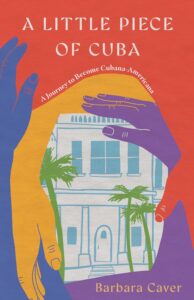 For fans of Chanel Cleeton’s Next Year in Havana, a real-life story of how a young woman’s five-day trip to Cuba, her mother’s birthplace, completely changed her view of herself as a second-generation American.
When Barbara Caver was growing up in South Carolina, her Cuban roots were as mysterious as the embargoed island her mother had been born on but left in 1959. For Barbara, Cuba represented a heritage that she’d never understood and couldn’t fully embrace. When she moved from South Carolina to New York, the vibrant diversity of the city and new friendships with other Cuban Americans made her curious about her mother’s home country. Finally, in 2017, she traveled to Cuba.
Immediately upon arriving in Havana, Barbara was struck by a sense of the familiar: tiles on a backsplash looked like tiles in her grandparents’ home, the airport smelled like a childhood memory, local dishes tasted like her grandmother’s cooking, and a morning stroll through Vedado delivered her to the front gate of her great-grandmother’s home—despite the fact that she didn’t have the address. She wasn’t just visiting a foreign country; she was being welcomed home.
Part travel adventure, part ghost story, and part memoir, A Little Piece of Cuba: A Journey To Become Cubana-Americanais an imaginative and humorous personal journey through Barbara’s memories and experiences as she discovers that she is and has always been more Cuban than she thought.
BUY HERE
BARBARA CAVER is a lifelong student of the arts and is an accomplished film and television production executive. She loves traveling, exercising, hiking, dancing, cooking, and eating, as well as writing about all of these things with great enthusiasm, affection, and humor. A Little Piece of Cuba is her first full-length memoir. Raised in South Carolina, Barbara currently resides in Jackson Heights, New York City.
Category: On Writing
Subscribe
If you enjoyed this article, subscribe to receive more just like it.