Judy Foreman: On Writing The Scallop Plot
I’ve been writing my whole life — my high school newspaper, my college paper, many, many wonderful years as the Boston Globe health columnist and science writer, and most recently, as a novice writer of thrillers.
And I can tell you, writing fiction, mysteries no less, after all these years of telling the truth, of trying to make things crystal clear, of putting the important facts out right up front and trying not to confuse readers, it’s been delightful learning to mystify readers, trying to keep them on the edge of their seats, guessing what will happen next.
In some ways, writing thrillers is harder than journalism. The biggest challenge with thrillers, at least for me, is trying to keep straight which character knows what when. You also need to tease what’s going to happen, but not give too much away. And you need to keep the pointsof view straight — not as easy as it sounds – in order to avoid “head hopping,” that is, slipping into the omniscient narrator voice when the words should come from one of the characters.
Even though I’m now writing fiction, at heart I’m stil a science and medical writer. I have been careful to make sure that the scientific facts in my fiction are absolutely correct. I consult with scientists and I fact check like crazy so that, while the plot in my thrillers is made up, the science is not. It’s all true, and, importantly, up to date.
Which presents another challenge. How to get the scientific facts across without being too didactic, sounding too journalistic or having a character do a mind dump, bogging down the action with too much information.
With “The Scallop Plot,” I did a lot of research. I visited a scallop hatchery in Maine to learn about the scallop life cycle. I talked to aquaculture specialists about putting growth hormone into marine embryos to make the resulting creatures bigger and more profitable.
I spent hours with a spunky scallop fisherwoman, whom I got to know well. I learned about the serious hazards of making one’s living on the sea, subject to extreme weather and dangerous shipboard equipment.
And, of course, I learned a lot about offshore wind farming, including how dark, right-wing money is funding much of the opposition. I learned that wind speeds on the ocean are stronger than on land, which meaning offshore wind — close to major population centers — has considerable advantages over land-based wind power.
I learned that, while the turbines are churning, there are few if any direct carbon emissions. I also learned that the construction of wind turbines can disrupt marine life and habitats and may affect bird migration routes.
And I learned that in the not-too-distant future, we may see floating, as opposed to fixed-bottom, turbines, which would allow wind farms in places where the ocean floor is deeper.
Bottom line? Researching and writing “The Scallop Plot” has been both a science reporter’s and a novelist’s dream. In a nutshell, it’s been pure fun.
—
THE SCALLOP PLOT
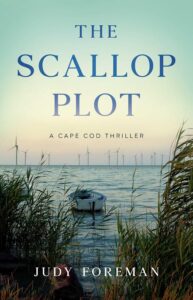 In this thriller, star investigative reporter Samantha Fuller joins a feisty Cape Cod fisherwoman to foil a wind farm developer’s evil plot to poison precious ocean scallop beds—and finds herself facing off against right-wing climate deniers.
In Provincetown, MA, feisty scallop fisherwoman Isabella Ferreira goes up against a sleazy wind farm developer, Olaf Svensson, who wants to install wind turbines in the ocean right off the coast of Cape Cod.
At a nearby scallop hatchery, marine biologists Leif and Astrid Borgen are already using the new gene editing technique CRISPR to insert a growth hormone gene into scallop embryos to make them bigger and thus more profitable—all of which is legal. But unbeknownst to the hatchery owner, Svensson is also paying the pair to insert another gene—one that causes PSP, paralytic shellfish poisoning. If this works, no one will ever eat scallops from this site again, thus freeing it up for Svensson’s turbines.
Enter Pulitzer Prize–winning Boston Times reporter Samantha Fuller. Together with Isabella, she slowly uncovers Svensson’s deadly plot—but not before hundreds of people die. Along the way, love blossoms, tragedies occur, and the subtleties of the pro- and anti-wind power groups are exposed.
BUY HERE
Category: On Writing
Subscribe
If you enjoyed this article, subscribe to receive more just like it.