You Are the Heroine You’ve Been Waiting For by Dale M. Kushner
I’m sitting at my desk in writing studio, my golden retriever, Maisie, curled at my feet. Outside, summer sunlight sifts through the leaves. A new wren family has moved into the birdhouse, the mother wren in a flurry of departures and returns, food for her nestlings in her beak.
She reminds me of the helper birds in fairy tales, those tiny powerhouses of benevolence that aid the heroine by performing supernatural tasks. Thank the white doves in Cinderella for separating the lentils from the hearth ashes and later poking out the eyes of her evil stepsisters. Thank the nameless winged ones for supplying a magic feather that grants a wish or casts a spell.
Cheer for the clever ravens and wise owls that serve as soul guides to other realms. How deep our wish to believe in the possibility of caring rescuers, how touching that even in our postmodern uber-rational world, our desire for intercession by unknowable sources doesn’t dissipate with age. Every wisdom tradition tells us this, and we too get glimpses, in dreams, or shimmering at the edge of our consciousness. What if these glimmers affirm an evolutionary and creative life force that has helped our species survive?
Here is my story of the ordinary miraculous.
In the midst of an intense personal crises, a dark night of the soul when the future looked murky and I was disoriented, confused, I traveled far north to a cabin in the woods, and there, in the silence among the pines, I was given a vision of a young girl staring out a window, her longing and loneliness jolting my heart. A voice began in that old familiar way: Once upon a time. The fairy tale I wrote during this time, more than thirty years ago, is called “The Princess Who Found Her Name,” and is at the core of my new book Wild Freedom: On Fairy Tales, Imagination and the Creative Mind. The book is a genre-bending hybrid—part memoir, part original fairy tale, and part commentary by three renowned Jungian analysts.
*
The crises in our lives can be a time of freedom and liberation, but we often don’t recognize this and for good reason. When the old order breaks down, when our life collapses, we’re dumbfounded, paralyzed, stunned. You could say we’re in a bardo, waiting to discover how to move forward, what will happen next. Real life seems a fairy tale with a potentially bad ending. Patience, faith, and self-compassion are required, exactly the attributes necessary for heroines in tales and beyond to endure the rigors and challenges of transformation. In my fairy tale, The Littlest Princess must escape the poisonous atmosphere of her family and set forth on a quest to find her true name.
How to tell a story about writing a book is itself a story, one that is not at all straightforward. What comes to mind is a quote by the great Maya Angelou: “There is no greater agony than bearing an untold story inside you.”
At the time of my crisis, I harbored an untold story, but it wasn’t the one I thought I had to tell. The genius of my unconscious is that it inspired me to write a fairy tale that depicted the root sources of my distress. Decades later, reflecting upon the process of emotional dismemberment and soul retrieval I wrote, “Writing as Self-Enchantment.”
*
Every family has secrets. Some secrets are harmless. Other secrets hide a truth that festers and causes harm. I grew up in a troubled home that appeared normal from the outside. Without warning, my mother could turn into The Scary One. She reinforced this identity by telling me she had eyes on the back of her head and could see everything I did and that if I lied or misbehaved, she would know and I would be punished. She could be stony cold or friendly and attentive. One had to tread carefully so as not to invoke the witch, a delicate maneuver since it was never clear what might trigger her mercurial nature. My father, a kind and good-humored man, seemed not to notice. If he felt the impact of my mother’s shifting self, he never said, nor did he protect his daughters. My older sister was a witch-in-training.
I don’t know if I was a sickly child or was simply kept home from school because of my mother’s fear of germs. I do know I spent a lot of time alone in a darkened bedroom with only my imagination for company. I had decided my mother was under a spell. Magical thinking possessed my child’s mind. Revenge and rescue were the themes of my imaginings. I would either redeem my mother from her bewitchment or make her beg for mercy.
(As an aside, I wish to reclaim the witch archetype from misogynist propaganda as a woman of fortitude, courage, power, and untold mysterious resources.)
*
One of my secrets was I wanted to be a heroine whose cleverness and daring won praise and recognition. I knew from the tales I’d read that heroines were survivors. Though innocent and untested, their curiosity, steadfastness, courage and daring as well as their instinct to cultivate the favor of helpers—dwarves, birds, toads—enabled them to escape their demise. Queenship never appealed. Fairy tale queens frequently leaned into evil, or despair, and good-mother queens died young. Kingship was out of the question. I longed to be a princess not for the royal finery or privilege but to go on adventures, be admired, seen. As a girl-child my life was circumscribed by prohibitions and restrictions. For a very long time, too long, I did not know I could trust my native skills. If “The Princess Who Found Her Name” and by extension, Wild Freedom, is about anything, it’s about a complex soul coming to know and trust itself through actions and choices in the world. It’s about loyalty and betrayal, compliance and agency, pleasing and authenticity.
The tale I wrote begins with a conflict as most fairy tales do.
Once there lived a queen and her daughter, Princess N. The
Queen loved her daughter, but she also envied her. She
envied the princess her eyes, which had not yet seen sorrow;
she envied the princess her laugh, which bubbled forth at
the slightest merriment. She even envied the princess her
sleep, which was the sleep of animals safe in their lair. But
what the Queen envied most was the princess’s life, which
was just beginning to unfold.
*
Our great-great-greats exchanged fairy tales around a fire, cautionary tales that taught about the nature of good and evil, about jealousy, grief, and love. Writing a fairy tale saved me. The tale became a guidebook for self-awareness and self-discovery. Writing every day over several weeks, listening to characters, setting scenes, writing dialogue taught me long-form fiction. I was already a well-published poet with an MFA and have published a novel since: The Conditions of Love. https://www.dalemkushner.com/the-conditions-of-love
Carl Jung believed that in the deepest chaos lies the seeds of transformation. A character in The Conditions of Love, Mr. Tabachnik, states a similar idea in his own indubitable way to the distraught young narrator, Eunice. “From the terrible the beautiful can come,” he tells her, “you should believe.”
—
Dale M. Kushner is an award-winning novelist, poet, and essayist.
With an MFA in Creative Writing and training in Jungian depth psychology, Dale has a passion for exploring the intersection of dreams, creativity, and transformation, and has a deep interest in transgenerational trauma.
Dale’s latest book, Wild Freedom: The Princess Who Found Her Name — On Fairy Tales, Imagination, and the Creative Mind, will be published in May 2026 by Chiron Publications. It is a hybrid work of fairy tale, memoir, and reflection that explores imagination as a vital psychological and spiritual practice.
She is also the author of the popular monthly Psychology Today column “Transcending the Past,” which bridges art, psychology, and science.
Dale’s debut novel, The Conditions of Love, was nominated for the Texas Library Association Award for Outstanding Adult Fiction, and her recent poetry collection, M, received Special Mention in the Pushcart Prize 2024.
Dale M. Kushner and her husband live in Madison, WI.
Wild Freedom: The Princess Who Found Her Name, On Fairy Tales, Imagination and the Creative Mind
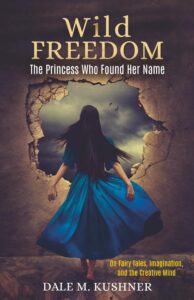 In this meditation on the creative mind, poet, novelist, essayist and student of Jung, Dale M. Kushner revisits a fairy tale she wrote decades ago during a time of crisis and uncertainty to examine the condition of “self-enchantment,” a state of being that infuses life with the healing power of creativity and illuminates the luminous darkness within.
Wild Freedom: The Princess Who Found Her Name, On Fairy Tales, Imagination and the Creative Mind, and Kushner’s accompanying essay present an unflinching and impassioned exploration of the persistence of the creative self and its not always peaceful coexistence with family, identity, motherhood and desire. Augmenting Kushner’s tale and reflections are three revelatory essays and a foreword by distinguished Jungian analysts Henry Abramovitch, Kenneth W. James, Dariane Pictet and Murray Stein. Together, the story and the essays invite readers on a journey of self-discovery through the wetlands and forests of soul.
BUY HERE
Category: On Writing
Subscribe
If you enjoyed this article, subscribe to receive more just like it.