Writer, Imposter by Kristen Tsetsi
I am an imposter.
I learned this recently in a conversation on #AuthorThreads. According to a certain way of thinking, or certain people’s way of thinking, I have for some time unknowingly been a writing fraud.
The label would be acceptable to me (if a little harsh) had it been assigned with the explanation that to be an imposter one would have to be guilty of conscious deception. (In the past when answering the question “How long have you been writing,” I would say I wrote my first short story at 12, mostly believing it while wondering whether it was true…hadn’t I worked on it in the bedroom I didn’t move into until I was 14? So, it’s very possible I quasi-knowingly engaged in fuzzy math about my first short story age. It was wrong).
“Conscious deception” isn’t what makes a writer an imposter, though. In the opinions of the Threads writers responding to an original post (thread?) asking, “[A]uthor to author… especially indie authors…. How are we dealing with imposter syndrome…. Because oh yikes,” the sign of a true imposter is the failure to experience a full-blown syndrome—imposter syndrome. “Real imposters,” replied a writer I know online in agreement with another comment, “don’t get imposter syndrome.”
It’s important to point out that in this case the term likely isn’t describing the actual phenomenon of imposter syndrome, which Marwa Azab, Ph.D. explains in Psychology Today is “associated with anxiety, depression, and somatic symptoms,” and was, in a study of high school students, “significantly correlated with a history of prior suicidal ideation, suicide attempts, and depression.”
No one would reasonably assign “imposter” to all writers who don’t claim to experience that severe toll on their emotional and mental health.
But it can’t be referring, either, to the imposter syndrome of high-achieving individuals who “cannot internalize their success” and “experience pervasive feelings of self-doubt, anxiety, depression, and/or apprehension of being exposed as a fraud in their work, despite verifiable and objective evidence of their successfulness” (NIH).
I say this because no one in the thread alluded to a specific success, never mind one that made them depressed or anxious. There wasn’t even a hint of a more surface-level version of success-related imposter syndrome—something, for example, like getting a publishing deal following reality TV fame. (A claim of “imposter syndrome” would make sense, in that case, because it would be hard not to wonder whether it was the fame, and not the writing, that led to a publishing deal.)
Anyway, success wasn’t the issue in the thread. The question addressed “especially indie authors,” which differentiates from traditionally published authors while implying automatic inferiority (or at least expected feelings of inferiority). Responses included one person saying they managed their “imposter syndrome” by thinking, “But what if there’s a tiny chance I don’t suck?” Another wrote, “I had anxiety thinking ‘who am I that I am allowed to do this?’” By “this” they meant write for public consumption.
This particular “imposter syndrome,” then, seems to have to do with not feeling worthy. “Who am I to pretend to be one of them? Who am I to think I’m good enough to join that clique?”
But who is them? What is that clique?
Are the people in the special clique the writers who’ve been published by one of the Big Five (Big Four? I can’t keep track)? Writers who’ve been published traditionally, period? “Known” writers (indie or otherwise)? Are they to be perceived as so magical, so other-worldly, that they should be revered by us, the (I guess?) sewer-dwelling, drooling urchins patting together crap sentences made entirely of rejected, vastly inferior words those “real writers” plopped into the toilet?
There are two sides of the “imposter syndrome” coin that prompted me to reply, in that thread, that I’ve never had imposter syndrome (this was hours, by the way, before the writer I know online contributed, “Real imposters don’t get imposter syndrome,” and I don’t believe she saw my comment before adding her own). The first is that to feel like an imposter, to believe I—one of millions of writers—should feel ashamed for trying to be one of them, I would have to believe myself uniquely bad, truly extraordinary in that regard. Side two is that I’d simultaneously (quietly, secretly) have to be daring to believe I, Kristen Tsetsi, could at that very moment be one of the revered, the magical, the other-worldly.
If I weren’t daring to believe such a thing, and if I didn’t believe being a “real writer” would make me worship-worthy, how could I possibly feel like an imposter?
Maybe that’s why I don’t. Maybe it’s because I don’t revere other writers, because I know they—even the ones who’ve had work selected for Oprah’s Book Club—are just people who got interested in writing and did a lot of it until they were good enough for people to want to read it. I know their financial success or outrageous “attention currency” doesn’t mean their writing isn’t criticized, or that they don’t worry their chapter or paragraph isn’t communicating something exactly right. One hundred percent of them have probably thought something they’ve just written is the worst thing to ever appear on a blank page. Anne Lamott, who’s been publishing since 1979, said (not verbatim) in a recent Good Hang podcast interview that she hates her first drafts as much as anyone could possibly hate a first draft.
The problem with embracing “imposter syndrome” as a catch-all diagnosis for any and all writing insecurities is that the language, so casually and ubiquitously used, can create and reinforce an undeserved negative self-perception as well as an overblown and equally undeserved perception of others. (Us: imposters. Those writers: heroes!) It also unnecessarily drama-queens these very basic, and unremarkable, writer experiences:
– Being new and unskilled and afraid readers will sense the newness and lack of skill. (Fears that the writing might not be ready could be justified, and they’re totally natural—just keep at it!)
– Being nervous that readers might hate/might not understanding/might be bored by the writing. (It happens. It’s awful. It passes.)
– Worrying about not being as good as some other writer in the same genre. (Someone is always better. And someone is always not as good.)
In most cases, these feelings are a normal human response to exposing something vulnerable – passion, earnest effort, a point of view. Sometimes the feeling is brought on by a pesky inner critic, for which The Charisma Myth author Olivia Fox Cabane, in a recent episode of the podcast Armchair Expert, recommends the book Embracing the Inner Critic. But whatever it is, it’s not a syndrome, or the phenomenon, unless it is.
And if it isn’t, it seems counterproductive to the already pretty fragile creative spirit to champion flogging ourselves as a way of confirming our legitimacy. Writing is hard enough on the ego as it is.
On the other hand, it’s some pretty obnoxious self-puffery to suggest that “only real imposters don’t get imposter syndrome” while claiming to have imposter syndrome, which (by that logic) only “real writers” suffer. A bit of a humble brag, no?
It reminds me of a twin sentiment I saw somewhere before: “If you don’t think your writing sucks, then it probably does.”
I would say that if you’re confident enough in your work to release it to readers, you’re not experiencing the imposter syndrome discussed in that thread. And I would ask why, if you truly think your writing does suck, you would subject anyone to it.
—
Kristen Tsetsi is the author, most recently, of the The Age of the Child (2017), which imagines the unexpected one-generation-later consequence of the overturn of Roe v. Wade. Her other novels are (men’s fiction) The Year of Dan Palace and (experience-informed homefront war story) Pretty Much True. Her short fiction was published years ago in Regarding Arts and Letters, Tryst3, Storyglossia, Pindeldyboz, Opium, Edifice Wrecked, and others and has been nominated for a Pushcart Prize. The collection of these stories is Carol’s Aquarium. When not writing, she’s thinking people should visit Youquet.com to create free personality-specific digital flower arrangements – called “the bouquet of you” – for anyone they want to make smile.
THE AGE OF THE CHILD
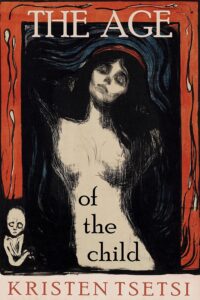 Katherine is accidentally pregnant in a newly post-Roe v. Wade America and the last hold-out clinic, where she’d made an appointment to terminate the pregnancy, has locked its doors.
A new law also demands that all miscarriages be investigated for “authenticity.” (And herbs and vitamins that might, if used the right way, end a pregnancy are rationed.)
The story follows Katherine’s journey in a post-Roe world, and then her legally-enforced daughter Millie and Millie’s friend Lenny, who was a chosen birth. By the time Millie and Lenny reach young adulthood, they’re living in a time when the laws have changed again: people are encouraged to be parents, but only under approved conditions.
THE AGE OF THE CHILD’s focus on the women’s personal stories allows for an intimate exploration of the effects of various reproductive rights restrictions and the surprising pitfalls of the two extremes.
BUY HERE
Category: On Writing
Subscribe
If you enjoyed this article, subscribe to receive more just like it.