The Journey That Inspired Camel from Kyzylkum by Lara Gelya
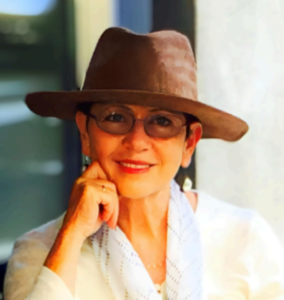 I was born and raised in Ukraine during the Soviet era, in a world shaped by discipline, endurance, and quiet resilience.
My childhood was a complex mosaic. Life was certainly not easy, and the shadow of antisemitism was a heavy, painful reality we had to navigate. Yet, in our neighborhood, Jewish and Ukrainian families lived side by side. My childhood friend, Natasha, came from a Ukrainian family, and our bond transcended the divisions around us. We were simply two children sharing the same world.
Those early years in Ukraine gave me my first day of school, my first friendship, my first boyfriend, and shaped the person I would become.
Ukraine was the beginning of everything.
Then, for twenty years, the Kyzylkum Desert was not just a place on the map—it was my home, my challenge, and my silent teacher.
The Kyzylkum, known as the “Red Desert,” stretches unforgivingly across Central Asia. Arid. Demanding. Seemingly endless. But crossed by those willing to endure.
When I first arrived, it felt like stepping onto another planet. The landscape was so different from the green streets of Ukraine and Belarus I had known. There were no tree-lined boulevards, no familiar rivers, no comforting sense of home. Instead, there was open sky, endless sand, dry air, and silence—so much silence that it could feel louder than noise.
The desert strips life down to essentials. You learn quickly what truly matters: family, dignity, resilience, friendship, and the courage to move forward. Comfort becomes less important than strength. Possessions matter less than perseverance.
Living there for two decades meant learning survival in every sense—not only physical survival in a harsh environment, but emotional survival as well.
The desert taught me discipline, humility, and grit. It prepared me for every journey that came after—for Austria, Italy, America, and the life I would continue to build.
Those twenty years shaped me profoundly.
When the Soviet system began to collapse, it unraveled people’s lives along with its institutions. For some, it opened doors. For others, it erased the very idea of home.
I became one of those people for whom the very idea of home was erased.
I lost my country. And everything that followed—every border crossed, every document obtained, every step toward a new life—began from that absence.
One day, I belonged somewhere. I had a language, a system, a place in the world that—however imperfect—was mine. The next, I was in transit, moving through countries that were never meant to keep me, carrying documents that did not quite prove I existed.
To be stateless is not just a legal condition—it is a psychological one. It means existing in between, in a space where no country fully claims you.
I moved through Europe not as a traveler, but as someone waiting—waiting for permission, for paperwork, for a decision that would determine whether I could begin a life or remain suspended outside of one.
When I arrived in Vienna, Austria, by train, it didn’t feel real. I remember looking out the window as the city slowly came into view—orderly streets, unfamiliar buildings, and people moving with purpose. I felt as though I were watching a film. Everything seemed composed and distant, as if I were observing someone else’s life rather than stepping into my own.
I had crossed a border, but I had not yet arrived anywhere.
Time did not move forward in those months—it stalled, stretched, repeated itself.
In Rome, Italy, I stood outside the wrong building, clutching my documents, my face covered with tears, my heart pounding with the knowledge that I might be late for the most important interview of my life—the one that could determine whether I would be allowed to go to America. I had gone to the wrong location of the American Embassy. For a moment, everything narrowed to panic: unfamiliar streets, a language I did not fully command, time slipping away. I remember the sense that everything could fail because I did not yet know how to exist in this new world.
Arriving in the United States was not the end of my journey—it was the beginning of a new chapter. Learning English as an adult, rebuilding my life from the ground up, working a series of demanding jobs before establishing a successful professional career, and ultimately finding the courage to write my memoir became part of the same remarkable journey.
The “camel” of the title becomes a powerful symbol: a creature built for endurance, carrying its sustenance within, much like the author herself.
America proved to me that it truly is a land of opportunity. Like millions of immigrants before me, I came searching not only for safety, but for possibility—the possibility to live freely, to build a future, and to create a life shaped by my own choices.
Today, in the era of “making America great again”, our country is drastically changing, and not for the better. With each passing day, the systems that have guided this nation for nearly 250 years—designed to protect democracy and guard against authoritarianism—are coming under increasing strain.
The cruelty in the treatment of immigrants and even American citizens is astounding. Our new policies reduce people to numbers and inhumanity.
It gives me a suffocating feeling — the sense that I can no longer breathe freely here and want to be somewhere else.
That is the feeling I once had in the Soviet Union. And now I feel it here.
At a time when migration, displacement, freedom, and democracy are central to global conversations, Camel from Kyzylkum feels both timely and timeless.
Born in Ukraine during the Soviet era, Lara Gelya spent two decades working in the remote Kyzylkum Desert of Uzbekistan before making the life-altering decision to leave everything behind.
In 1990, she arrived in the United States alone, carrying only two suitcases and the determination to begin again. What followed was a journey defined by resilience — learning a new language, rebuilding a life, and ultimately creating a future from nothing.
Now retired in Florida, Lara continues to explore the world through writing, travel, and storytelling — capturing the beauty and complexity of a life fully lived.
Camel from Kyzylkum
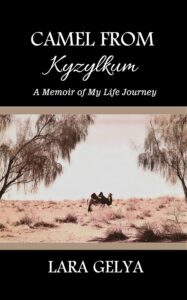 For twenty years, Lara Gelya worked in the Kyzylkum Desert of Uzbekistan, watching camels survive one of the harshest landscapes on Earth. They carried everything they needed within them. When she escaped the Soviet Union with nothing but two suitcases and hope, she became that camel—carrying her own strength across continents. This is her story.
This is more than an immigration story. It is the story of two lives lived by one woman. Camel from Kyzylkum tells both with honesty, resilience, and quiet strength—qualities that Publishers Weekly, Literary Titan, and Bookshelfie have recognized as something truly rare.
More than a memoir, Camel from Kyzylkum is a cinematic, soul-baring, continent-spanning journey of courage, sacrifice, and hope.
This award-winning nonfiction memoir, told in the first person, traces the author’s childhood in Ukraine and her twenty years living and working in the Kyzylkum Desert of Uzbekistan, when both republics were part of the Soviet Union. It offers a rare glimpse into a world few Western readers have experienced.
Leaving the Soviet Union in search of freedom was a heartbreaking decision. Stripped of her citizenship and rendered stateless, Lara embarked on an uncertain journey through Austria and Italy before arriving at New York’s JFK Airport with two suitcases, no money, and an unwavering belief that a better life was possible.
Arriving in the United States was not the end of her journey—it was the beginning of a new chapter. Learning English as an adult, rebuilding her life from the ground up, working a series of demanding jobs before establishing a successful professional career, and ultimately finding the courage to write this memoir became part of the same remarkable journey.
At its heart, Camel from Kyzylkum asks a universal question: What does it mean to begin again in a new country with nothing but hope and two suitcases?
The camel of the title becomes a powerful symbol of endurance—a creature that survives by carrying its strength within, much like the author herself. Throughout the memoir, that image reflects the resilience required to overcome adversity, adapt to the unknown, and keep moving forward despite extraordinary challenges.
Through the lens of one woman’s life, Camel from Kyzylkum offers a deeply human perspective on life under an authoritarian regime, where truth is dangerous and freedom is never guaranteed. It also captures the immigrant experience in all its complexity—the sacrifices, hardships, quiet triumphs, and unwavering determination required to build a new life. Themes of loss, identity, resilience, and self-determination emerge not as abstract concepts but as lived experience.
At a time when migration, displacement, freedom, and democracy are at the center of global conversations, Camel from Kyzylkum offers readers both a window into a little-known world and a deeply personal story that speaks to universal human aspirations.
BUY HERE
Category: Contemporary Women Writers, On Writing
Subscribe
If you enjoyed this article, subscribe to receive more just like it.