The Romance of Ruins by Louisa Morgan
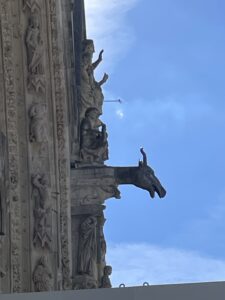
Gargoyle of Notre Dame of Rheims
I happened to be touring the beautiful Middle Rhine area of Germany at the same moment that my newest Arthurian novel (The Faerie Handmaid) was being released in the United States. Many travelers, myself included, visit that romantic region because of the numerous castles, particularly on the Middle Rhine.
They are best seen from the river, and the sheer number of them is impressive. There is a joke that Germany has more castles than America has McDonalds, and while no doubt that’s a stretch, there are certainly castles on every viewpoint, every bluff, every clifftop along the Mosel and the Rhine. As I traveled, with my novel on my mind, I imagined my courageous characters peopling every one of them, especially the ruined ones.
Would Camelot have looked like the thirteenth-century Gutenfels Castle? Or perhaps the tenth-century Schoenberg Castle? Would it have housed soldiers and cooks and families behind eighteen-foot stone walls like those of Marksberg Castle? It towers over the town of Koblenz, reminding me of Scotland’s Edinburgh Castle.
It was a rare treat being allowed to experience the inside of Marksberg. Its kitchens, bedrooms, great hall, its armory, even its thirteenth-century indoor privy are well-preserved. The visitor can imagine people living there, kept safe by those impenetrable walls and the steepness of the approach to the castle site.
The medieval castle of Reichenstein comes closest to my image of Camelot, though. It has everything—a keep protected by a courtine, towers from which lookouts can watch for impending danger, gardens where farmers grow food outside the walls. Reichenstein was first built in the twelfth century, which is almost old enough for Arthur’s Camelot. I picture Arthur’s knights riding through the arched stone entrance, and his scarlet pennants snapping in the breeze from the crenellated towers. I see the keep lively with dogs and horses and sheep. There are swordsmen practicing outside the stables, and children playing in the sunshine.
My best experience, though, is mentally rebuilding one of the many dramatic ruins that dot the landscape. Ehrenfels Castle is relatively new, having been built in the thirteenth century, but it’s perfect. All that’s left of what must have been a massive structure is a stone tower and a single great wall. It perches on a rocky crag above the Rhine with a view up and down the river. Blue sky shows through the two remaining windows, and the tower’s crenellated top stretches high into the clouds, reminding us that soldiers once had to climb steep, narrow, claustrophobic stairs to reach the battlements. I hope I’m not the only one who sees a relic like this and fills it with people, with the sounds of medieval musical instruments, with the ringing of bells and the clatter of horses’ hooves.
Many historians question the existence of the storied King Arthur. I’m in the camp that believes an Arthur figure did exist in fourth or fifth century Britain, and if there really was a man at the root of the myth, he would undoubtedly have built his own castle, Camelot, very like Ehrenfels. He would have needed to protect his people from incursions by the Romans and raids by the Saxons. In my recent travels, I walked on cobblestones first laid down by the Romans in Germany.
Many such roads, or remnants of them, still exist in England, and I imagine the Romans attacking Camelot as part of their years-long effort to conquer Britain. In Cochem, I crossed a bridge with giant stone supports built by the Romans in the third century and still in use today. I have a habit of laying my hands on such artifacts, and I swear I can feel the vibration of centuries tingle in my palms. I’m glad the peaceful constructions are the ones, here in Germany, and also in Arthur’s Britain, that have stood the test of time.
Not everyone has the privilege of traveling the way I just did, but I wish everyone could. There’s simply nothing like it for bringing the past to life.
When I visit these beautiful places I feel a deep connection to people long gone. I sense their joy, their sadness, their hopes and fears, all so very like our own. This is the romance for me, that these ancient buildings carry the imprint of the people who built them, lived in them, fought for them. I think of the aristocracy of those days, of course, but also of the ordinary people who labored in the fields, in the kitchens, in the laundries and the stables and the forges. These are the details that inspire my stories and spur my imagination, and by the time I’ve put them down on paper, they are as real to me as those old stone walls.
If Camelot existed, it’s a ruin now, and no one knows where it is. I despair of ever seeing it, but have another place I long to visit. It’s the site of this breathtaking contemporary sculpture, erected on a windy Cornish coast.
This picture is of Gallos, a glorious statue by the artist Rubin Eynon, erected near the ruins of the ancient Castle Tintagel, where legend holds that King Arthur was born. When I look at it, I feel the winds of time fluttering through the solidity of history. One day, I hope I can put my hands on it, too, and sense the way it speaks to the past.
Note: If any reader would like to see the little made of my castle tour, they can watch it on my Instagram feed: https://www.instagram.com/p/DdmT_VJjap3/
—
Louisa is an award-winning writer of science fiction under her other name, Louise Marley. She lives and writes in the wine country of southern Oregon, where she practices yoga, teaches a writers workshop, and is learning to grow flowers.
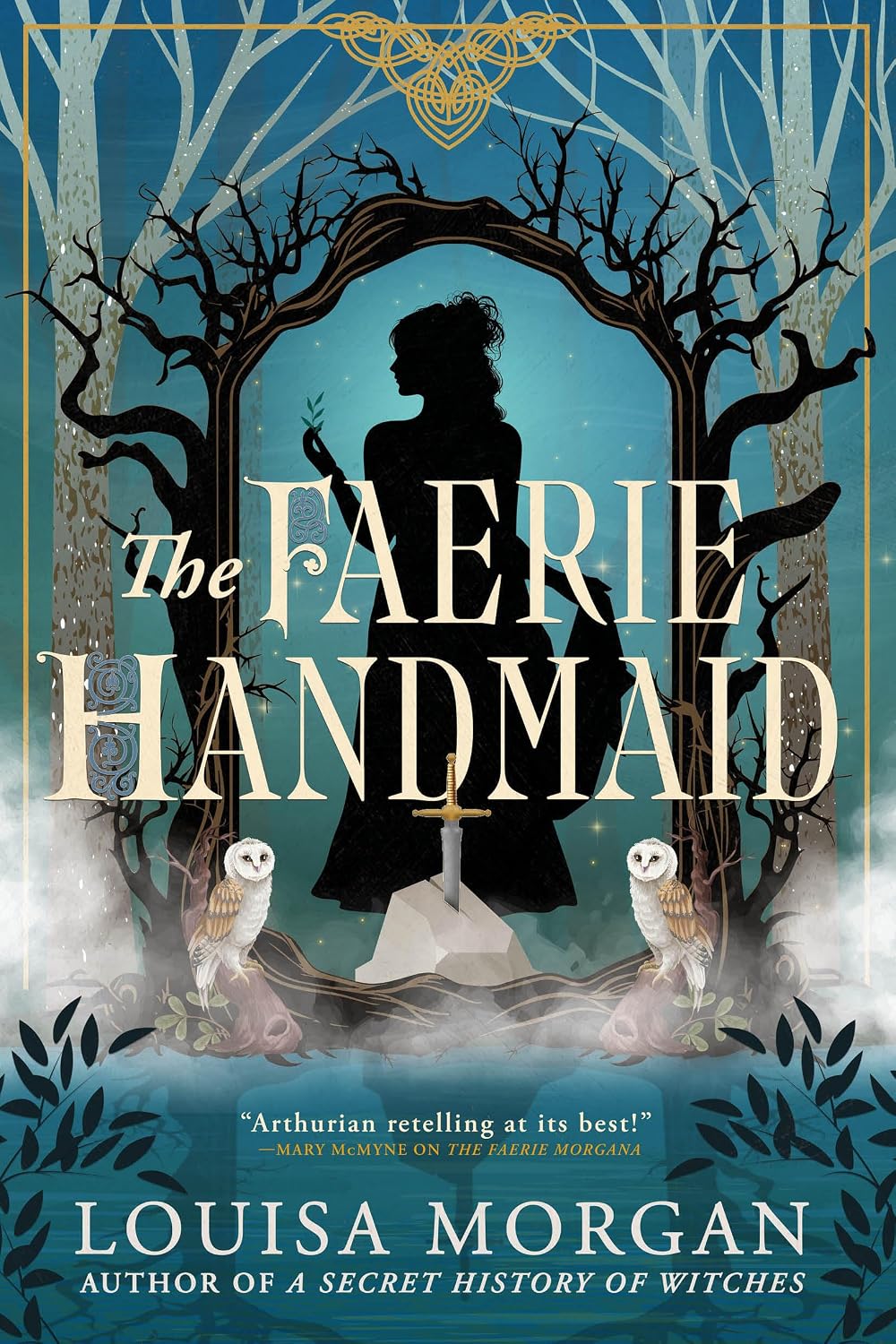
THE FAERIE HANDMAID
 When the new king of Camelud is cursed, a magicless handmaid must embrace her own power and save the kingdom in this spellbinding coming-of-age tale from Louisa Morgan.
As an acolyte on the Isle of Apples, Braithe never dreamed she’d become a handmaid to Morgana, the most powerful priestess in all Camulod. When the two learn the king is cursed by powerful magic, they journey to the White City deep in fae country to investigate.
The magical city is nothing like Braithe imagined. The fae are cold and callous and quick to bewitch. Moreover, Morgana’s magic is unreliable, and it falls to Braithe to uncover who is behind the curse. But she will have to believe herself capable of more than she ever imagined.
BUY HERE
Category: On Writing
Subscribe
If you enjoyed this article, subscribe to receive more just like it.