Full Circle—The Journey From Writer to Editor to Author by Kelli Christiansen
 I floated through hallways crammed with floor-to-ceiling shelves teeming with books. My first editorial job in book publishing had landed me in a sprawling single-story building in Chicago’s north suburbs, and everywhere I looked I saw books. I remember thinking “I can’t believe I get to work here!”
After having spent four years as a reporter for community newspapers, I joined the ranks of a value publisher whose books typically sold by the thousands in bulk sales to bookstores and big-box stores. I worked in the General Books division as an acquisitions editor, publishing everything from Window Treatment Styles to Irish Wit and Wisdom to The Holocaust Chronicle.
When, a few years later I moved to a New York-based house, where again I served as an acquisitions editor, my transition from writer to editor was complete. Now, instead of creating text, I was editing it. Little did I know early in my publishing career how profoundly this transition would affect me.
Flashback to my girlhood, and I am sitting at the old-school, lift-top desk in my bedroom, handwriting manuscripts in No. 2 pencil on white paper trimmed to mimic the dimensions of a book. My first title was a Lois Duncan ripoff focusing on extra-sensory perception, a phenomenon that, in the 1970s and ’80s, was as prevalent as quicksand and killer bees.
Handwritten manuscripts littered my cluttered desk before I transitioned to typewritten texts crafted on my family’s Sears Communicator Electric Typewriter and, later, on an Apple IIc computer that used 5¼” floppy discs with less storage capacity than my iPhone.
Novels, short stories, poems, essays—words poured out of my brain as ideas swarmed my mind. I naïvely sent finished manuscripts to publishers, hoping my work would find a home. Most went unacknowledged; at best, some kind editor would send a note encouraging me to keep honing my craft.
And I did. For years.
Until life as an editor consumed me.
As editorial work became my focus, the words in my brain became those that had originated elsewhere. My ideas slowed to a trickle as I corrected grammar, queryied awkward phrasing, and rewrote sloppy manuscripts. As an acquisitions editor, I helped experts become authors.
As an executive editor, I designed publishing programs full of books written by people whose work I finessed into readable text. As a freelance editor, I educated authors about the nuances of the book publishing process, shaped manuscripts that needed attention, helped publishers fill gaps in their lists.
I crafted book proposals with winning pitches designed to entice other editors to offer publishing contracts to writers I worked with. I honed unique concepts calculated to ensure the success of a book. I concentrated on the hook of each book I helped someone else publish. I researched complementary and related titles, studying the market to determine the viability of a proposed book. I advised authors on how to build their platforms (which, in the Selfie Age has become as—if not more—important than subject-matter expertise).
The deeper I dug into the business of publishing, the more I buried my own voice. The harder I worked to perform market analyses to assess the potential of someone else’s book, the easier it was to convince myself that anything I might write wouldn’t—couldn’t—sell. The more closely I followed market trends (e.g., The Girl in the This, The Girl on the That), the more I ignored my own, unique ideas.
Every now and then, though, an idea would break through, loud enough to hear over the voices of all the authors I was working with. A novel-length manuscript would emerge after years of fitful toil. Sporadically, a prompt discovered in a social media post sparked an idea for a short story that eventually was published. But a writing habit that once was cultivated daily had largely been quashed. Instead of honing my craft, as I had been urged to do decades ago, I fine-tuned writing created by others.
Until one idea roared at me, demanding attention.
I would write the book I could not find, telling the story I had been unable to discover.
The seed for After the End: A Postwar Novel has been planted.
Soon I was researching and outlining and drafting and imagining and, ultimately, writing the story of a Holocaust survivor navigating the chaotic year following liberation from a concentration camp. The manuscript became the thesis for my master’s degree. And, after twenty-three rejections from various literary agents and publishers, an acquisitions editor responded to my query—with exactly the kind of email I had sent countless authors whose pitches I liked.
Suddenly I found myself on the other side of the desk, as it were—no longer the editor but the writer. As my debut novel nears publication, I realize I have come full circle, moving from writer to editor to author. As an author, I now must heed the advice I’ve given countless folks about editing, publishing, and marketing. “Doctor, heal thyself” is the phrase that springs to mind as I am forced to swallow my own publishing medicine.
Every author’s journey to publication is something of an odyssey. Mine has been a circular trajectory, one arc following another, leading me, at last, to publication of my debut novel. Again I find myself thinking “I can’t believe I get to do this!”
—
Kelli Christiansen has spent more than two decades in publishing, as a bookseller, an editor, a literary agent, and a writer. Over the years, Kelli has acquired, developed, edited, or ghosted hundreds of books, some of which have recognition from such publications as Booklist, Kirkus, Library Journal, The New York Times, Publishers Weekly, and The Wall Street Journal. A writer herself, Kelli’s work has appeared in such media as Chicago Book Review; Chicago Life; Chicago Literati; Faith, Hope & Fiction; Midwest Book Review; Midwestern Gothic; and San Francisco Book Review.
She earned a master’s of liberal arts (MLA) from University of Chicago. She is the author of After the End: A Postwar Novel (Sibylline Press, 2026).
After The End
For Sarah Morgenstern, the end of the war is only the beginning of the battle.
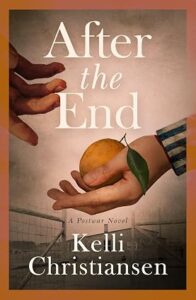 For Sarah Morgenstern, Liberation Day doesn’t mark the end of World War II. Nor does VE Day. Rather, these milestones signal merely a new phase of wartime existence, launching Sarah on a quest to find what might remain of her family and her home–and the life she knew before the Nazis took everything. After the End opens on May 5, 1945, three days after the 82nd Airborne and the U.S. 8th Infantry Division liberated Wöbbelin concentration camp.
With nothing to her name but the filthy, raggedy camp uniform on her back, Sarah welcomes the end of the war. She is a survivor. Now a displaced person instead of a prisoner, she and thousands of other survivors remain confined to Wöbbelin before being transported to Feldafing, still under guard, although now under the watchful eyes of the Americans. During the year following Liberation, Sarah reenters society. She begins a job working as a translator with the U.S. Army. She makes lasting friendships. She lets go the fears that plagued her while living under Nazi rule. She discovers the fate of her family. And she makes a decision that will set the direction for the rest of her life–a new beginning in a new land in the wake of war.
BUY HERE
Category: How To and Tips
Subscribe
If you enjoyed this article, subscribe to receive more just like it.