Behind the Scenes of THIS BOOK MAY CAUSE SIDE EFFECTS by Helen Pilcher
 I’d like to start by sharing a true story with you. I first heard it fifteen years ago from an American doctor called Clifton Meador. For reasons that will become clear, it has stayed with me ever since.
The story is about a man called Sam Shoeman who, in the 1970s, was diagnosed with oesophageal cancer. The news was not good. Doctors told him that his cancer had spread, and that there was nothing more they could do for him. He was given just a few months to live, and a few months later he died.
So far, so sad, but nothing out of the ordinary. Then came the post-mortem.
To their surprise, the doctors could find no cancer in Shoeman’s oesophagus. He did have a tumour in his liver, but it was small and contained – definitely not enough to kill him. Further investigation revealed a terrible administrative error. Hospital files had been mixed up and Shoeman had been given someone else’s diagnosis.
Think about that for a moment.
A man had been told he was dying. He believed it. His family believed it. The hospital staff believed it. Then he fell into a terminal decline.
Meador told me, “The man didn’t die from cancer. He died from believing he had cancer.”
These words left my head spinning. On the one hand, the story could be no more than an anecdote; a single case history with a perfectly ordinary explanation. Perhaps Shoeman died from an undiagnosed disease.
On the other, as Meador indicated, it could hint at a darker reality; one where dismal expectations have the power to erode our health.
When this happens, it is known as the nocebo effect. If the word sounds familiar, it’s probably because you’ve heard of the placebo effect, where people feel better after taking a sugar pill.
The nocebo effect is its evil twin.
Fifteen years ago, when I first became interested in it, researchers were just starting to scratch the surface of this strange and little-known phenomenon.
Scientists had observed the nocebo effect in clinical trials. When participants unknowingly receive a placebo treatment along with the warning “this tablet may cause side effects,” they can develop those very symptoms – even though the pill contains no active ingredient.
The effect had also been witnessed in the real world. Around a quarter of cancer patients undergoing chemotherapy experience nausea before their treatment begins. In these cases, it is not the toxic drug that is to blame, but rather the nocebo effect.
There were even suggestions that this same force might help explain documented cases of so-called voodoo death. Perhaps the story of Sam Shoeman, too.
I was hooked. I wrote up my findings for a feature in New Scientist magazine and promised myself I would follow this field of research.
Which I did.
Time ticked by.
Then, six years ago, three things happened.
First, I realised that research into the nocebo effect had gathered pace. The nocebo effect had gone from being little more than an academic footnote to a nerdy hot topic.
Second, Covid hit. Fear and anxiety can fuel the nocebo effect’s fire. It made me realise that if ever there was a time for the phenomenon to manifest on a global scale, this was it.
And third, I was diagnosed with cancer.
After my treatment, I found myself returning to the story of Sam Shoeman and wondering whether our thoughts about our own health – or lack of it – can really affect us physically.
This Book May Cause Side Effects is my attempt to answer that question.
My quest led me to read hundreds of academic papers and interview dozens of experts. The conclusions I’ve drawn are grounded not in speculation or woo-woo, but in peer-reviewed scientific research.
The picture that emerges is that none of us is immune to the nocebo effect. It occurs when our thoughts – conscious or otherwise – conspire to create, exacerbate or prolong symptoms. The nocebo effect can conjure dizziness, nausea, headaches, pain, rashes, non-epileptic seizures and more.
During Covid, it accounted for more than two-thirds of the systemic side effects experienced by people after their first dose of the vaccine.
And it’s not just vaccines. If you’ve ever developed side effects while taking a prescription medication, the nocebo effect may have contributed to your suffering.
If the thought of eating a certain food makes you feel sick, it’s possible that placebo’s evil twin has struck again.
If you’ve ever had an annoyingly recalcitrant symptom that defies medical diagnosis – where test results come back negative and no one can find an obvious cause – don’t rule out the nocebo effect. Symptoms like these, which can arise from the complex interactions between mind and body, are every bit as real as symptoms that have a clear physical cause. They’re not made up or ‘all in your head.’ They’re not a sign that you’re crazy. Recognising the role that expectations may be playing can be an important step on the road to recovery.
In the healthcare sector, the nocebo effect helps to explain why two people freshly discharged from hospital after the same successful operation can have very different recovery times. Why people with back pain can have the same amount of physical damage but wildly different degrees of disability. And why, as oncologists have told me in a whisper, the decline of desperately ill patients can sometimes be influenced by more than just the disease itself.
If that all sounds bleak, don’t despair. The good news is that as researchers learn more about the nocebo effect, they are revealing not only the extent of its influence but also ways to lessen its grip. Studies suggest, for example, that simply understanding how our expectations can influence our symptoms can help to ease them. In other words, knowing about the nocebo effect could actually be good for your health.
So, whether you’re sceptical, curious or just looking for your next book to read, consider This Book May Cause Side Effects a public service announcement! I hope you enjoy it.
—
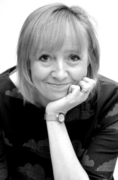
Helen Pilcher is a tea-drinking, biscuit-nibbling science and comedy writer. A recovering scientist with a PhD in cell biology, she writes regularly for the likes of The Guardian, BBC Science Focus and BBC Wildlife magazines. She has penned many popular science books. Life Changing: How Humans are Altering Life on Earth was a Science Book of the Year by The Times and was shortlisted for the Wainwright Prize for Writing on Global Conservation. Bring Back the King: The New Science of De-extinction was a BBC Radio 2 Fact Not Fiction Book of the Week, and Small Inventions that Made a Big Difference led to Helen’s 2022 TEDx talk. She lives in the UK, where she has the love of a genetically-modified wolf called Higgs.
Find out more about Helen on her website www.helenpilcher.com
Follow her on Instagram: @helen_pilcher/
This Book May Cause Side Effects: The Curious and Dangerous Power of the Nocebo Effect, Placebo’s Evil Twin
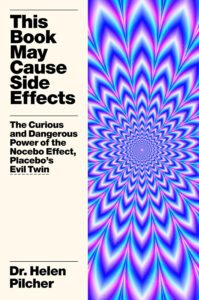 In This Book May Cause Side Effects, Dr. Helen Pilcher explores the “nocebo” effect―the shadow side of the placebo―and shows how our convictions can sometimes quite literally harm us.
Take the COVID vaccine. If you experienced side effects from your COVID vaccine, there is a 76 percent chance that these were caused by your belief that you would experience them―not by the mRNA circulating in your system.
Or, even more extreme, take the case of Sam Shoeman: Although his diagnosis of late-stage esophageal cancer turned out to be erroneous, he was nonetheless dead in months. The power of words, especially from health-care providers, is so formidable that even a wrong diagnosis can actually kill.
Our health, or lack of it, is as much about our expectations of illness and its causes as it is about damaged cells or wayward hormones. And because we can never fully step outside our cultural context, it’s only by understanding these effects that we can hope to prevent them.
From “hex deaths” to TikTok “illfluencers” to mysterious disorders with very real symptoms but no obvious physical cause, This Book May Cause Side Effects explores the many ways expectations can shape our health. Although the nocebo effect has always existed, the internet age has helped it spread faster than ever.
Thankfully, Dr. Pilcher also explains what we can do about it. She walks us through steps we can take individually and collectively to avoid invoking the nocebo, like reevaluating our relationship with technology, setting up risk-minimizing guidelines in health-care settings, and even crowbarring open-label placebo therapies and nocebo-blocking medicines into the pharmacological toolkit.
Smart, surprising, and full of unforgettable true stories, This Book May Cause Side Effects reveals the hidden ways our expectations influence our bodies―and what we can do to take back control.
BUY HERE
Category: On Writing
Subscribe
If you enjoyed this article, subscribe to receive more just like it.