How Stories Turned a Fiction Writer Into a Memoirist
During college, when my freshman year rhetoric teacher pulled me aside after class and asked if I’d ever considered a career in writing, my heart bloomed. I’d wanted to be an author since I was in the first grade and created a construction paper book complete with illustrations. Still, I didn’t know if I was interesting enough to be a writer. As a longtime lover of fiction, I found comfort in my imagination. My first two published books were fiction, but one day, during the pandemic, I returned to the story I’d been writing and could not go on. The world was falling apart, my daughters now attending school on Zoom, my own classes had also shifted online, and when I put pencil to paper, my mind awash in memories, I discovered I wanted to write about life–my life.
I heard the thwap of my father’s belt as he bent beside the bed where my sister and I were hiding. There was the sound of my black velvet dress ripping as my high school date tried to strip me of it, but there was also the warm plush of my daughter’s breath as I held her in my arms. Unlike fiction where I could hide behind imaginary plots and characters, these events were real. How could I possibly share such anecdotes much less transform them into something others would find engaging?
The word memoir comes from the French word for memory. A memoirist focuses on true memories from their life that have both personal and universal appeal. Yet as I sat with my memories that day at my desk, I realized I needed a guide just like my college rhetoric teacher.
A fiction writer fluent in the attributes of scenes and dialogue, plot and character arc, I applied this knowledge to write true stories. To turn myself and loved ones into characters, I turned to story masters. When the narrator of Amy Bloom’s “Silver Water,” spies her sister she says “Huge and white in the moonlight, her flowered smock bleached in the light and shadow, her sweatpants now completely wet.” Here sensory details are slanted to imply an ominous mood.
When Brian, the narrator in Bonnie Jo Campbell’s “The Solution to Brian’s Problems” considers his wife’s drug addiction he says: “you haven’t told them the truth, because it’s too much to explain, and it’s too much to explain that, yes you knew she had this history when you married her, when she got pregnant, but you though you could kick it together, you.” Campbell uses the second person to allow the reader to further identify with the narrator and in turn, I wondered how selecting a different point of view might help me approach my own trauma with grace.
As I continued drafting, I initially envisioned that I would write my memoir in chronological order beginning with childhood then young adulthood and later motherhood. But my memories didn’t chart such a linear path. The novel-in-stories form that Elizabeth Strout uses in Olive Kitteridge linked separate chapters by a common character–Olive–as well as the town of Crosby, Maine, dipping in and out of Olive’s life at crucial moments. With such vision in mind, I focused on the “hot spots” or personal stories that felt most urgent and I wrote such stories as essays or chapters, so that these moments could stand alone like Strout’s work, but were linked together by the theme of the personal and emotional toll of being female.
In fiction, the story holds the reader’s attention, but now I was aware of myself as part of this memoir-making machine. I interrogated such memories and wove in the introspection and self-reflection that is the hallmark of personal writing. I asked propelling questions about my girlhood, daughterhood and life now as a mother. Cara Blue Adams used such questions to develop the interior world of characters in her collection You Never Get It Back, when the protagonist, Kate, considers whether or not she has been assaulted. “She would never admit what had happened, she decided. It would only make him angrier. And if she cast it in more dramatic terms than she was willing to do, explained, emphasized, that she had said no, he would still be angry and she would be a rape victim, and that was not what she wanted to be.” Such moments illustrate the vastness of interior life, the thinking work that characters do–that we all do.
Unlike a story, where the resolution of plot drives the narrative, I challenged myself to instead go deeper than my personal experiences, bringing in research into pop culture of the 1980s and 90s, science and psychology to expand the universal threads of the book by exploring what baffled and intrigued me years after the fact.
All writers need guides, but when you’re years out of school, you must create them for yourself. By returning to the books I loved and taking note of the chapters and stories that did exactly what I thought I could not, I benefited from studying not just what these writers were sharing but how. I was able to move beyond the restrictions of fear to tell my personal stories with courage.
—
Melissa Fraterrigo’s forthcoming memoir, The Perils of Girlhood will be published by the University of Nebraska Press in Fall 2025. She is also the author of the novel Glory Days (University of Nebraska Press), which was named one of “The Best Fiction Books of 2017” by the Chicago Review of Books as well as the short story collection The Longest Pregnancy (Livingston Press). Her fiction and nonfiction have appeared in numerous literary journals and anthologies from storySouth and Shenandoah to Notre Dame Review, Sou’wester and The Millions. A graduate of the University of Iowa (BA) and Bowling Green State University (MFA), she teaches creative writing at Purdue University, in the Butler University MFA in Creative Writing program, and is also the founder and executive director of the Lafayette Writers’ Studio in Lafayette, Indiana, where she offers classes on the art and craft of writing. She lives with her husband and two daughters in West Lafayette, Indiana.
THE PERILS OF GIRLHOOD
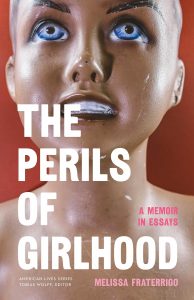 Like many girls growing up in the eighties and nineties, Melissa Fraterrigo leaned on popular culture to transition from childhood to adolescence and beyond. Judy Blume told stories about girls embracing their imperfections; Madonna encouraged bold moves. But Fraterrigo’s experiences with dating and attempts to refashion her body through diet and exercise left her feeling far from empowered. It wasn’t until Fraterrigo became a mother to twin daughters and they began their own self-criticisms that she questioned how she might help them navigate their own girlhoods.
A handsome swim coach’s advances, an anxious daughter soothing her father’s temper, the history of Mace, and the joy of female friendship: these are some of the memories that shape Fraterrigo’s worldview as an adult. Written with lyricism and insight, The Perils of Girlhood provides a reckoning and a reclamation. And while these personal narratives developed from Fraterrigo’s desire to guide her daughters, their universal truths compel us to consider how best to bring all of our daughters into the future.
Category: On Writing
Subscribe
If you enjoyed this article, subscribe to receive more just like it.