Keep Driving Those Nails, Ladies By Jean Gordon Kocienda
One hundred years ago, the only daughter of a family in Rochester, NY, faced an unhappy life. One of her brothers had a mental disorder, and her parents assumed she would take care of him when they grew old. She was afraid of him, though. Perhaps he abused or threatened her, she never said, but she did not intend to sacrifice her life for him.
She had dreams. She wanted to see the world. As soon as she could scrape together enough dimes, she got herself out of Rochester. Working as a typist and secretary, she set off, in between world wars, eventually reaching the Philippines, Japan, and China. That woman was my paternal grandmother, and I grew up hearing about her adventures. Maybe that’s why I became fascinated with Asia, and with another woman who ran away from home at around the same time, a Japanese poet named Yosano Akiko (1878-1942).
The Japanese have a saying, hako-iri-musume or “daughter-in-a-box”, which describes girls whose families sheltered them like fragile dolls in wooden boxes until they were old enough to be married. Yosano Akiko was like that: a girl in a box. She was born into a family of confectionery merchants, a daughter when a son was needed, so as an infant she was bundled away to live with relatives until her mother conceived a boy three years later.
As a schoolgirl, she worked every day rolling mochi-and-adzuki-bean cakes and rice crackers. After her mother suffered a stroke, she took over tending to the shop ledger. She was miserable. She knew she had more to offer; she was already writing poetry on the sly and reading the Tale of Genji, the world’s first novel, written around the year 1000 AD (by a woman, you should know).
When she reached puberty, things got worse. Her parents began locking her in her room at night to protect her. She became a girl-in-a-box. Akiko was smart and stubborn, though. Like my grandmother, she refused to accept these terms. She ran away from home, eloped with a rakish poet, and though her life after that got much, much harder, it was her life, the life she chose, dedicated to her poetry and, over time, essays about the unacceptable predicament of women.
Maybe you know someone like this. Maybe it was your grandmother or mother, maybe it was you. For many women through history, marriage has been an ejection seat, an emergency exit; sometimes they took the ‘out’ even if the partner wasn’t ideal, or led to new obstacles (such as children) for women seeking a room of their own and time to create.
My mother was not a writer, but she did escape from misery to live a life of her choosing. When she was thirteen years old, her mother died, sending her father into an alcoholic spiral and leaving her to fend for herself. She worked her way through college and married an Air Force officer who took her as far away from her poor Irish Catholic Boston home as she could get.
Look at the history of women writers in the English-speaking world (the ones we know about, anyway; how many more died in obscurity?) and find an honor roll of unhappy women. Virginia Woolf drowned herself; Sylvia Plath killed herself by inhaling oven gas; Emily Dickinson was a notorious recluse. Some had secret relationships with other women. Most soldiered on, like Akiko, managing traditional families, often exchanging sleep for writing time.
These days, the name Yosano Akiko is known by Japanese schoolchildren who study her as a feminist hero. In one of Akiko’s later tanka poems, she acknowledges her contribution, knowing that the male builders of civilized edifices might not:
Long ago, when the Great Hall was built
I, too, drove a single, golden nail
We are all better off because our mothers and grandmothers persisted, and some pushy ones demanded rights, recognition, and creative freedom. We are better off because Akiko drove her nails. Now, let’s be sure to pound in some of our own.
—
Jean Gordon Kocienda’s historical novel about the life of Yosano Akiko, Girl in a Box (Sibylline Press) will be released on April 21, 2026. (www.jeangordonkocienda.com)
GIRL IN A BOX
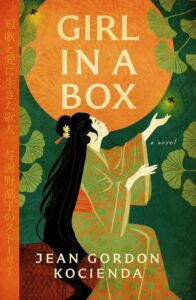 In early twentieth century Japan, women have few rights. Yet one precocious poet—a brooding daughter, locked in her room at night by protective parents—runs away from home to live a life of her choosing.
She falls in love with a fellow poet and follows him across Siberia to Paris, where they witness the last days of the Belle Epoque. She perseveres through poverty, back-to-back pregnancies, infidelity, earthquake and fire, to become a name every Japanese schoolchild knows today as a pioneering feminist poet and the first person to translate the classical Tale of Genji into modern Japanese. In her single-minded dedication to her art, she inflicts wounds on a daughter that echo from her own childhood. She sets out to make amends, knowing it may be too late.
Based on the life of poet Yosano Akiko (1878-1942) and filled with original translations of her poetry, Girl in a Box will ignite the discussion about the female artist’s challenge to create while juggling family, career, and personal freedom. Historical fiction at its best.
BUY HERE
Category: On Writing
Subscribe
If you enjoyed this article, subscribe to receive more just like it.