THE PROCESS OF WRITING SCRAP: SALVAGING A FAMILY BY LUANNE CASTLE
After I retired early from teaching for health reasons, my husband and I moved from California to Arizona. As soon as the dust had settled (literally, since Arizona is very dusty) in our new home, I decided I was going to write a memoir about my father and my relationship with my father. At the time, my grandfather’s identity was still a mystery.
I expected the project to take as long as ten years. I’m not an impatient person, I knew I didn’t know much about writing a memoir, and I had years of experience reading and studying literature so I knew it was difficult to write the genre of memoir and to write in a literary manner. To me, a literary style is to write a work of art in the same way that a sculptor crafts a sculpture.
Not too long after I began writing what would become this book, my father shared with me the identity of his father. Then, my father became ill, and our relationship changed. After my father passed away, I realized that the new knowledge and experience I had gained altered the nature of the book I had intended to write.
I began by taking a couple of online memoir workshops at Gotham, then joined the creative nonfiction cohort at Stanford University’s Continuing Studies. Every class, every workshop, taught me something new about writing memoir. At the same time, I discovered a small local writing group. The four of us met every month, sharing our newest memoir pieces and giving each other encouragement and advice.
From the beginning, I was thinking in terms of small stories of memories, rather than full chapters. After being told that my book needed chapters, I began to experiment with writing a traditional memoir divided by chapters. This was difficult because my memory wasn’t functioning in chapters. I used Stuart Horowitz’s Book Architecture to identify first the themes and recurrent images and then to guide them into chapters.
At least two, if not three, versions of this traditional chapter memoir were completed. By me apparently. But it didn’t feel as if I wrote them. Because I felt strongly that I wanted the distillation of image and experience. Creating chapters meant writing filler language. That felt inauthentic to me.
A few years ago, I started writing flash fiction and through the process of learning how to write micro and flash stories, I got the idea to write a collection of these for Scrap. Then it followed that I use other genres that I was familiar with where it worked best in the book: poems, playscript, essay, and yes, a blend of nonfiction and imaginative reconstruction for the stories told by my father and grandmother. Ultimately, this hybrid memoir in flash was completed in a way that feels not only authentic but also very true to my heart and experience.
—
Luanne Castle’s hybrid flash memoir, Scrap: Salvaging a Family (2026), is available from ELJ Editions. Her story, “Garden Seasons,” was selected for Best Microfiction 2026. Her poetry and prose have appeared in Copper Nickel, River Teeth, Your Impossible Voice, JMWW, Grist, Fourteen Hills, Verse Daily, Disappointed Housewife, Lunch Ticket, Saranac Review, Pleiades, Cleaver, Moon City, Moon Park, Anti-Heroin Chic, Bending Genres, BULL, The Mackinaw, The Ekphrastic Review, Phoebe, MacQueen’s Quinterly, Gone Lawn, and many other journals. She has published four award-winning poetry collections. Her ekphrastic flash and poetry collection Hunting the Cosmos is forthcoming from Shanti Arts in fall 2026.
Scrap: Salvaging a Family: A Memoir in Flash
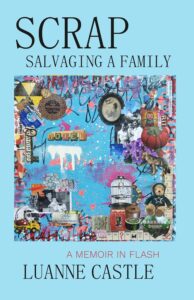 The hybrid flash memoir Scrap: Salvaging a Family explores the stain of childhood fear and anxiety on the adult spirit and the experience of reconciling with an aging or dying parent. A daughter has grown up in a household with an angry and abusive father. He keeps the secret of his biological father’s identity from his daughter for decades. When the elderly man faces his mortality, he finally names his father. The more the daughter learns about her father’s early life and origins, the more she understands him which leads to forgiveness for the past.
Borne of shame and trauma, the secrets uncovered in Luanne Castle’s hybrid memoir reveal her father’s complicated childhood and the impact it had on their relationship. Told in brief, strikingly vivid fragments, and through various perspectives and forms, the book as a whole presents a deeply moving and unforgettable account. We readers are privileged to bear witness to this emotional excavation, one that ultimately reminds us that love is powerful even when it’s painful and that forgiveness is the only way forward. Scrap: Salvaging a Family is a gorgeous and brilliantly original collection. I highly recommend it.
—Kathy Fish, author of Wild Life: Collected Works
The vignettes in Castle’s Scrap are beautifully rendered. With house as vessel, we are voyeurs through her domesticity, the skilled lens of speaker Luanne’s traumas and perseverance as she navigates the rawness and fragility of youth. The book is both powerful and arresting–Castle is a deft miniaturist–each story etched with a fine blade, yet a delicate touch. Scrap is a collection of constellations of the ordinary.
—Robert Vaughan, Editor-in-Chief of Bending Genres, author of ASKEW.
Luanne Castle’s Scrap is a memoir in flash. In flashes might be a more accurate term. This is a family story told in bursts of memory and image, puzzle pieces waiting to connect. It’s a young girl’s coming of age, navigating a path to womanhood out of hand-sewn dresses, gym class movies shown behind closed doors, stacks of moldering girlie magazines discovered at the dump. A girl living in the shadow of her father’s anger, violent and unpredictable as the tornadoes her family hides from. Behind the father’s anger, a missing piece. A birth certificate hinting at bastard. A hole where a father should be, a “space of unknowingness” both child and father must try to fill.
This lyrical, beautifully imagistic work is both an exploration of the long roots of generational trauma and identity erasure and a vivid look back at growing up female in mid-century America.
—Kathryn Kulpa, author of A Map of Lost Places
BUY HERE
Category: On Writing
Subscribe
If you enjoyed this article, subscribe to receive more just like it.