The Challenge That Turned into a Journey of Passion by Jane Little Botkin
 I have long been fascinated by the West and, over time, by the human stories that bring its history to life. My interest began at age six in Mrs. Durham’s first-grade classroom in Hereford, Texas. She asked us to draw and color scenes from Palo Duro Canyon in the Texas Panhandle, where the renowned trail driver, Texas Ranger, and scout Charles Goodnight had co-founded the JA Ranch in June 1877.
I was born nearby in Hereford, a small town on Tierra Blanca Creek, which flows into the canyon. We children all knew about Charles Goodnight, but nothing about Mary Ann Goodnight or orphaned buffalo calves. A huge sheet of white butcher paper covered one classroom wall, ready for our impressions of the canyon. I could hardly wait to draw Native American teepees, horses, and buffaloes. At that age, however, the people themselves did not interest me.
I was so excited that I began banging my hands underneath a two-person desk, you know, the kind with a real wood top and metal underside where we kept our school supplies. Mrs. Durham ordered me to stop, which I did, but the little girl next to me picked up the beat. My teacher yanked me out of the desk, ordered me to hold out my hand—palm side up—whereupon she slapped my hand with a wooden ruler several times. Yes, it stung, terribly, but worse, I would not return to the wall to draw the buffalo that fascinated me so much. Little did I know, the American Plains bison wove itself into the threads of my life at that moment.
Sixty-some-odd years later, during a visit to the Charles and Mary Ann Goodnight ranch house near Goodnight, Texas, I inquired if there had been any books written on Mary Ann Goodnight. The docent in charge quipped, “No one has written a biography on Molly Goodnight and, besides, there is only a smidgeon of information!” Then she squeezed her index finger and thumb together, not realizing that her response to me would become a years-long challenge.
In truth, Mary’s story had never been told, though it was she, not her famous husband, whose initial action preserved the American Southern Plains bison herd from extinction. Charles Goodnight ordered the extermination of bison within Palo Duro Canyon, Texas, in late 1877. In fact, by first saving four bison calves and adding other survivors to her herd over the months and years that followed, this pioneer of bison conservation helped establish foundational herds across the United States, Canada, and abroad, increasing genetic diversity in parks, zoos, private ranches, and Native lands.
I immediately sought primary documents for writing Mary’s story, even as I read every secondary source I could put my hands on. These included old legal documents, memoirs, and out-of-print books. I scoured various archives from Texas to Tennessee to Colorado and back. I stumbled upon letters and photographs previously hidden in barn eaves.
I interviewed ninety-year-olds who knew some of the players in Mary’s life. Finally, I retraced Mary’s journey—following her steps through the places she knew, imagining her presence, and absorbing what I discovered along the way. Within four years, I had pieced together Mary Ann Goodnight’s life story and was finally ready to write. So why hadn’t other authors and historians attempted her biography years earlier?
In truth, biopics of women were uncommon in the early-twentieth century, and, besides, Charles Goodnight’s interview answers and essays for his biographers, Laura V. Hamner and J. Evetts Haley, focused mostly on anecdotal information and his well-known accomplishments on cattle trails and with the Texas Rangers—historically, masculine endeavors. Mary had achieved fame in 1898, when a reporter from Ladies Home Journal traveled to the Goodnight Buffalo Ranch to do an interview. He discovered that Mary founded the buffalo herd, cultivated and managed it.
The title of the article, “The Buffaloes of Goodnight Ranch, showing the ‘Only Herd in the World Owned by a Woman,’” says it all. Newspapers from St. Louis to Los Angeles carried her story too, often using the phrase, “A Woman’s Buffalo Herd.” Yet after Mary’s death in 1926, Hamner’s completed biography, The No Gun Man of Texas, approved by Charles Goodnight himself, became a Texas elementary textbook for two generations with minimal information about Mary.
As for Haley, he wrote his 1936 Charles Goodnight, Cowman and Plainsman, based on his interviews and Goodnight’s dictated list of events, typed up by a second wife, cementing Charles Goodnight’s Texas legacy. To further carry Charles Goodnight’s life story, Larry McMurtry’s novel and later television series, Lonesome Dove, carried some of Goodnight’s story into the contemporary west.
In short, generations of Texans and other Americans had been indoctrinated—learning about Charles Goodnight and frontier Texas through print and film. So, it is no surprise that a docent at the Charles and Mary Ann Goodnight ranch house in the Texas Panhandle once squeezed her fingers together in dismissal of Mary’s role in such a unique, American story.
For we women writers today, especially biographers, our challenge is to seek out unconventional subjects, willing ourselves to explore historical topics—including marginalized women—that other biographers and historians overlook. The work may be tedious, but when the writer’s journey is concluded and the narrative is written, I guarantee the effort will be worth it. More importantly, the writer will leave her own mark for posterity.
—
The Breath of a Buffalo, The Life of Mary Ann Goodnight
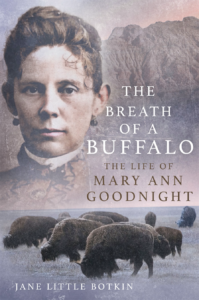 Mary Ann Goodnight (1839–1926) should be an outsized figure in Texas history. Known primarily as the wife of legendary scout and cattleman Charles Goodnight, she was an educator, a businesswoman, and the architect of the resurrection of the Southern Plains bison―in short, a force in shaping the social and environmental legacy of the Texas Panhandle.
Bringing Mary out of Charles’s larger-than-life shadow, award-winning author Jane Little Botkin’s The Breath of a Buffalo restores Mary Ann Goodnight to her rightful place in the drama of frontier Texas―and for the first time tells the story of this indomitable woman’s remarkable life.
Moving from Tennessee to North Texas as a young girl, Mary’s family faced many of the challenges associated with westward migration. As she entered adulthood, she became an educator, an experience that would prove indelible in shaping her personality and spirit.
As a teacher, she witnessed the violence and upheaval of the Civil War and the conflicts between settlers and Native American tribes. Botkin’s biography draws an intimate picture of Mary’s life and of the dramatic changes that her storied marriage forged.
The Breath of a Buffalo describes how the unlikely couple―Mary, a petite and refined schoolteacher, and Charles, a prickly, near-illiterate, and foul-mouthed trail driver―built ranching empires in Colorado and Texas and endured financial booms and busts alongside the relentless hardships of life in the Panhandle.
Living as close to the land as they did, Mary saw the mass slaughter of buffalo, especially within the Palo Duro Canyon, and was deeply disturbed. Botkin recounts how Mary insisted on rescuing and nurturing orphaned calves and thus established a foundational herd that directly contributed to the survival of the species.
Long overdue, Botkin’s biography situates Mary’s story within the broader context of westward resettlement and Native American displacement while offering a nuanced portrait of a woman whose conservation and determination left a lasting mark on Texas history. The Breath of a Buffalo ultimately restores Mary Ann Goodnight to the history of the American West, in all its dramatic sweep and singular experience.
See The Breath of a Buffalo, The Life of Mary Ann Goodnight at https://janelittlebotkin.com/the-breath-of-a-buffalo/ for preordering information.
Category: On Writing
Subscribe
If you enjoyed this article, subscribe to receive more just like it.